




Mar 10, 2008
Nooron: a platform for collaboration on a global scale
18:50 Posted in ICT and complexity | Permalink | Comments (0)
Improving quality of life using compound mind-body therapies
Improving quality of life using compound mind-body therapies: evaluation of a course intervention with body movement and breath therapy, guided imagery, chakra experiencing and mindfulness meditation.
Qual Life Res. 2008 Mar 7;
Authors: Fernros L, Furhoff AK, Wändell PE
Objective Assess changes in quality of life and in sense of coherence (SOC), after an intervention involving a self-development course using mind-body medicine (MBM) activities. Design A questionnaire study using a health-related quality of life (HRQOL) instrument, the SWEDQUAL, with 13 subscales and scores ranging from 0 to 100, combined with the SOC-13 scale, healthcare utilisation, medication and sick listing data. Setting A training centre for MBM. Eligible course attendants (study group, SG, n = 83) assessed their HRQOL before and 6 months after a 1-week course. A control group (CG) of individuals who had previously attended the course (n = 69), matched for age, sex and length of course time to the SG, also made assessments. Main outcome Changes in HRQOL and SOC in SG and CG. Results Of the 13 HRQOL subscales, eight showed clinically significant improvement in the SG (>9%, p < 0.01), namely, General health perceptions (9%), Emotional well-being [negative (45%) and positive (26%)], Cognitive functioning (24%), Sleep (15%), Pain (10%), Role limitation due to emotional health (22%) and Family functioning (16%). Sexual, marital and physical function and role in the SG as well as all CG scores were similar to average population values. The assessed SOC also improved in the SG after intervention (p < 0.01), challenging previous statements of 'the stableness of SOC'. Use of psychotropic medication was slightly reduced in the younger aged SG participants after intervention. Conclusions This group of men and women (SG), starting from a clinically significant low health assessment, had improved their HRQOL and SOC after the course intervention.
13:35 Posted in Meditation & brain | Permalink | Comments (0) | Tags: meditation, neuroscience
Blood Pressure Response to Transcendental Meditation: A Meta-analysis
Blood Pressure Response to Transcendental Meditation: A Meta-analysis.
Am J Hypertens. 2008 Mar;21(3):310-6
Authors: Anderson JW, Liu C, Kryscio RJ
BackgroundPrior clinical trials suggest that the Transcendental Meditation technique may decrease blood pressure of normotensive and hypertensive individuals but study-quality issues have been raised. This study was designed to assess effects of Transcendental Meditation on blood pressure using objective quality assessments and meta-analyses.MethodsPubMed and Cochrane databases through December 2006 and collected publications on Transcendental Meditation were searched. Randomized, controlled trials comparing blood pressure responses to the Transcendental Meditation technique with a control group were evaluated. Primary outcome measures were changes in systolic and diastolic blood pressure after practicing Transcendental Meditation or following control procedures. A specific rating system (0-20 points) was used to evaluate studies and random-effects models were used for meta-analyses.ResultsNine randomized, controlled trials met eligibility criteria. Study-quality scores ranged from low (score, 7) to high (16) with three studies of high quality (15 or 16) and three of acceptable quality (11 or 12). The random-effects meta-analysis model for systolic and diastolic blood pressure, respectively, indicated that Transcendental Meditation, compared to control, was associated with the following changes: -4.7 mm Hg (95% confidence interval (CI), -7.4 to -1.9 mm Hg) and -3.2 mm Hg (95% CI, -5.4 to -1.3 mm Hg). Subgroup analyses of hypertensive groups and high-quality studies showed similar reductions.ConclusionsThe regular practice of Transcendental Meditation may have the potential to reduce systolic and diastolic blood pressure by approximately 4.7 and 3.2 mm Hg, respectively. These are clinically meaningful changes.American Journal of Hypertension (2008) doi:10.1038/ajh.2007.65American Journal of Hypertension (2008) doi:10.1038/ajh.2007.65.
13:35 Posted in Meditation & brain | Permalink | Comments (0) | Tags: meditation, neuroscience
Kinesthetic Imagery and Tool-Specific Modulation of Corticospinal Representations in Expert Tennis Players
Kinesthetic Imagery and Tool-Specific Modulation of Corticospinal Representations in Expert Tennis Players.
Cereb Cortex. 2008 Feb 21;
Authors: Fourkas AD, Bonavolontà V, Avenanti A, Aglioti SM
Specific physical or mental practice may induce short- and long-term neuroplastic changes in the motor system and cause tools to become part of one's own body representation. Athletes who use tools as part of their practice may be an excellent model for assessing the neural correlates of possible bodily representation changes that are specific to extensive practice. We used single-pulse transcranial magnetic stimulation to measure corticospinal excitability in forearm and hand muscles of expert tennis players and novices although they mentally practiced a tennis forehand, table tennis forehand, and a golf drive. The muscles of expert tennis players showed increased corticospinal facilitation during motor imagery of tennis but not golf or table tennis. Novices, although athletes, were not modulated across sports. Subjective reports indicated that only in the tennis imagery condition did experts differ from novices in the ability to form proprioceptive images and to consider the tool as an extension of the hand. Neurophysiological and subjective data converge to suggest a key role of long-term experience in modulating sensorimotor body representations during mental simulation of sports.
13:32 Posted in Mental practice & mental simulation | Permalink | Comments (0) | Tags: mental practice
Clinical Assessment of Motor Imagery After Stroke
Clinical Assessment of Motor Imagery After Stroke.
Neurorehabil Neural Repair. 2008 Mar 6;
Authors: Malouin F, Richards C, Durand A, Doyon J
OBJECTIVE: The aim of this study was to investigate: (1) the effects of a stroke on motor imagery vividness as measured by the Kinesthetic and Visual Imagery Questionnaire (KVIQ-20); (2) the influence of the lesion side; and (3) the symmetry of motor imagery. METHODS: Thirty-two persons who had sustained a stroke, in the right (n = 19) or left (n = 13) cerebral hemisphere, and 32 age-matched healthy persons participated. The KVIQ-20 assesses on a 5-point ordinal scale the clarity of the image (visual scale) and the intensity of the sensations (kinesthetic scale) that the subjects are able to imagine from the first-person perspective. RESULTS: In both groups, the visual scores were higher (P = .0001) than the kinesthetic scores and there was no group difference. Likewise, visual scores remained higher than kinesthetic scores irrespective of the lesion side. The visual scores poststroke were higher (P = .001) when imagining upper limb movements on the unaffected side than those on the affected side. When focusing on the lower limb only, however, the kinesthetic scores were higher (P = .001) when imagining movements of the unaffected compared to those on the affected side. CONCLUSIONS: The vividness of motor imagery poststroke remains similar to that of age-matched healthy persons and is not affected by the side of the lesion. However, after stroke motor imagery is not symmetrical and motor imagery vividness is better when imagining movements on the unaffected than on the affected side, indicating an overestimation possibly related to a hemispheric imbalance or a recalibration of motor imagery perception.
13:31 Posted in Mental practice & mental simulation | Permalink | Comments (0) | Tags: mental practice
IEEE Spectrum Online reports on prosthethic arm development
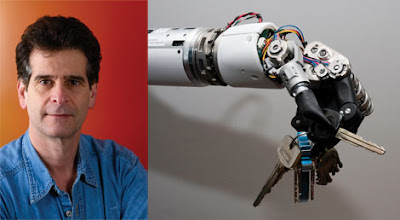
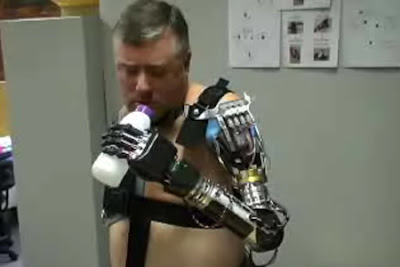
IEEE Spectrum Online has a special report on the current state of prosthethic arm development, including the latest on Dean Kamen's "Luke Arm" which is being funded by DARPA. There's also an amazing video showing the arm in action.
00:45 Posted in Neurotechnology & neuroinformatics | Permalink | Comments (0)
The art of Anya Langmead


00:41 Posted in Cyberart | Permalink | Comments (0) | Tags: cyberart
New platform for crowdsourcing
Via TheAppGap
Kluster is a platform for crowdsourcing and then organizing and putting to use skills, energy and availability on projects and initiatives. From the ReadWriteWeb review:
Kluster Launches at TED: A New Product in 72 Hours
Crowdsourcing firm Kluster officially launched yesterday at the TED conference, which is underway this week in Monterey, California. Founder Ben Kaufman, who bankrolled the company in part with money from the sale of his last company Mophie, has organized a gimmick over the course of the TED conference he hopes will prove Kluster’s worth. Kaufman intends to let TED attendees — and users from around the world — design a completely new product over the course of 72 hours.
The idea behind Kluster is that a group of passionate people working together can come up with better solutions for any decision-making problem than a single person. Whether that is planning an event, designing a new logo, or creating a new product, Kluster believes their system can.
[ Snip … ]
The Kluster system works by breaking down products into manageable chunks. For each chunk (or "phase"), people submit what are called "sparks." Sparks are proposed solutions for that phase. For each spark, other participants can submit "amps" — which are improvements to that idea. Users also assign "watts" to sparks and amps they like. Watts work kind of like investments. You accrue points based on participation and other factors, and can invest those points (watts) in ideas you like.Then an algorithm that takes into account "each user’s successes, failures, reputation, areas of expertise, and overall history" goes to work to determine which sparks are the best. Companies interested in using the Kluster system, put up cash prizes that are doled out along the way (at the completion of each phase).
00:15 Posted in Creativity and computers, Social Media | Permalink | Comments (0)