




Mar 09, 2008
Cyber Goggles: High-tech memory aid
From Pink Tentacle
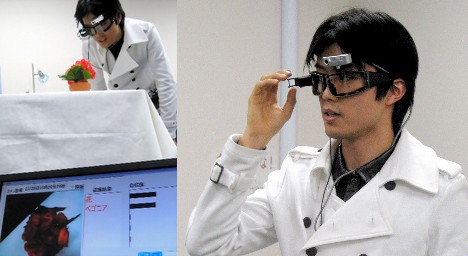
Researchers at the University of Tokyo have created a smart video goggle system that should records everything the wearer looks at, recognizes and assigns names to objects that appear in the video, and creates an easily searchable database of the recorded footage.
23:56 Posted in Future interfaces | Permalink | Comments (0) | Tags: future interfaces
Immersive Virtual, Mixed, or Augmented Reality Art

International Journal of Arts and Technology (IJART) - Call For Papers : Special Issue on Immersive Virtual, Mixed, or Augmented Reality Art : Guest Editors: Maria Roussou and Maurice Benayoun: Deadline: September 1, 2008.
For the past fifteen years, virtual reality (VR) and, more recently, mixed reality (MR) and augmented reality (AR) environments that immerse their participants in imaginary space, have emerged to define an area that blurs the lines between the seemingly different worlds of research, creativity, and technological practice, while exploring the interdependencies between the virtual and the physical. From the immersive, yet more esoteric, CAVE®-based projects of the mid-nineties to the contemporary open experiences spread out in virtual as well as physical space, creative VR / MR / AR applications are challenging the ways we perceive both digital art and the science and engineering behind them.
Early enthusiasm with the use of projection-based display structures and the development of authoring solutions for application-building has brought a level of maturity, characterized by the emergence of new technical and conceptual forms. It is this particular moment in the evolution of immersive VR / MR / AR art practice that this special issue seeks to capture. Hence, in this special issue, we aim to bring forth the topic of immersive art in its current maturity, present the newest developments and explore its evolving forms, aspiring to shape a framework that will help us to develop the next generation of environments.
Therefore, this special issue will not include contributions that deal solely with describing a narrow and specific piece of art or research without reference to a conceptual framework or a critical analysis; rather we encourage contributions that take a broad and integrative view of relevant topics, encompassing both theoretical and empirical perspectives of digitally-generated creative spaces.
Submissions are invited that touch on but are not limited to the following themes:
- Theoretical discourse on immersive virtual, mixed or augmented reality art environments.
- Novel design concepts, applications, implementations and experiences from the actual deployment of immersive VR / MR / AR art applications
- Research or empirical work addressing some of the open questions in the design of immersive art environments. For example:
- Issues concerning creativity and aesthetics, visual depiction, storytelling and narrative, triggering other senses, embodiment, etc.
- The fine line between designing for entertainment or for artistic pleasure
- Issues in the design of interactivity, interfaces, and interaction methodologies, such as navigation by and tracking of multiple users, meaningful group interaction, the integration of multi-modal interfaces (e.g. tactile and haptic displays, sensing technologies), etc.
- Issues concerning the design and development process of immersive artwork, such as the conceptualisation and collaboration challenges presented by multitalented interdisciplinary teams working together, the unavailability of resources and work environments, etc.
- Issues in the deployment of different display configurations, sizes, and installations, as well as challenges in the practical use with diverse audiences (e.g., the need to guide people in experiencing the artwork)
Contributions are encouraged from different disciplinary perspectives, including fine arts, computer science, performance art, theatre, design, architecture, communications and social sciences, philosophy, cognitive psychology, and enabling technologies.
Contributions should take a broad and integrative view of relevant topics, rather than merely describing a narrow and specific piece of art or research.
Important Dates
Submission intent (title and 300-word abstract): 1 September, 2008
Deadline for full paper submission: 31 October, 2008
Review results returned to authors: February 29, 2009
Deadline for camera-ready papers: June 30, 2009
23:42 Posted in Cyberart | Permalink | Comments (0) | Tags: cyberart
The efficacy of an augmented virtual reality system to alleviate pain in children undergoing burns dressing changes
The efficacy of an augmented virtual reality system to alleviate pain in children undergoing burns dressing changes: A randomised controlled trial.
Burns. 2008 Mar 4;
Authors: Mott J, Bucolo S, Cuttle L, Mill J, Hilder M, Miller K, Kimble RM
22:38 Posted in Cybertherapy | Permalink | Comments (0) | Tags: virtual reality