



Oct 27, 2007
LevelHead
Re-blogged from Networked Performance

levelHead is an interactive game that uses a cube, a webcam, and pattern recognition. When the cube is rotated or tilted in front of the camera the user will be able to see ‘inside’ the cube and guide a small avatar through six different rooms.
Pattern recognition has already been used in several other projects, but this is a new way of using it, and a new way of thinking of the technology. The idea behind the game itself is rather simple. When the cube is tilted the avatar moves in the corresponding direction. The goal of the game is to guide him through a maze of rooms connected by doors, and lead him to the outside world.
According to the creater, Julian Oliver, the game is currently in development, but will be released as open-source soon.
Check out the explanatory video.
15:25 Posted in Augmented/mixed reality | Permalink | Comments (0) | Tags: future interfaces
Effects of natural stress relief meditation on trait anxiety
Effects of natural stress relief meditation on trait anxiety: a pilot study.
Psychol Rep. 2007 Aug;101(1):130-4
Authors: Coppola F
Natural Stress Relief meditation, a mental technique which is practiced for 15 minutes twice a day, aims to reduce stress and anxiety by eliciting a specific state of physiological rest along with mental alertness. The meditation is taught in a self-administered program, requiring one hour of training during the first three days, followed by the regular twice daily practice. Each 15-min. session consists in sitting quietly with closed eyes while applying a specific mental procedure. To test the effectiveness of meditation in reducing trait anxiety, Spielberger's State-Trait Anxiety Inventory was administered to 25 participants four times over a 3-wk. period: one week before starting to practice the meditation, a few hours before starting, 1 wk. after, and 2 wk. after. The difference in Trait Anxiety score between pretreatment and before starting the practice was not significant, while it was significant both after the first week of practice (Cohen d=.46) and after the first 2 wk. of practice (d=.67).
15:23 Posted in Meditation & brain | Permalink | Comments (0) | Tags: meditation, neuroscience
Pocket Supercomputer
15:21 Posted in Research tools | Permalink | Comments (0) | Tags: data mining
Oct 25, 2007
Darkness-enhanced startle responses in ecologically valid environments
Darkness-enhanced startle responses in ecologically valid environments: A virtual tunnel driving experiment.
Biol Psychol. 2007 Sep 14;
Authors: Mühlberger A, Wieser MJ, Pauli P
Using the startle reflex methodology, researchers have shown that darkness, a phylogenetically relevant aversive context for humans, elicits fear responses. The present study replicated these findings in an ecologically valid situation, a virtual tunnel drive. Furthermore, the study focused on the question whether the darkness-enhanced startle response is modulated by an additional task involvement of the participants. Startle responses were assessed during virtual tunnel drives with darker and brighter sections. Participants once actively drove the virtual car and once passively sat in the car as a passenger. We found more negative feelings during darker parts of the virtual tunnel and during active driving. However, facilitated startle reactions in darkness were restricted to passive drives. Furthermore, correlation analyses revealed that darkness-enhanced startle modulation was more pronounced in participants with lower state anxiety. These results extend earlier findings in an experimental paradigm using ecologically valid virtual environments. Further research should use virtual reality paradigms to address context-dependent research questions.
22:49 Posted in Telepresence & virtual presence | Permalink | Comments (0) | Tags: virtual reality
Japanese android recognizes and uses body language
Via Pink Tentacle
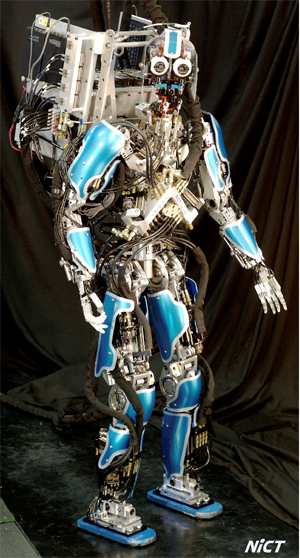
Japan’s National Institute of Information and Communications Technology (NICT) researchers have developed an autonomous humanoid robot that can recognize and use body language. According to the press release, the android can use nonverbal communication skills such as gestures and touch to facilitate natural interaction with humans. NICT researchers envision future applications of this technology in robots that can work in the home or assist with rescue operations when disaster strikes.
NICT press release (japanese)
22:45 Posted in AI & robotics | Permalink | Comments (0) | Tags: artificial intelligence, robotics
Oct 24, 2007
Movement imagery increases pain in people with neuropathic pain following complete thoracic spinal cord injury
Movement imagery increases pain in people with neuropathic pain following complete thoracic spinal cord injury.
Pain. 2007 Oct 15;
Authors: Gustin SM, Wrigley PJ, Gandevia SC, Middleton JW, Henderson LA, Siddall PJ
Spinal cord injury (SCI) results in deafferentation and the onset of neuropathic pain in a substantial proportion of people. Based on evidence suggesting motor cortex activation results in attenuation of neuropathic pain, we sought to determine whether neuropathic SCI pain could be modified by imagined movements of the foot. Fifteen subjects with a complete thoracic SCI (7 with below-level neuropathic pain and 8 without pain) were instructed in the use of movement imagery. Movement imagery was practiced three times daily for 7days. On the eighth day, subjects performed the movement imagery in the laboratory and recorded pain ratings during the period of imagined movement. Six out of 7 subjects with neuropathic pain reported an increase in pain during imagined movements from 2.9+/-0.7 during baseline to 5.0+/-1.0 during movement imagery (p<0.01). In SCI subjects without neuropathic pain, movement imagery evoked an increase in non-painful sensation intensity from a baseline of 1.9+/-0.7 to 4.8+/-1.3 during the movement imagery (p<0.01). Two subjects without a history of pain or non-painful phantom sensations had onset of dysesthesia while performing imagined movements. This study reports exacerbation of pain in response to imagined movements and it contrasts with reports of reduction pain in people with peripheral neuropathic pain. The potential mechanisms underlying this sensory enhancement with movement imagery are discussed.
16:50 Posted in Mental practice & mental simulation | Permalink | Comments (0) | Tags: mental practice, motor imagery
Oct 22, 2007
DARPA next generation prosthetic arm
The Boston Globe has an article by Scott Kirsner about the next generation of prosthetic limbs under development at DARPA
From the article:
Without any covering to emulate human skin - what those in the prosthetics field call a "cosmesis" - the arm is distinctly robotic, all metal cylinders and dark gray carbon fiber. I held out my index finger, and Van Der Merwe manipulated the arm so that the index finger and thumb grabbed my fingertip and squeezed lightly. Suddenly, there was a buzzing sound. "That's a sensor in the fingers letting me know how hard I'm squeezing," Van Der Merwe explained. A few minutes later, when I shook hands, the grip was firm (if not warm), and Van Der Merwe chided me for not shaking more vigorously. I didn't want to break the hand and get on the Pentagon's bad side
Check the video
00:00 Posted in Neurotechnology & neuroinformatics | Permalink | Comments (0) | Tags: bionic