




May 25, 2007
Haptic Telexistence
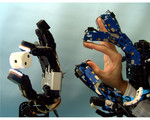
Haptic Telexistence (SIGGRAPH 2007)provides highly realistic haptic interaction among humans and objects located in remote places. Human interaction will be dramatically improved by this concept, which perceives us as the properties of an object.
Enhanced Life: With conventional systems, we can only perceive the stiffness of an object. But with Haptic Telexistence, we can also perceive the exact shape of an object, and more natural and dexterous object manipulations become possible. This simplifies complex tasks such as telesurgery and 3D modeling.
Because this system can present properties such as texture and temperature, it will support dramatic improvements in human life. For example, not only will we be able to shake hands with people at remote locations but we will also be able to feel the warmth of their hands. While shopping on the web, we will be able to check the texture of an article before purchase.
Goals: Our ultimate goal is to present all the haptic sensations through a master-slave system. Using current telepresence systems, we can interact with humans or objects even if they are located in remote places or in virtual environments. We can watch, listen, touch, and move objects. However, the properties of an object are not present in these systems, and that reduces realism and interactivity. Haptic Telexistence aims to provide highly realistic haptic interaction among human and objects in remote places.
Innovations: The system consists of four innovative devices: a dexterous slave hand, q finger-shaped haptic sensor for the slave hand, an encounter-type master hand, and an electro-tactile display. Each of these devices has more advantages than the corresponding conventional ones. In addition, integrating them to realize Haptic Telexistence is also a technical innovation.
Vision: Because haptic and robotic technologies continue to improve rapidly, we believe that this technology will be fully realized with 10 years.
Contact
Katsunari Sato
The University of Tokyo
Katsunari_Sato (at) ipc.i.u-tokyo.ac.jp
13:47 Posted in Virtual worlds | Permalink | Comments (0) | Tags: virtual reality
Electronic Lens
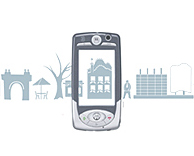
The Electronic Lens explores and creates new paradigms of civic ubiquitous networking with mobile technologies. We think of Electronic Lens as something of a viewfinder. Using a motion that is already familiar (think point and shoot camera phones), the citizen can use the eLens to gather information about physical objects and places.
The eLens matches electronic information with the physical environment in an innovative way. For example, eLens users can post lasting messages in physical locations, tag buildings and places, or create social networks based on interest and social affinities. eLens interactions combine the physical environment with formal and institutional information and the annotations from users' personal experiences.
Ultimately the eLens enhances the value of the city for its citizens by making their environments more accessible, more culturally vibrant, more socially just. The eLens fosters communication among people and between institutions; as a result citizens are now better able to navigate the social, institutional and physical urban space.
13:44 Posted in Information visualization, Locative media | Permalink | Comments (0) | Tags: locative media
May 24, 2007
Wearable brain scanner

Hitachi has successfully trial manufactured a lightweight, portable brain scanner that enables users to keep tabs on their mental activity during the course of their daily lives. The system, which consists of a 400 gram (14 oz) headset and a 630 gram (1 lb 6 oz) controller worn on the waist, is the result of Hitachi’s efforts to transform the brain scanner into a familiar everyday item that anyone can use.The rechargeable battery-operated mind reader relies on Hitachi’s so-called “optical topography” technology, which interprets mental activity based on subtle changes in the brain’s blood flow. Because blood flow increases to areas of the brain where neurons are firing (to supply glucose and oxygen to the tissue), changes in hemoglobin concentrations are an important index by which to measure brain activity. To measure these hemoglobin concentrations in real time, eight small surface-emitting lasers embedded in the headset fire harmless near-infrared rays into the brain and the headset’s photodiode sensors convert the reflected light into electrical signals, which are relayed to the controller.
The real-time brain data can either be stored in Flash memory or sent via wifi to a computer for instant analysis and display. A single computer can support up to 24 mind readers at a time, allowing multiple users to monitor brain activity while communicating or engaging in group activities.
In addition to health and medical applications, Hitachi foresees uses for the personal mind reader in fields such as psychology, education and marketing. Although it is unclear what neuromarketing applications the company has in mind, it is pretty clear that access to real-time customer brain data would provide marketers with a better understanding of how and why shoppers make their purchasing decisions. One can also imagine interactive campaigns that, for example, ask customers to think positive thoughts about a certain product in exchange for discount coupons or the chance to win a prize.
The technology could also be used in new forms of entertainment such as “mind gaming,” where the player’s physical brain activity becomes a part of game play. It is also feasible to integrate the brain scanner with a remote control brain-machine interface that would allow users to operate electronic devices with their minds.
18:59 Posted in Research tools | Permalink | Comments (0) | Tags: positive technology