




Feb 17, 2007
Action Video Games Sharpen Vision 20 Percent
From Medgadget
According to researchers at University of Rochester, video games that contain high levels of action, such as Unreal Tournament, can actually improve your vision:
Researchers at the University of Rochester have shown that people who played action video games for a few hours a day over the course of a month improved by about 20 percent in their ability to identify letters presented in clutter--a visual acuity test similar to ones used in regular ophthalmology clinics.
In essence, playing video game improves your bottom line on a standard eye chart...
Bavelier [Daphne Bavelier is Professor of brain and cognitive sciences at the University of Rochester --ed.] and graduate student Shawn Green tested college students who had played few, if any, video games in the last year. "That alone was pretty tough," says Green. "Nearly everybody on a campus plays video games."
At the outset, the students were given a crowding test, which measured how well they could discern the orientation of a "T" within a crowd of other distracting symbols--a sort of electronic eye chart. Students were then divided into two groups. The experimental group played Unreal Tournament, a first-person shoot-'em-up action game, for roughly an hour a day. The control group played Tetris, a game equally demanding in terms of motor control, but visually less complex.
After about a month of near-daily gaming, the Tetris players showed no improvement on the test, but the Unreal Tournament players could tell which way the "T" was pointing much more easily than they had just a month earlier.
"When people play action games, they're changing the brain's pathway responsible for visual processing," says Bavelier. "These games push the human visual system to the limits and the brain adapts to it. That learning carries over into other activities and possibly everyday life."
The improvement was seen both in the part of the visual field where video game players typically play, but also beyond--the part of your vision beyond the monitor. The students' vision improved in the center and at the periphery where they had not been "trained." That suggests that people with visual deficits, such as amblyopic patients, may also be able to gain an increase in their visual acuity with special rehabilitation software that reproduces an action game's need to identify objects very quickly.
20:58 Posted in Research tools | Permalink | Comments (0) | Tags: research tools
New Video Games Aim at Improving Mental Health

Psychologist Mark Baldwin has developed and clinically tested a new commercial software, Mindhabits, that aims to decrease stress and build self-esteem:
MindHabits produces computer software designed to help people reduce their stress levels and boost their self-confidence, using games that automatically retrain the way the mind responds to social stress. This patent pending technology is the result of a decade of research by scientists at McGill University, one of the world's top medical research centers. The software -- based on the emerging science of social intelligence -- helps you practice the mind habit of focusing on positive social feedback, which in turn reduces stress levels and improves self-confidence...Our starting point is past research showing that insecurity feelings and daily stress arise, in large part, from anxieties about whether one will be liked, accepted, and respected by one's peers and significant others. Sometimes people are aware of these concerns, but often social insecurities of this type influence people's thoughts and feelings "automatically", without a lot of deliberate thought and sometimes even entirely outside of their awareness. All they experience are negative reactions to the self or to social situations.
People with fewer insecurities, on the other hand, seem to have a range of automatic thought processes that make them confident and buffer them from worrying about the possibility of social rejection. Fortunately, our recent research shows that with enough practice, even people prone to stress and low self-esteem can develop these beneficial thought processes that might allow them to gradually become more secure and self-confident. We started with the idea that just as playing the game Tetris over and over for hours can start to shape the way you look at the world (even in your dreams!), playing a specially-designed computer game might also help to improve your thoughts and feelings about yourself.
We drew on research showing that certain people have attentional biases toward socially threatening information, so they automatically focus on any sign of rejection or criticism from others, which in turn perpetuates their sensitivity to rejection and heightened tendency to experience social stress. The attentional training software teaches people to look for the smiling/approving person in a crowd of frowning faces. By doing this repeatedly and as quickly as possible, this trains an automatic response of looking for acceptance and ignoring rejection. In several studies we have shown that after using the software, people become less distracted by rejection, and they become less stressed at work and school.
20:55 Posted in Serious games | Permalink | Comments (0) | Tags: cybertherapy, serious gaming
GRAViTONUS® Gaming System For Quadriplegics
From Medgadget

Gravitonus, a new medical device company from Russia, has created Alternative Computer Control System (ACCS), a system designed to help paralyzed individuals control computers and 'resume active lifestyles'.
Any person with physical disabilities is entitled to active interaction with all aspects of social life, independent personal life, self-determination, freedom of choice, as are all other human beings.The concept of independent personal life assumes elimination of dependency from manifestations of an illness, removal of limitations generated by the illness, becoming functionally independent, formation of skills indispensable in day-to-day social engagements that should enable incorporation and problem free participation in all types of social activities, finally resulting in meaningful development as a valuable member of society.
People with paralyzed legs and hands (quadriplegics) can not execute any movement of arms and legs. At a high lesion of a spinal cord in cervical department of a vertebral column skeletal muscles cease to operate completely. Only the groups of mandibulo-facial muscles and tongue remain functional as they are innervated by cerebral nerves which are anatomically irrelevant to the spinal cord.
The proposed alternative hands-free computer control system ACCS - Alternative Computer Control System - is being already effectively used by SCI (spinal cord injury) patients who have become completely immobilized. If incorporated into personnal computer, home electronics and personnal movement control systems, ACCS will provide a person with an additional control contour, which will allow for continuous computer control.
ACCS GRAViTONUS® has high level of precision positioning, discontinuity, low response time, and is resistant to all kinds of noise interference.
ACCS is placed in a person's mouth (and comprises a tongue controlled directional command module along with 12 additional commands). It does not interfere with breathing, talk and consumption of fluids.
Without resorting to outside assistance, users can operate his or her movement accessory device, independently make telephone calls and respond to them. They can even be virtually present in any part of a house and actively participate in the life of their family, as well as use unlimited capabilities of the computer and INTERNET.
Completely motionless and otherwise helpless persons can compensate for lack of physical capabilities with their intellectual potential. ACCS GRAViTONUS® allows:
1. To realize many common professional skills, e.g., engage in scientific research, teaching, legal work, economic studies, engineering, medical, literary, musical and art activities, as well as countless other skills.
2. To gain new knowledge via remote education, on-line libraries, etc.
20:44 Posted in Serious games | Permalink | Comments (0) | Tags: serious gaming
Social Networks for Disaster Relief

From MIT's Technology Review:
The emergence of the Internet as a social environment led us to come up with a service where people could first report the scope of a tsunami or a wildfire or even an E. coli attack," says Ben Schneiderman, a computer scientist at the University of Maryland and a coauthor of the report. Schneiderman got the idea when he typed 911 into Google and was unable to find any useful information. "There was no service that would provide information or assistance during Katrina-like events." The system is not strictly an online analog of 911 or other emergency-reporting services, says Schneiderman. "We think it may be helpful in advance of emergencies, during emergencies, and during rebuilding and restoration afterwards."Murray Turoff, of the New Jersey Institute of Technology, says that "what most people don't seem to understand is that the real first responders in disasters are the people in the community." Turoff, who developed the first emergency computer network for the U.S. Office of Emergency Preparedness in 1971, says that the government still has not taken steps to ensure that relief efforts are properly coordinated. "All these organizations need to be able to talk laterally," he says.
Jennifer Preece, an expert in human-computer interactions at the University of Maryland and a coauthor of the study, says that for 911.gov to be successful, it will have to draw in volunteers from other communities and be integrated with existing social-networking sites. If the government backs the site, she says, it, too, could have the clout to draw in users. She points out that during Katrina, many people found their information by heading to local libraries. "Why did they go there? These are established and trusted communities that they know about.
20:39 Posted in Social Media | Permalink | Comments (0) | Tags: social computing
NTT DoCoMo breathalyzer phone
Via Medgadget
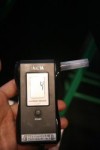
The NTT DoCoMo breathalyzer phone sends a text message to your boss before you get behind the wheel of your company's bus or truck.
Gizmodo report:
KDDI Corp has developed a breathalyzer/cellphone combo that prevents inebriated taxi and bus drivers in Japan from getting behind the wheel. Companies that buy the phone will require their employees to blow into the breathalyzer before getting behind the wheel. The phone then measures how drunk (or sober) you are and sends the results to your company's computer along with a snapshot of the your mug and your location. If you've had too much sake, the phone will notify your boss who'll most likely fire your drunk ass. The phone and software cost a combined $1,250, which shouldn't be too much money for a big company to spend.
20:36 Posted in Persuasive technology | Permalink | Comments (0) | Tags: persuasive technology
Mindfulness meditation versus relaxation training
A randomized controlled trial of mindfulness meditation versus relaxation training: effects on distress, positive States of mind, rumination, and distraction.
Ann Behav Med. 2007 Feb;33(1):11-21
Authors: Jain S, Shapiro SL, Swanick S, Roesch SC, Mills PJ, Bell I, Schwartz GE
Background: Although mindfulness meditation interventions have recently shown benefits for reducing stress in various populations, little is known about their relative efficacy compared with relaxation interventions. Purpose: This randomized controlled trial examines the effects of a 1-month mindfulness meditation versus somatic relaxation training as compared to a control group in 83 students (M age = 25; 16 men and 67 women) reporting distress. Method: Psychological distress, positive states of mind, distractive and ruminative thoughts and behaviors, and spiritual experience were measured, while controlling for social desirability. Results: Hierarchical linear modeling reveals that both meditation and relaxation groups experienced significant decreases in distress as well as increases in positive mood states over time, compared with the control group (p < .05 in all cases). There were no significant differences between meditation and relaxation on distress and positive mood states over time. Effect sizes for distress were large for both meditation and relaxation (Cohen's d = 1.36 and .91, respectively), whereas the meditation group showed a larger effect size for positive states of mind than relaxation (Cohen's d =.71 and .25, respectively). The meditation group also demonstrated significant pre-post decreases in both distractive and ruminative thoughts/behaviors compared with the control group (p < .04 in all cases; Cohen's d = .57 for rumination and .25 for distraction for the meditation group), with mediation models suggesting that mindfulness meditation's effects on reducing distress were partially mediated by reducing rumination. No significant effects were found for spiritual experience. Conclusions: The data suggest that compared with a no-treatment control, brief training in mindfulness meditation or somatic relaxation reduces distress and improves positive mood states. However, mindfulness meditation may be specific in its ability to reduce distractive and ruminative thoughts and behaviors, and this ability may provide a unique mechanism by which mindfulness meditation reduces distress.
20:27 Posted in Meditation & brain | Permalink | Comments (0) | Tags: meditation
Mindfulness meditation and alcohol use
The role of thought suppression in the relationship between mindfulness meditation and alcohol use.
Addict Behav. 2007 Jan 23;
Authors: Bowen S, Witkiewitz K, Dillworth TM, Marlatt GA
Previous studies have demonstrated that attempts to suppress thoughts about using substances may actually lead to increases in substance use. Vipassana, a mindfulness meditation practice, emphasizes acceptance, rather than suppression, of unwanted thoughts. A study by Bowen and colleagues examining the effects of a Vipassana course on substance use in an incarcerated population showed significant reductions in substance use among the Vipassana group as compared to a treatment - usual control condition [Bowen S., Witkiewitz K., Dillworth T.M., Chawla N., Simpson T.L., Ostafin B.D., et al. (2006). Mindfulness Meditation and Substance Use in an Incarcerated Population. Psychology of Addictive Behaviors.]. The current study further examines the mediating effects of thought suppression in the relationship between participation in the course and subsequent alcohol use. Those who participated in the course reported significant decreases in avoidance of thoughts when compared to controls. The decrease in avoidance partially mediated effects of the course on post-release alcohol use and consequences.
20:26 Posted in Meditation & brain | Permalink | Comments (0) | Tags: meditation
Brain Scan Mind Reading 70% Accurate

Researchers are making progresses in predicting the intention of subjects with reasonable accuracy:
Now researchers have been able to decode these secret intentions from patterns of their brain activity. They let subjects freely and covertly choose between two possible tasks - to either add or subtract two numbers. They were then asked to hold in mind their intention for a while until the relevant numbers were presented on a screen. The researchers were able to recognize the subjects intentions with 70% accuracy based alone on their brain activity - even before the participants had seen the numbers and had started to perform the calculation.
That quote is from a press release from the Max Planck Institute, Revealing secret intentions in the brain
20:23 Posted in Research tools | Permalink | Comments (0) | Tags: research tools
Center for Neurotechnology Studies Launched at Potomac Institute for Policy Studies
from Brainwaves

The Potomac Institute for Policy Studies has announced the launch of The Center for Neurotechnology Studies (CNS) which intends on providing neutral, in-depth analysis of matters at the intersection of neuroscience and technology—neurotechnology—and public policy. The Center will anticipate ethical, legal, and social issues (ELSI) associated with emerging neurotechnology, and shepherd constructive discourse on these issues. It will provide a forum for reasoned consideration of these subjects both by experts and the public.
Read the full post on Brainwaves blog
20:18 Posted in Neurotechnology & neuroinformatics | Permalink | Comments (0) | Tags: neurotechnology
Cognitive Informatics
On Cognitive Informatics
Yingxu Wang, Brain and Mind, Volume 4, Number 2 / August, 2003
Supplementary to matter and energy, information is the third essence for modeling the natural world. An emerging discipline known as cognitive informatics (CI) is developed recently that forms a profound interdisciplinary study of cognitive and information sciences, and tackles the common root problems sharing by informatics, computing, software engineering, artificial intelligence, cognitive science, neuropsychology, philosophy, linguistics, and life science. CI focuses on internal information processing mechanisms and the natural intelligence of the brain. This paper describes the historical development of informatics from the classical information theory and contemporary informatics, to CI. The domain of CI, and its interdisciplinary nature are explored. Foundations of CI, particularly the brain versus the mind, the acquired life functions versus the inherited ones, and generic relationships between information, matter, and energy are investigated. The potential engineering applications of CI and perspectives on future research are discussed. It is expected that the investigation into CI will result in fundamental findings towards the development of next generation IT and software technologies, and new architectures of computing systems.
20:09 Posted in Cognitive Informatics | Permalink | Comments (0) | Tags: cognitive informatics
Movement feedback in rehabilitation medicine
From diagnostics to therapy-conceptual basis for real-time movement feedback in rehabilitation medicine.
Biomed Tech (Berl). 2006;51(5-6):299-304
Authors: Schablowski-Trautmann M, Kögel M, Rupp R, Mikut R, Gerner HJ
Recently, locomotion therapy on a treadmill has become part of rehabilitation programs for neurological gait disorders (spinal cord injury, hemiplegia). Instrumental gait analysis is an important tool for quantification of therapy progress in terms of functional changes in a patient's gait patterns. Whereas most of current applications focus on diagnostic assessment of gait, the current paper presents an extension of movement analysis offering enhanced therapeutic options. Specifically, the conceptual basis for application of real-time movement feedback in rehabilitation medicine is outlined and is put into context with recent developments in the field. A first technical realization of these concepts is presented and first results are reported. Furthermore, open questions towards a universal environment for movement feedback in rehabilitation medicine are discussed and future lines of research are identified.
20:02 Posted in Biofeedback & neurofeedback | Permalink | Comments (0) | Tags: biofeedback, neurofeedback