




Oct 07, 2007
Teleglass T4-N wearable monitor
Via Pink Tentacle
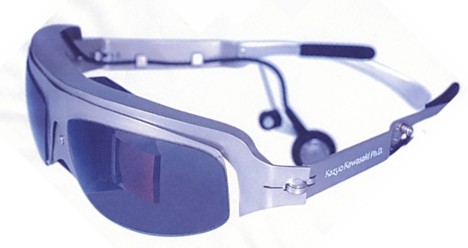
The Teleglass T4-N wearable monitor weighs 30 grams and features titanium frames by eyeglass designer Kazuo Kawasaki. The device supports any NTSC-capable video player (including iPods) and delivers images directly to the eye via a pair of tiny monitors tucked away behind the lenses. The 640 x 480 screen resolution at close proximity simulates the effect of watching a 45-inch screen from 2 meters (6 feet) away.
500 sets are available through the Scalar website, where they sell for 134,400 yen ($1,150) each.
23:40 Posted in Wearable & mobile | Permalink | Comments (0) | Tags: wearable
Decode

Decode is a multimedia exhibition showcasing the work of two artists: Jason Van Anden and Christy Matson. Experienced in traditional art-making processes - Van Anden in sculpture and Matson in weaving - both have integrated time honored methods with digital technologies. From sounds and projections to video games and robots, Van Anden and Matson’s work engages the senses and challenges perceptions in compelling and innovative ways.
Manchester Craftsmen’s Guild’s Kerr Gallery will feature Jason Van Anden’s life-sized emotive robots, Neil and Iona. The week preceding this opening, Van Anden will conduct a workshop with 10-12 students from Pittsburgh Schools at the Manchester Craftsmen’s Guild on Pittsburgh’s North side. Students participating in this workshop will be challenged to collaborate in the creation of an interactive piece that explores improvisational concepts and is inspired by the artist’s online videogame Farklempt!
Manchester Craftsmen’s Guild is a multi-discipline arts and learning center that complements traditional humanities education with studio-based art and performance programs that help catalyze academic achievement. MCG Youth serves Pittsburgh School students through year-round programs and, in conjunction with MCG Arts, promotes cultural discovery and empathy by connecting diverse accomplished artists to young people and their communities.
Neil and Iona made possible thanks to the generous support of the Finishing Fund.
23:36 Posted in Cyberart | Permalink | Comments (0) | Tags: cyberart
Mastery of the mind east and west
Mastery of the Mind East and West: Excellence in Being and Doing and Everyday Happiness.
Ann N Y Acad Sci. 2007 Sep 28;
Authors: Brown DP
Western psychological research on positive psychology and Buddhism have recently converged in their emphasis on the development of positive states, like states of excellence and veryday happiness. Yet, these traditions differ in their approaches to positive states, with respect to a state-trait and doing-being distinction. Western scientific research on peak performance emphasizes discontinuous, time-limited peak performance states wherein individuals do things extraordinarily well in sports and in the arts. The Eastern spiritual traditions emphasize continuous excellence of being, in the form of traits or character strengths. In both traditions mental imagery is a key ingredient to excellence training. With respect to everyday happiness, Western psychological research has focused on the role of meaning systems in the transformation of flow states into vital engagement in everyday life, while Buddhism stresses the role of meditation training to gain mastery over all levels of mind that leads to everyday happiness. Rorschach and tachistoscopic research on advanced meditators suggests that advance meditators have gained unusual mastery over states of mind not yet documented in the Western psychological research on positive psychology.
22:20 Posted in Meditation & brain | Permalink | Comments (0) | Tags: meditation, neuroscience
Promoting mindfulness in psychotherapists in training influences the treatment results of their patients
Promoting mindfulness in psychotherapists in training influences the treatment results of their patients: a randomized, double-blind, controlled study.
Psychother Psychosom. 2007;76(6):332-8
Authors: Grepmair L, Mitterlehner F, Loew T, Bachler E, Rother W, Nickel M
BACKGROUND: All therapists direct their attention in some manner during psychotherapy. A special form of directing attention, 'mindfulness', is recommended. This study aimed to examine whether, and to what extent, promoting mindfulness in psychotherapists in training (PiT) influences the treatment results of their patients. METHODS: The therapeutic course and treatment results of 124 inpatients, who were treated for 9 weeks by 18 PiTs, were compared. The PiTs were randomly assigned to 1 of 2 groups: (i) those practicing Zen meditation (MED; n = 9 or (ii) control group, which did not perform meditation (noMED; n = 9). The results of treatment (according to the intent-to-treat principle) were examined using the Session Questionnaire for General and Differential Individual Psychotherapy (STEP), the Questionnaire of Changes in Experience and Behavior (VEV) and the Symptom Checklist (SCL-90-R). RESULTS: Compared to the noMED group (n = 61), the patients of PiTs from the MED group (n = 63) had significantly higher evaluations (according to the intent-to-treat principle) for individual therapy on 2 STEP scales, clarification and problem-solving perspectives. Their evaluations were also significantly higher for the entire therapeutic result on the VEV. Furthermore, the MED group showed greater symptom reduction than the noMED group on the Global Severity Index and 8 SCL-90-R scales, including Somatization, Insecurity in Social Contact, Obsessiveness, Anxiety, Anger/Hostility, Phobic Anxiety, Paranoid Thinking and Psychoticism. CONCLUSIONS: This study indicates that promoting mindfulness in PiTs could positively influence the therapeutic course and treatment results in their patients.
22:16 | Permalink | Comments (0) | Tags: mindfulness
NIPS 2007 WORKSHOP: Robotics Challenges for Machine Learning
Dates: 7-8 December, 2007
Organizers:
Jan Peters (Max Planck Institute for Biological Cybernetics & USC), Marc Toussaint (Technical University of Berlin)
http://www.robot-learning.de
email: nips07@robot-learning.de
Acceptance Notification: October 26, 2007
22:12 Posted in AI & robotics | Permalink | Comments (0) | Tags: artificial intelligence, robotics