



Apr 11, 2007
Cortical current density estimation for the classification of motor imagery
Classification of motor imagery by means of cortical current density estimation and Von Neumann entropy.
J Neural Eng. 2007 Jun;4(2):17-25
Authors: Kamousi B, Amini AN, He B
The goal of the present study is to employ the source imaging methods such as cortical current density estimation for the classification of left- and right-hand motor imagery tasks, which may be used for brain-computer interface (BCI) applications. The scalp recorded EEG was first preprocessed by surface Laplacian filtering, time-frequency filtering, noise normalization and independent component analysis. Then the cortical imaging technique was used to solve the EEG inverse problem. Cortical current density distributions of left and right trials were classified from each other by exploiting the concept of Von Neumann entropy. The proposed method was tested on three human subjects (180 trials each) and a maximum accuracy of 91.5% and an average accuracy of 88% were obtained. The present results confirm the hypothesis that source analysis methods may improve accuracy for classification of motor imagery tasks. The present promising results using source analysis for classification of motor imagery enhances our ability of performing source analysis from single trial EEG data recorded on the scalp, and may have applications to improved BCI systems.
23:41 | Permalink | Comments (0) | Tags: brain-computer interface
IJHCS Special Issue on Mobility: Understanding Mobile Use
Via Usability News
Call for Papers: International Journal of Human-Computer Studies Special Issue on Mobility: Understanding Mobile Use and Users
23:16 Posted in Call for papers | Permalink | Comments (0) | Tags: mobile
Future Networked Interactive Media Systems and Services for the New-senior Communities
Via Usability News
This Special issue of the Journal of Computers in Human Behavior is a consequence of a UbiComp 06 workshop and looks at understanding crucial design issues of incoming scenarios of pervasive networked systems for elderly people
23:15 Posted in Call for papers | Permalink | Comments (0) | Tags: pervasive computing
Summer school on Presence
The First PEACH Summer School: 4-6th July 2007, Santorini Greece
"Towards Human Machine Confluence - Presence Technologies and Foundations"
Are you a PRESENCE researcher or PhD student? Are you looking to find out more about the latest presence research, methodologies and technologies? If so then the first PEACH Summer School is for you.
Registration deadline: 20th April 2007
PEACH is a FP6 Coordination Action on Presence. Its objective is to stimulate structure and support the Presence research community, with special attention to the challenges associated with the interdisciplinary character of the field, and to produce visions and roadmaps to support the construction of the Presence ERA. The Summer School is the ideal place to join the leaders in the field for a series of lectures and presentations. There are also working groups, which will focus on the latest technologies, applications and measurement techniques along with a poster session where you can present your work to other attendees and experts.
KEYNOTE SPEAKERS INCLUDE
Prof David Benyon, Napier University
Dr Wijnand IJsselsteijn, Eidhoven University of Technology (Pasion IP-EU Project)
Dr Paul Verschure, University Pompeu Fabra (Presenccia)
Prof Mel Slater, University College London (Presenccia IP-EU Project, Immersence IP-EU Project)
Dr Christoph Gurger, Guger Technologies OEG BMI (Presenccia)
Dr Maria Victoria Sánchez Vives, Universidad Miguel Hernández-CSIC (Presenccia IP-EU Project)
Prof John Waterworth, Umea University
Dr Doron Friedman, University College London, (Presenccia IP-EU Project)
Dr Robert Bracewell, Universities of Birmingham and Wales, (Immersence IP-EU Project)
Dr Luciano Gamberini, University of Padua (Pasion)
Dr Wolfgang Broll, Fraunhofer (IP City-EU Project)
Dr Giullio Jacucci, Fraunhofer (IP City-EU Project)
23:09 Posted in Telepresence & virtual presence | Permalink | Comments (0) | Tags: presence, telepresence
MOBI
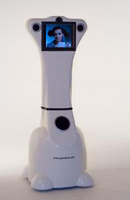
Graham Smith is a leading expert in the fields of telepresence, virtual reality, videoconferencing and robotics. He has worked with leading Canadian high tech companies for more than 14 years, including Nortel, Vivid Effects, VPL, BNR and IMAX. Graham initiated and headed the Virtual Reality Artist Access Program at the world-renowned McLuhan Program at the University of Toronto, and has lectured internationally. He holds numerous patents in the field of telepresence and panoramic imaging, and was recognized in Macleans magazine as one of the top 100 Canadians to watch.
23:05 Posted in AI & robotics, Telepresence & virtual presence | Permalink | Comments (0) | Tags: robotics, artificial intelligence, telepresence