




Dec 23, 2006
Effects of VR distraction on pain, fear, and distress
Effects of distraction on pain, fear, and distress during venous port access and venipuncture in children and adolescents with cancer.
J Pediatr Oncol Nurs. 2007 Jan-Feb;24(1):8-19
Authors: Windich-Biermeier A, Sjoberg I, Dale JC, Eshelman D, Guzzetta CE
This study evaluates the effect of self-selected distracters (ie, bubbles, I Spy: Super Challenger book, music table, virtual reality glasses, or handheld video games) on pain, fear, and distress in 50 children and adolescents with cancer, ages 5 to 18, with port access or venipuncture. Using an intervention-comparison group design, participants were randomized to the comparison group (n = 28) to receive standard care or intervention group (n = 22) to receive distraction plus standard care. All participants rated their pain and fear, parents rated participant fear, and the nurse rated participant fear and distress at 3 points in time: before, during, and after port access or venipuncture. Results show that self-reported pain and fear were significantly correlated (P = .01) within treatment groups but not significantly different between groups. Intervention participants demonstrated significantly less fear (P <.001) and distress (P = .03) as rated by the nurse and approached significantly less fear (P = .07) as rated by the parent. All intervention parents said the needlestick was better because of the distracter. The authors conclude that distraction has the potential to reduce fear and distress during port access and venipuncture.
18:00 Posted in Cybertherapy, Virtual worlds | Permalink | Comments (0) | Tags: virtual reality, cybertherapy
Positive emotions boost creativity
Researchers from the University of Toronto found that creativity is improved when people are in a good mood.
Read the post on WoP
Read ABC health report on the study
17:55 Posted in Creativity and computers | Permalink | Comments (0) | Tags: creativity and computers
Brain mouse
via omnibrain
if you are still looking for a xmas gift, what about this Brain mouse designed by Pat Says Now

17:50 Posted in Cyberart | Permalink | Comments (0) | Tags: cyberart
FDA Approves Cool-Cap
Via BrainBlog

FDA Approves Novel Device That Prevents or Reduces Brain Damage in Infants (FDA press release)
The Food and Drug Administration (FDA) today approved a first-of-a-kind medical device for the treatment of babies born with moderate to severe hypoxic-ischemic encephalopathy (HIE), a potentially fatal injury to the brain caused by low levels of oxygen. The Olympic Cool-Cap system is designed to prevent or reduce damage to the brains of these patients by keeping the head cool while the body is maintained at a slightly below-normal temperature. The Cool-Cap is manufactured by Olympic Medical Corporation, a subsidiary of Natus Medical Incorporated of San Carlos, Calif.
Read the full PR
14:03 Posted in Neurotechnology & neuroinformatics | Permalink | Comments (0) | Tags: neurotechnology
A Virtual Reprise of the Stanley Milgram Obedience Experiments

Mel Slater at UCL and colleagues have recreated Milgram’s classic obediency psychology experiment using virtual reality. Back in the 1960s Stanley Milgram appeared to show that student participants would obey a researcher and administer lethal electric shocks to a stranger, but the studies have not been replicated because of ethical concerns. Now researchers have tested participants’ willingness to administer electric shocks to a computer animated woman in a virtual reality environment. The study was published a few days ago in PLOS online
Slater, M., Antley, M., Davison, A., Swapp, D., Guger, C., Barker, C., Pistrang, N. & Sanchez-Vives, M.V. (2006). A Virtual Reprise of the Stanley Milgram Obedience Experiments. PLOS ONE, 1, e39 (open access).
13:55 Posted in Research tools | Permalink | Comments (0)
The future of research journals and peer-review
Via Medgadget
PLoS ONE - the newest journal of the Public Library of Science - is looking to completely shift the way peer-reviewed literature works:
Scope:PLoS ONE features reports of primary research from all disciplines within science and medicine. By not excluding papers on the basis of subject area, PLoS ONE facilitates the discovery of the connections between papers whether within or between disciplines.
Peer Review:
Each submission will be assessed by a member of the PLoS ONE Editorial Board before publication. This pre-publication peer review will concentrate on technical rather than subjective concerns and may involve discussion with other members of the Editorial Board and/or the solicitation of formal reports from independent referees. If published, papers will be made available for community-based open peer review involving online annotation, discussion, and rating.
Open Access:
All works published in PLoS journals are open access, licensed under the Creative Commons Attribution License. Everything is immediately available online without cost to anyone, anywhere--to read, download, redistribute, include in databases, and otherwise use--subject only to the condition that the original authorship is properly attributed. Copyright is retained by the author.
Read more
13:45 Posted in Research tools | Permalink | Comments (0) | Tags: research tools
Future scenario video about UMPCs

The UMPC site has an interesting little future scenario video about how UMPCs might be used
13:39 Posted in Wearable & mobile | Permalink | Comments (0) | Tags: mobile, wereable, mediated social presence
Dec 22, 2006
The significance of sigma neurofeedback training on sleep spindles and aspects of declarative memory
The significance of sigma neurofeedback training on sleep spindles and aspects of declarative memory.
Appl Psychophysiol Biofeedback. 2006 Jun;31(2):97-114
Authors: Berner I, Schabus M, Wienerroither T, Klimesch W
The functional significance of sleep spindles for overnight memory consolidation and general learning aptitude as well as the effect of four 10-minute sessions of spindle frequency (11.6-16 Hz, sigma) neurofeedback-training on subsequent sleep spindle activity and overnight performance change was investigated. Before sleep, subjects were trained on a paired-associate word list task after having received either neurofeedback training (NFT) or pseudofeedback training (PFT).Although NFT had no significant impact on subsequent spindle activity and behavioral outcomes, there was a trend for enhanced sigma band-power during NREM (stage 2 to 4) sleep after NFT as compared to PFT. Furthermore, a significant positive correlation between spindle activity during slow wave sleep (in the first night half) and overall memory performance was revealed. The results support the view that the considerable inter-individual variance in sleep spindle activity can at least be partly explained by differences in the ability to acquire new declarative information.We conclude that the short NFT before sleep was not sufficient to efficiently enhance phasic spindle activity and/or to influence memory processing. NFT was, however, successful in increasing sigma power, presumably because sigma NFT effects become more easily evident in actually trained frequency bands than in associated phasic spindle activity.
00:35 Posted in Biofeedback & neurofeedback | Permalink | Comments (0) | Tags: biofeedback, neurofeedback
Second Life avatars consume as much electricity as Brazilians
From 3Dpoint
Nick Carr calculates that a Second Life avatar consumes as much electricity as a Brazilian:
If there are on average between 10,000 and 15,000 avatars "living" in Second Life at any point, that means the world has a population of about 12,500. Supporting those 12,500 avatars requires 4,000 servers as well as the 12,500 PCs the avatars' physical alter egos are using. Conservatively, a PC consumes 120 watts and a server consumes 200 watts. Throw in another 50 watts per server for data-center air conditioning. So, on a daily basis, overall Second Life power consumption equals... 60,000 kilowatt-hours....
Which, annualized, gives us [an average avatar consumption of] 1,752 kWh. So an avatar consumes 1,752 kWh per year..... [T]he average citizen of Brazil consumes 1,884 kWh, which, given the fact that my avatar estimate was rough and conservative, means that your average Second Life avatar consumes about as much electricity as your average Brazilian.
Which means, in turn, that avatars aren't quite as intangible as they seem. They don't have bodies, but they do leave footprints.
00:25 Posted in Virtual worlds | Permalink | Comments (0) | Tags: second life
Smoking cues in a virtual world provoke craving in cigarette smokers
Smoking cues in a virtual world provoke craving in cigarette smokers.
Psychol Addict Behav. 2006 Dec;20(4):484-9
Authors: Baumann SB, Sayette MA
Twenty smoking-deprived cigarette smokers participated in a study to test the ability of smoking cues within a virtual world to provoke self-reported craving to smoke. Participants were exposed to 2 virtual-reality simulations displayed on a computer monitor: a control environment not containing any intentional smoking stimuli and a cue-exposure environment containing smoking stimuli. At various points, participants rated their urge to smoke on a scale of 0-100. Results indicated that baseline urge ratings were equivalent in both conditions, but the maximum increase in urge ratings was significantly higher in the cue-exposure environment than in the control environment. This is comparable to what in vivo studies have reported, but with the advantage of simulating more naturalistic and complex settings in a controlled environment.
00:14 Posted in Cybertherapy, Virtual worlds | Permalink | Comments (0) | Tags: virtual reality, cybertherapy
Recent trends in robot-assisted therapy environments
Recent trends in robot-assisted therapy environments to improve real-life functional performance of affected limbs.
J Neuroengineering Rehabil. 2006 Dec 18;3(1):29
Authors: Johnson MJ
ABSTRACT: Upper and lower limb robotic tools for neuro-rehabilitation are effective in reducing motor impairment but they are limited in their ability to improve real world function. There is a need to improve functional outcomes after robot-assisted therapy. Improvements in the effectiveness of these environments may be achieved by incorporating into their design and control strategies important elements key to inducing motor learning and cerebral plasticity such as mass-practice, feedback, task-engagement, and complex problem solving. This special issue presents nine articles. The novel strategies covered in this issue encourage more natural movements through the use of virtual reality and real objects and faster motor learning through the use of error feedback to guide acquisition of natural movements that are salient to real activities. In addition, several articles describe novel systems and techniques that use of custom and commercial games combined with new low-cost robot systems and a humanoid robot to embody the supervisory presence of the therapy as possible solutions to exercise compliance in under-supervised environments such as the home.
00:13 Posted in AI & robotics, Cybertherapy | Permalink | Comments (0) | Tags: artificial intelligence, robotics, cybertherapy
Dec 20, 2006
Mobile social networking growing
Re-blogged from Mobile blog
ABI Research have released news that they believe users of mobile social networking will rise to more than 170 million by 2011, up from the estimated 50 million now."
The rapid rise of online social communities - gathering places such as MySpace and Facebook - has done more than bring the 'pen pal' concept into the 21st century," says vice president of research Clint Wheelock. "It has created a new paradigm for personal networking. In a logical progression, many social communities are now based on the mobile phone and other portable wireless devices instead of (or as well as) the PC. Such mobile social communities extend the reach of electronic social interaction to millions of people who don't have regular or easy access to computers."
23:00 Posted in Social Media | Permalink | Comments (0) | Tags: mobile social software
WE (you) are TIME's Person of the Year

You -- Yes, You -- Are TIME's Person of the Year by Lev Grossman
22:58 | Permalink | Comments (0) | Tags: time person of the year
Mobile Presence
From Networked Performance (via Pasta and Vinegar)
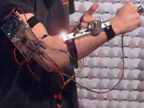
MoPres: Sense and contribute to the ghosty presences around you by Jane Oh, Alex Bisceglie:
MoPres brings out the residual presence of the people who occupied your current location. It is a geotagging project with the humanized `context' of the locations. The raw data is from bio-metric sensers rather than the conscious, forceful, and mostly inaccurate logging which will provide a more creative and sophisticated flexibility of interpretation on the experiences of people
User Scenario: People wear the vest with embedded sensor package [heart rate and body temperature sensors], and the data is logged through the cell phone with geo tagging [gps and/or cell-tower id]. Once the mobile application reads the pattern of the data in relation to locations, it triggers the output devices embedded in the vest [heater and the pulse motor] with relevant residual patterns so that people can experience others' past experiences at the given spot.
22:57 Posted in Wearable & mobile | Permalink | Comments (0) | Tags: mobile, wereable, mediated social presence
Key players in mobile social software
key players in the MoSoSo arena:
Dodgeball, Enpresence, Jambo Networks, Loopt, Mologogo, My MoSoSo, Pinppl, PlaceSite, Plazes, Saki Mobile, Nokia Sensor, Microsoft SLAM, Vixo, Zingku
22:45 Posted in Social Media, Wearable & mobile | Permalink | Comments (0) | Tags: mobile social software
Top 25 Questions About Brain Fitness
Elkhonon Goldberg, Alvaro Fernandez and Caroline Latham (Sharpbrains) have written Brain Fitness for Sharp Brains: Your New New Year Resolution, an introductory guide to the concept, science, and practice of brain fitness
A free copy of the report can be ordered here
22:30 Posted in Brain training & cognitive enhancement | Permalink | Comments (0) | Tags: brain training, cognitive enhancement
Positive effects of cognitive training on daily function and cognitive abilities
Via Smart Mobs
The Journal of the American Medical Association (JAMA) has published a study entitled "Long-term Effects of Cognitive Training on Everyday Functional Outcomes in Older Adults" that shows the positive effects of cognitive training on daily function and cognitive abilities.
Authors: Sherry L. Willis, PhD; Sharon L. Tennstedt, PhD; Michael Marsiske, PhD; Karlene Ball, PhD; Jeffrey Elias, PhD; Kathy Mann Koepke, PhD; John N. Morris, PhD; George W. Rebok, PhD; Frederick W. Unverzagt, PhD; Anne M. Stoddard, ScD; Elizabeth Wright, PhD.
JAMA. 2006;296:2805-2814.
Context. Cognitive training has been shown to improve cognitive abilities in older adults but the effects of cognitive training on everyday function have not been demonstrated. Objective. To determine the effects of cognitive training on daily function and durability of training on cognitive abilities. Design, Setting, and Participants. Five-year follow-up of a randomized controlled single-blind trial with 4 treatment groups. A volunteer sample of 2832 persons (mean age, 73.6 years; 26% black), living independently in 6 US cities, was recruited from senior housing, community centers, and hospitals and clinics. The study was conducted between April 1998 and December 2004. Five-year follow-up was completed in 67% of the sample. Interventions. Ten-session training for memory (verbal episodic memory), reasoning (inductive reasoning), or speed of processing (visual search and identification); 4-session booster training at 11 and 35 months after training in a random sample of those who completed training. Main Outcome Measures. Self-reported and performance-based measures of daily function and cognitive abilities. Results. The reasoning group reported significantly less difficulty in the instrumental activities of daily living (IADL) than the control group (effect size, 0.29; 99% confidence interval [CI], 0.03-0.55). Neither speed of processing training (effect size, 0.26; 99% CI, –0.002 to 0.51) nor memory training (effect size, 0.20; 99% CI, –0.06 to 0.46) had a significant effect on IADL. The booster training for the speed of processing group, but not for the other 2 groups, showed a significant effect on the performance-based functional measure of everyday speed of processing (effect size, 0.30; 99% CI, 0.08-0.52). No booster effects were seen for any of the groups for everyday problem-solving or self-reported difficulty in IADL. Each intervention maintained effects on its specific targeted cognitive ability through 5 years (memory: effect size, 0.23 [99% CI, 0.11-0.35]; reasoning: effect size, 0.26 [99% CI, 0.17-0.35]; speed of processing: effect size, 0.76 [99% CI, 0.62-0.90]). Booster training produced additional improvement with the reasoning intervention for reasoning performance (effect size, 0.28; 99% CI, 0.12-0.43) and the speed of processing intervention for speed of processing performance (effect size, 0.85; 99% CI, 0.61-1.09). Conclusions. Reasoning training resulted in less functional decline in self-reported IADL. Compared with the control group, cognitive training resulted in improved cognitive abilities specific to the abilities trained that continued 5 years after the initiation of the intervention.
Link to full-text article
Link to Washington Post report about the study
22:10 Posted in Brain training & cognitive enhancement | Permalink | Comments (0) | Tags: brain training, cognitive enhancement
Integration of motor imagery and physical practice in PD patients
Integration of motor imagery and physical practice in group treatment applied to subjects with Parkinson's disease.
Neurorehabil Neural Repair. 2007 Mar;21(1):68-75
Authors: Tamir R, Dickstein R, Huberman M
BACKGROUND: and PURPOSE: The application of motor imagery practice in the treatment of Parkinson's disease (PD) is a novel treatment approach for improving motor function. The purpose of this study was to compare group treatment using a combination of physical and motor imagery practice with group treatment using only physical practice in subjects with PD. METHODS: . Of 23 patients with idiopathic PD, 12 received combined therapy, whereas 11 received physical therapy alone. Exercises for both groups were applied during 1-h sessions held twice a week for 12 weeks. Comparable motor tasks provided to both groups included callisthenic exercises, functional tasks, and relaxation exercises. However, the experimental group was treated with both imagery and real practice, whereas the control group received only physical exercises. Outcome measures included the time required to complete sequences of movements, the performance of balance tasks, impairment and functional scores on the Unified Parkinson's Disease Rating Scale (UPDRS), and specific cognitive abilities (Stroop and clock drawing tests). RESULTS: . Following the intervention, the combined treatment group exhibited significantly faster performance of movement sequences than the control group. In addition, the experimental subjects demonstrated higher gains in the mental and motor subsets of the UPDRS and in the cognitive tests. Both groups improved on the activities of daily living scale. CONCLUSIONS: . The combination of motor imagery and real practice may be effective in the treatment of PD, especially for reducing bradykinesia. The implementation of this treatment regimen allows for the extension of practice time with negligible risk and low cost.
21:37 Posted in Mental practice & mental simulation | Permalink | Comments (0) | Tags: mental practice
Studies of advanced stages of meditation in the tibetan buddhist and vedic traditions
Studies of advanced stages of meditation in the tibetan buddhist and vedic traditions. I: a comparison of general changes.
Evid Based Complement Alternat Med. 2006 Dec;3(4):513-21
Authors: Hankey A
This article is the first of two comparing findings of studies of advanced practitioners of Tibetan Buddhist meditation in remote regions of the Himalayas, with established results on long-term practitioners of the Transcendental Meditation programs. Many parallel levels of improvement were found, in sensory acuity, perceptual style and cognitive function, indicating stabilization of aspects of attentional awareness. Together with observed increases in EEG coherence and aspects of brain function, such changes are consistent with growth towards a state of total brain functioning, i.e. development of full mental potential. They are usually accompanied by improved health parameters. How they may be seen to be consistent with growth of enlightenment will be the subject of a second article.
21:36 Posted in Meditation & brain | Permalink | Comments (0) | Tags: meditation
ESP: Emotional Social Intelligence Prosthesis
Technology does not naturally sense nonverbal cues such as facial expressions and tone of voice, and does not easily acquire common sense knowledge about people. These "mindreading" functions also do not come naturally for some people, such as those diagnosed with autism. ESP is an affective wearable system that explores ways to augment and enhance the wearer's emotional-social intelligence. ESP's computational model of mind-reading infers in real time affective-cognitive mental states from nonverbal cues such as head and facial displays of people, and communicates these inferences to the wearer via visual, sound, and tactile feedback.
Our work leverages the advances in affect sensing and perception to (1) develop technologies that are sensitive to people's affective-cognitive states; (2) advance autism research and (3) create new technologies that enhance the social-emotional intelligence of people diagnosed with autism, as well as those who are not.
The project addresses open research challenges pertaining to whether machines can augment social interactions in a way that improves human to human communication. A longer term aim is to use the prosthesis as an assistive and therapeutic device for people with Autism Spectrum Disorder.
00:27 Posted in Emotional computing | Permalink | Comments (0) | Tags: emotional computing