




Feb 11, 2006
Cloud

19:45 Posted in Emotional computing, Meditation & brain, Serious games | Permalink | Comments (0) | Tags: emotional computing, serious gaming
Feb 10, 2006
BCI-info
BCI-info is an open international platform for Brain-Computer Interface research. Hosted by BCI Lab, TU Graz, Austria, the platform aims to provide information for scientists, patients, students, the media, and people from the general public interested in BCI technology.
Registration and submissions are free., but contributions are reviewed by the BCI-info board.
20:56 Posted in Brain-computer interface | Permalink | Comments (0) | Tags: Positive Technology
Beyond reading thoughts
In an article recently appeared on the Observer, biologist Steven Rose argues the risk of a new era of mind control.
Concern about rising levels of mental distress have resulted in unprecedented levels of funding in the US and Europe. And a range of new technologies, from genetics to brain imaging, are offering extraordinary insights into the molecular and cellular processes underlying how we see, how we remember, why we become emotional.
Brain imaging has become familiar. Scanners, known by their initials - CAT, PET, MRI - began as clinical tools, enabling surgeons to identify potential tumours, the damage following a stroke or the diagnostic signs of incipient dementia. But neuroscientists quickly seized on their wider potential. The images of regions of the brain 'lighting up' when a person is thinking of their lover, imagining travelling from home to the shops, or solving a mathematical problem, have captured the imagination of researchers and public alike. What if they could do more?
Read full article
20:49 Posted in Research tools | Permalink | Comments (0) | Tags: Positive Technology
Feb 09, 2006
Train your brain with neurofeedback
The new edition of Scientific American Mind includes an interesting article on the use of neurofeedback to improve cognitive performance. I quote here an excerpt from the article
Such "mind reading" offers many possible applications. It has, for instance, enabled "locked-in" patients--who cannot speak or gesture--to communicate with caregivers [see "Thinking Out Loud," by Nicola Neumann and Niels Birbaumer; Scientific American Mind, Premier Issue, Vol. 14, No. 5, 2004]. By controlling their brain waves, the patients manipulate letters and words on a computer screen. Practice with neurofeedback may also benefit those who suffer from epilepsy, attention deficits, depression and other debilitating mental disorders. The experimental therapy, also called EEG biofeedback, may even help rev up healthy brains, improving cognitive performance.
16:59 Posted in Biofeedback & neurofeedback | Permalink | Comments (0) | Tags: Positive Technology
Feb 08, 2006
Dynamical Principles for Neuroscience and Intelligent Biomimetic Devices
March, 8-10, 2006, (Registration deadline: February 13 !) Ecole Polytechnique Fédérale de Lausanne (EPFL), Switzerland
Aim of the Conference
The goal of the conference is to bring together scientists and engineers interested in understanding the dynamical properties of the nervous system, and in taking inspiration from those properties for the design of prosthetic and robotic devices. The conference is interdisciplinary in nature, and aims at bringing together researchers working on similar topics and phenomena but from different backgrounds.
The conference is made possible thanks to the generous support of the Latsis Foundation. The presentations will consists of a series of invited talks (see below) and of poster presentations (with short poster spotlights).
For more background on the aim of the conference, please visit latsis2006.epfl.ch
Registration
------------
Registration for the EPFL-LATSIS Symposium 2006 is open. Please visit the website for information and registration form
15:26 Posted in AI & robotics | Permalink | Comments (0) | Tags: Positive Technology
Feb 07, 2006
Multi-Touch Interaction Research
via WMMNA
Jefferson Y. Han and coll. have developed multi-touch sensing technologies based on a technique called FTIR (frustrated total internal reflection), originally developed for fingerprint image acquisition. It acquires true touch information at high spatial and temporal resolutions, and is scalable to very large installations.
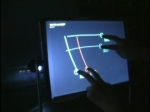 Multi-touch sensing allows a user to interact with a system with more than one finger at a time, as in chording and bi-manual operations. Such sensing devices are also able to accommodate multiple users simultaneously, which is especially useful for larger interaction scenarios such as interactive walls and tabletops.
See MPEG-1 demo and visit the project's web site
12:44 Posted in Future interfaces | Permalink | Comments (0) | Tags: Positive Technology
MobileHCI 2006
CALL FOR PAPERS
MOBILEHCI 2006
The 8th International Conference on Human-Computer Interaction with Mobile Devices and Services
Date: 12-15 September 2006
Location: Espoo, Finland
Website: www.mobilehci.org
Deadlines: *Papers, Workshops and Tutorials: 1 March 2006 *Short Papers, Posters, Demos, Panels, Industry Cases, Doctoral Consortium: 7 May 2006
Purpose
The 8th conference in the MOBILEHCI series provides a forum for academics and practitioners to discuss the challenges, potential solutions and innovations towards effective interaction with mobile systems and services. It covers the analysis, design, evaluation and application of human-computer interaction techniques and approaches for all mobile computing devices, software and services. Suggested topics include but are not limited to:
*Audio and speech interaction
*Context-dependent systems
*Designing Web sites for mobile devices
*Ethographical and field studies with mobile technology
*Evaluation of mobile devices and services
*Group interaction and mobility
*Intelligent environments
*Location-aware interaction
*Methods to evaluate mobile usability
*Model-based design of interactive mobile systems
*Mobile phenomena
*Mobility and work environments
*Multimodal interaction
*Novel user interfaces and interaction techniques
*Perception and modelling of the environment
*Safety issues (e.g., in-car user interfaces, payments)
*Specific classes of handheld devices (PDA, Pocket PC, WAP phone,...)
*3D graphics on mobile devices
*3G/4G devices and services
*Usability of mobile devices and services
*Visualization techniques for the mobile context
*Interdisciplinary perspectives towards mobile interaction (e.g. Social aspects)
*User centered design tools and methods for mobile systems
12:20 Posted in Call for papers | Permalink | Comments (0) | Tags: Positive Technology, mobile
Neurofeedback improves cognitive performance
Increasing individual upper alpha power by neurofeedback improves cognitive performance in human subjects.
Appl Psychophysiol Biofeedback. 2005 Mar;30(1):1-10
Authors: Hanslmayr S, Sauseng P, Doppelmayr M, Schabus M, Klimesch W
The hypothesis was tested of whether neurofeedback training (NFT)--applied in order to increase upper alpha but decrease theta power--is capable of increasing cognitive performance. A mental rotation task was performed before and after upper alpha and theta NFT. Only those subjects who were able to increase their upper alpha power (responders) performed better on mental rotations after NFT. Training success (extent of NFT-induced increase in upper alpha power) was positively correlated with the improvement in cognitive performance. Furthermore, the EEG of NFT responders showed a significant increase in reference upper alpha power (i.e. in a time interval preceding mental rotation). This is in line with studies showing that increased upper alpha power in a prestimulus (reference) interval is related to good cognitive performance.
11:55 Posted in Biofeedback & neurofeedback | Permalink | Comments (0) | Tags: Positive Technology, Biofeedback, neurofeedback
Can neurofeedback training enhance performance?
Can neurofeedback training enhance performance? An evaluation of the evidence with implications for future research.
Appl Psychophysiol Biofeedback. 2005 Dec;30(4):347-64
Authors: Vernon DJ
There have been many claims regarding the possibilities of performance enhancement training. The aim of such training is for an individual to complete a specific function or task with fewer errors and greater efficiency, resulting in a more positive outcome. The present review examined evidence from neurofeedback training studies to enhance performance in a particular area. Previous research has documented associations between specific cortical states and optimum levels of performance in a range of tasks. This information provides a plausible rationale for the use of neurofeedback to train individuals to enhance their performance. An examination of the literature revealed that neurofeedback training has been utilised to enhance performance from three main areas; sport, cognitive and artistic performance. The review examined evidence from neurofeedback training studies within each of these three areas. Some suggestive findings have been reported with regard to the use of neurofeedback training to enhance performance. However, due to a range of methodological limitations and a general failure to elicit unambiguous changes in baseline EEG activity, a clear association between neurofeedback training and enhanced performance has yet to be established. Throughout, the review highlights a number of recommendations to aid and stimulate future research.
11:53 Posted in Biofeedback & neurofeedback | Permalink | Comments (0) | Tags: Positive Technology