




May 02, 2006
Cardiac responses induced during thought-based control of a virtual environment
Cardiac responses induced during thought-based control of a virtual environment.
Int J Psychophysiol. 2006 Apr 25;
Authors: Pfurtscheller G, Leeb R, Slater M
Cardiac responses induced by motor imagery were investigated in 3 subjects in a series of experiments with a synchronous (cue-based) Brain-Computer Interface (BCI). The cue specified right hand vs. leg/foot motor imagery. After a number of BCI training sessions reaching a classification accuracy of at least 80%, the BCI experiments were carried out in an immersive virtual environment (VE), commonly referred as a "CAVE". In this VE, the subjects were able to move along a virtual street by motor imagery alone. The thought-based control of VE resulted in an acceleration of the heart rate in 2 subjects and a heart rate deceleration in the other subject. In control experiments in front of a PC, all 3 subjects displayed a significant heart rate deceleration of the order of about 3-5%. This heart rate decrease during motor imagery in a normal environment is similar to that observed during preparation for a voluntary movement. The heart rate acceleration in the VE is interpreted as effect of an increased mental effort to walk as far as possible in VE.
22:47 Posted in Brain-computer interface | Permalink | Comments (0) | Tags: Positive Technology
Steady-state somatosensory evoked potentials
Steady-state somatosensory evoked potentials: suitable brain signals for brain-computer interfaces?
IEEE Trans Neural Syst Rehabil Eng. 2006 Mar;14(1):30-7
Authors: Müller-Putz GR, Scherer R, Neuper C, Pfurtscheller G
One of the main issues in designing a brain-computer interface (BCI) is to find brain patterns, which could easily be detected. One of these pattern is the steady-state evoked potential (SSEP). SSEPs induced through the visual sense have already been used for brain-computer communication. In this work, a BCI system is introduced based on steady-state somatosensory evoked potentials (SSSEPs). Transducers have been used for the stimulation of both index fingers using tactile stimulation in the "resonance"-like frequency range of the somatosensory system. Four subjects participated in the experiments and were trained to modulate induced SSSEPs. Two of them learned to modify the patterns in order to set up a BCI with an accuracy of between 70% and 80%. Results presented in this work give evidence that it is possible to set up a BCI which is based on SSSEPs.
22:45 Posted in Brain-computer interface | Permalink | Comments (0) | Tags: Positive Technology
Does subliminal advertising work?
Via Kurzweilai.net
Researchers have shown that subliminal advertising may work after all..
New Scientist: It was a stunt that launched a thousand conspiracy theories. Market researcher James Vicary claimed in 1957 that he could get movie-goers to "drink Coca-Cola" and "eat popcorn" by flashing those messages on the screen for such a short time that viewers were unaware of it. People were outraged, and the practice was banned in the UK, Australia and the US.
Vicary later admitted that his study was fabricated, and scientists through the years who have tried to replicate it have largely failed. But now researchers have shown that if the conditions are right, subliminal advertising to promote a brand can be made to work.
Read the full article
22:40 Posted in Persuasive technology | Permalink | Comments (0) | Tags: Positive Technology
Playing pong with thought

22:37 Posted in Brain-computer interface | Permalink | Comments (0) | Tags: Positive Technology
Telepathy Playground
(Bill Hanley, Rhizome News)
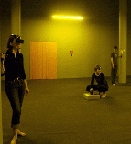
Marseilles-based artist Mathieu Briand makes installations that use light, video, sound, and other media to let viewers destabilize and manipulate their own perceptions. His stylish works adopt the sleek, cold, and ambiguously menacing look of '2001: A Space Odyssey' and other dystopian science fiction fables of that era. Briand's first U.S. solo show recently opened at Los Angeles' Redcat gallery, and its title, Ubiq: A Mental Odyssey references both the Kubrick film and 'Ubik,' the Philip K. Dick classic about telepathy, unstable realities, and an elusive cure-all product. On view through June 18, the exhibition includes a standout work consisting of four retro-futuristic helmets outfitted with cameras and monitors, which allow wearers to swap perspectives and steal each other's points of view as they explore the exhibition. The piece highlights an important difference between Briand's work and the bleak science fiction tradition that he references: his work makes a hallucinatory future of failed technological utopias seem like fun. In these playful installations, a Phillip K. Dick-style confusion between reality and fractured perceptions becomes the perfect context for anarchic play. -
22:23 Posted in Cyberart | Permalink | Comments (0) | Tags: Positive Technology
BabyBot
From the BabyBot project website:
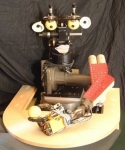
The Babybot is the LIRA-Lab humanoid robot. The latest version has eighteen degrees of freedom distributed along the head, arm, torso, and hand. The head and hand were custom designed at the lab. The arm is an off-the-shelf small PUMA manipulator and it is mounted on a rotating torso. The Babybot's sensory system is composed of a pair of cameras with space-variant resolution, two microphones each mounted inside an external ear, a set of three gyroscopes mimicking the human vestibular system, positional encoders at each joint, a torque/forse sensor at the wrist and tactile sensors at the fingertips and the palm.
The one you see in the picture above is the latest realization of the Babybot, a project started in 1996 at LIRA-Lab. The hardware itself went through many revisions so there's not much remaining of the mechanics of the first Babybot beside the PUMA arm.
Our scientific goal is that of uncovering the mechanisms of the functioning of the brain by building physical models of the neural control and cognitive structures. In our intendment physical model are embodied artificial systems that freely interact in a not too unconstrained environment. Also, our approach derives from studies of human sensorimotor and cognitive development with the aim of investigating if a developmental approach to building intelligent systems may offer new insight on aspects of human behavior and new tools for the implementation of complex, artificial systems.
Examples of the behaviors we implemented include (but not only) the control of eye movements such as vergence, saccades, and vestibulo-ocular reflex. We've been working on the integration of different sensory modalities as for example vestibular and visual cues, or acoustic perception with vision. We implemented reaching behavior as a means to physically interact with the external environment to discover about the properties of objects.
22:09 Posted in AI & robotics | Permalink | Comments (0) | Tags: Positive Technology
Computer game technology will plug directly into our brains
Via the Presence Mailing List
(from Australia's The Age)
The new PlayStation or X-box may not need a joystick, with the Federal Government approving the development of Australian computer game technology that plugs directly into our brains.
With technology that is reminiscent of science fiction classics such as Ghost in the Shell, Lawnmower Man and Firefox, Sydney-based company Emotiv Systems will develop, with the assistance of $1.5 million in Federal Government funding, a wireless headset that will "read" brain waves for a gaming experience that will blur the line between fantasy and reality.
The funding was announced by federal Industry Minister Ian Macfarlane yesterday, and forms part of the Government's Commercial Ready program, the aim of which is to help develop new Australian ideas into commercially viable products.
Read the full story
14:25 Posted in Brain-computer interface | Permalink | Comments (0) | Tags: Positive Technology