



Apr 28, 2006
Playdocam
PlaydoCAM™ is a free software that allows to use the web camera into a motion-tracking gaming device and play pong or basketball on Mac or PC without installing any new software by the interface mechanism of waving the hands in the air. I tried it and it worked fine...
I think that this technology could be effectively used in home-based training for poststroke hemiplegia


17:40 Posted in Cybertherapy | Permalink | Comments (0) | Tags: Positive Technology
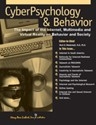
April issue of CyberPsychology & Behavior is online
From the CP&B website
| TIES that BIND: An Introduction to Domain Mapping as a Visualization Tool for Virtual Rehabilitation Patrice L. (Tamar) Weiss, Rochelle Kedar, Meir Shahar |
| Feasibility, Motivation, and Selective Motor Control: Virtual Reality Compared to Conventional Home Exercise in Children with Cerebral Palsy C. Bryanton, J. Bossé, M. Brien, J. Mclean, A. McCormick, H. Sveistrup |
| Integrating Haptic-Tactile Feedback into a Video-Capture–Based Virtual Environment for Rehabilitation Uri Feintuch, Liat Raz, Jane Hwang, Naomi Josman, Noomi Katz, Rachel Kizony, Debbie Rand, Albert "Skip" Rizzo, Meir Shahar, Jang Yongseok, Patrice L. (Tamar) Weiss |
| Reaching within Video-Capture Virtual Reality: Using Virtual Reality as a Motor Control Paradigm Assaf Y. Dvorkin, Meir Shahar, Patrice L. (Tamar) Weiss |
| Virtual Reality in the Rehabilitation of the Upper Limb after Stroke: The User?s Perspective J.H. Crosbie, S. Lennon, M.D.J. McNeill, S.M. McDonough |
| Usability of the Remote Console for Virtual Reality Telerehabilitation: Formative Evaluation Jeffrey A. Lewis, Judith E. Deutsch, Grigore Burdea |
| The Rutgers Arm, a Rehabilitation System in Virtual Reality: A Pilot Study Manjuladevi Kuttuva, Rares Boian, Alma Merians, Grigore Burdea, Mourad Bouzit, Jeffrey Lewis, Devin Fensterheim |
| Responses to a Virtual Reality Grocery Store in Persons with and without Vestibular Dysfunction Susan L. Whitney, Patrick J. Sparto, Larry F. Hodges, Sabarish V. Babu, Joseph M. Furman, Mark S. Redfern |
| A Treadmill and Motion Coupled Virtual Reality System for Gait Training Post-Stroke Joyce Fung, Carol L. Richards, Francine Malouin, Bradford J. McFadyen, Anouk Lamontagne |
| Influences of the Perception of Self-Motion on Postural Parameters E.A. Keshner, K. Dokka, R.V. Kenyon |
| Immersive Virtual Reality as a Rehabilitative Technology for Phantom Limb Experience: A Protocol Craig D. Murray, Emma Patchick, Stephen Pettifer, Fabrice Caillette, Toby Howard |
| Motor Training in the Manipulation of Flexible Objects in Haptic Environments I. Goncharenko, M. Svinin, Y. Kanou, S. Hosoe |
| Using Virtual Environment to Improve Spatial Perception by People Who Are Blind Orly Lahav |
| The Jerusalem TeleRehabilitation System, a New Low-Cost, Haptic Rehabilitation Approach Heidi Sugarman, Ehud Dayan, Aviva Weisel-Eichler, Joseph Tiran |
| Human Experience Modeler: Context-Driven Cognitive Retraining to Facilitate Transfer of Learning C.M. Fidopiastis, C.B. Stapleton, J.D. Whiteside, C.E. Hughes, S.M. Fiore, G.A. Martin, J.P. Rolland, E.M. Smith |
| Application of Virtual Reality Graphics in Assessment of Concussion Semyon Slobounov, Elena Slobounov, Karl Newell |
| Virtual Reality Pencil and Paper Tests for Neglect: A Protocol Kenji Baheux, Makoto Yoshizawa, Kazunori Seki, Yasunobu Handa |
| Virtual and Physical Toys: Open-Ended Features for Non-Formal Learning Eva Petersson, Anthony Brooks |
| Three-Dimensional Virtual Environments for Blind Children Jaime Sánchez, Mauricio Sáenz |
| Effectiveness of Virtual Reality for Pediatric Pain Distraction during IV Placement Jeffrey I. Gold, Seok Hyeon Kim, Alexis J. Kant, Michael H. Joseph, Albert "Skip" Rizzo |
| Simulating Social Interaction to Address Deficits of Autistic Spectrum Disorder in Children Cheryl Y. Trepagnier, Marc M. Sebrechts, Andreas Finkelmeyer, Willie Stewart, Jordana Woodford, Maya Coleman |
| Starting Research in Interaction Design with Visuals for Low-Functioning Children in the Autistic Spectrum: A Protocol Narcís Parés, Anna Carreras, Jaume Durany, Jaume Ferrer, Pere Freixa, David Gómez, Orit Kruglanski, Roc Parés, J. Ignasi Ribas, Miquel Soler, Àlex Sanjurjo |
| Virtual Reality Assessment of Medication Compliance in Patients with Schizophrenia Elizabeth K. Baker, Matthew Kurtz, Robert S. Astur |
| Reality Check: The Role of Realism in Stress Reduction Using Media Technology Y.A.W. de Kort, W.A. Ijsselsteijn |
| Hippocampus Function Predicts Severity of Post-Traumatic Stress Disorder Robert S. Astur, Sarah A. St. Germain, David Tolin, Julian Ford, David Russell, Mike Stevens |
| BusWorld: Designing a Virtual Environment for Post-Traumatic Stress Disorder in Israel: A Protocol Naomi Josman, Eli Somer, Ayelet Reisberg, Patrice L. (Tamar) Weiss, Azucena Garcia-Palacios, Hunter Hoffman |
| Simulation and Virtual Reality in Medical Education and Therapy: A Protocol Michael J. Roy, Deborah L. Sticha, Patricia L. Kraus, Dale E. Olsen |
| Virtual Reality Applications to Agoraphobia: A Protocol Georgina Cárdenas, Sandra Muñoz, Maribel González, Guillermo Uribarren |
17:25 Posted in Cybertherapy | Permalink | Comments (0) | Tags: Positive Technology
Functions of the Mirror Neuron System: Implications for Neurorehabilitation
Functions of the Mirror Neuron System: Implications for Neurorehabilitation.
Cogn Behav Neurol. 2006 Mar;19(1):55-63
Authors: Buccino G, Solodkin A, Small SL
Mirror neurons discharge during the execution of hand object-directed actions and during the observation of the same actions performed by other individuals. These neurons were first identified in the ventral premotor cortex (area F5) and later on in the inferior parietal lobule of monkey brain, thus constituting the mirror neuron system. More recently, mirror neurons for mouth object-directed actions have also been found in the monkey. Several pieces of experimental data demonstrate that a mirror neuron system devoted to hand, mouth, and foot actions is also present in humans. In the present paper we review the experimental evidence on the role of the mirror neuron system in action understanding, imitation learning of novel complex actions, and internal rehearsal (motor imagery) of actions. On the basis of features of the mirror neuron system and its role in action understanding and imitation, we discuss the possible use of action observation and imitation as an approach for systematic training in the rehabilitation of patients with motor impairment of the upper limb after stroke.
17:16 Posted in Mental practice & mental simulation | Permalink | Comments (0) | Tags: Positive Technology
Mental imagery in the acquisition of surgical skills
Cognitive skills analysis, kinesiology, and mental imagery in the acquisition of surgical skills.
J Otolaryngol. 2005 Oct;34(5):328-32
Authors: Bathalon S, Dorion D, Darveau S, Martin M
GOAL: Isolate and evaluate the impact of mental imagery on the acquisition of an emergency surgical technique. METHOD: We studied 44 first-year medical students performing a cricothyrotomy on a mannequin to determine the impact of teaching using mental imagery (MI) and/or kinesiology (KG) compared to the standard Advandec Trauma Life Support (ATLS) approach. Students were randomly assigned to one of three groups: MI and KG, KG alone or control (ATLS). Two weeks after the one-hour teaching session, they were evaluated with an OSCE testing the performance of the different steps of the technique, the time required and its fluidity. RESULTS: Total results (maximum: 25 marks) are as follows: KG + MI = 20.3 +/- 1.5 ; KG = 19.3 +/- 2.9 ; ATLS = 18.2 +/- 2.5. The only statistically significant difference for total results was in the use of MI and KG compared to the control group. Kinesiology alone or with mental imagery improved the fluidity of the performance. CONCLUSION: Many factors influence the acquisition of a surgical technique. This study showed that acquisition and performance of an emergency procedure (cricothyrotomy) was improved when mental imagery and kinesiology were combined to teach it.
17:15 Posted in Mental practice & mental simulation | Permalink | Comments (0) | Tags: Positive Technology
Simulating social interaction to address deficits of autistic spectrum disorder in children
Simulating social interaction to address deficits of autistic spectrum disorder in children.
Cyberpsychol Behav. 2006 Apr;9(2):213-7
Authors: Trepagnier CY, Sebrechts MM, Finkelmeyer A, Stewart W, Woodford J, Coleman M
Autistic spectrum disorder (ASD) is diagnosed on the basis of impairment in reciprocal social interaction and language, and rigidity of behavior. This brief paper describes the development of an experimental intervention for preschool children newly diagnosed with ASD. The rationale for this intervention is the hypothesis that failure to attend to social cues in very early life, of itself, may bear a large share of responsibility for core social and communicative deficits. The intervention, therefore, uses eye-tracking to monitor and trigger rewards for attention to facial expression and direction of gaze.
17:13 Posted in Cybertherapy | Permalink | Comments (0) | Tags: Positive Technology
Neurofeedback treatment of epilepsy
Neurofeedback treatment of epilepsy: from basic rationale to practical application.
Expert Rev Neurother. 2006 Feb;6(2):247-57
Authors: Egner T, Sterman MB
The treatment of epilepsy through operant conditioning of the sensorimotor rhythm electroencephalogram has a 35-year history. Neurophysiological studies have shown that this phasic oscillation reflects an inhibitory state of the sensorimotor system. Operant learning of sensory motor rhythm production results in an upregulation of excitation thresholds within the thalamocortical sensory and motor circuitry, which in turn is associated with reduced susceptibility to seizures. The clinical benefits derived from this neurofeedback training protocol, particularly in patients that are nonresponsive to pharmacotherapy, have been documented in many independent laboratories. Recent advances in computer technology have resulted in the availability of relatively inexpensive high-quality equipment for the application of neurofeedback therapy, thus presenting a viable and promising treatment alternative to the interested clinician.
17:11 Posted in Biofeedback & neurofeedback | Permalink | Comments (0) | Tags: Positive Technology