




Jan 28, 2006
Telepresence and Bio Art
Via Boing-Boing
For nearly two decades Eduardo Kac has been at the cutting edge of media art, first inventing early online artworks for the web and continuously developing new art forms that involve telecommunications and robotics as a new platform for art. Interest in telepresence, also known as telerobotics, exploded in the 1990s, and remains an important development in media art. Since that time, Kac has increasingly moved into the fields of biology and biotechnology.
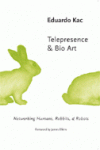 Telepresence and Bio Art is the first book to document the evolution of bio art and the aesthetic development of Kac, the creator of the "artist's gene" as well as the controversial glow-in-the-dark, genetically engineered rabbit Alba. Kac covers a broad range of topics within media art, including telecommunications media, interactive systems and the Internet, telematics and robotics, and the contact between electronic art and biotechnology. Addressing emerging and complex topics, this book will be essential reading for anyone interested in contemporary art. Artist Eduardo Kac is internationally recognized for his interactive Internet installations and his bio art. A pioneer of telecommunications art in the pre-web '80s, Kac emerged in the early '90s with his radical telepresence and biotelematic works.
19:40 Posted in Cyberart | Permalink | Comments (0) | Tags: Positive Technology, cyberart
Researchers Pinpoint Brain Areas That Process Reality, Illusion
Via Washington University in St Luis
A study by Daniel Moran and coll. has focused on studying perception and playing visual tricks on macaque monkeys and some human subjects. These scholars have created a virtual reality video game to trick the monkeys into thinking that they were tracing ellipses with their hands, though they actually were moving their hands in a circle.
Then researchers monitored nerve cells in the monkeys enabling them to see what areas of the brain represented the circle and which areas represented the ellipse. They found that the primary motor cortex represented the actual movement while the signals from cells in a neighboring area, called the ventral premotor cortex, were generating elliptical shapes. The research shows how the mind creates its sense of order in the world and then adjusts on the fly to eliminate distortions.
For instance, the first time you don a new pair of bifocals, there is a difference in what you perceive visually and what your hand does when you go to reach for something. With time, though, the brain adjusts so that vision and action become one. The ventral premotor complex plays a major role in that process. Knowing how the brain works to distinguish between action and perception will enhance efforts to build biomedical devices that can control artificial limbs, some day enabling the disabled to move a prosthetic arm or leg by thinking about it.
Results were published in the Jan. 16, 2004 issue of Science.
19:29 Posted in Telepresence & virtual presence | Permalink | Comments (0) | Tags: Positive Technology
Effect of tutorial input in addition to augmented feedback on manual dexterity training and its retention
Effect of tutorial input in addition to augmented feedback on manual dexterity training and its retention.
Eur J Dent Educ. 2006 Feb;10(1):24-31
Authors: Wierinck E, Puttemans V, van Steenberghe D
Abstract Virtual reality (VR) simulators can be used as tools in manual dexterity training. The visual feedback guides the subject towards proper performance but creates, at the same time, some dependency on this feedback. To overcome this drawback, the effect of adjunct tutorial input on motor learning behaviour was examined. Novice dental students were randomly assigned to one of two training groups or to a non-training control group, given the task of preparing a geometrical class 1 cavity in phantom teeth. The feedback (FB) group trained under augmented visual feedback conditions, provided by the VR system (DentSim(TM)). The feedback-plus (FB+) group received, in addition, standardised expert input to enrich the augmented feedback information. The control group, consisting of same year students, did not participate in any training programme. All preparations were evaluated by the VR scoring system. Performance analyses revealed an overall trend towards significant improvement with practice for the training groups. Performance of the FB+ group was most accurate across training. After 1 day and 3 weeks of no practice, both training groups outperformed the control group. After 4 months, however, only the FB+ condition was significantly more accurate than the control group. The same tendency was noted for the transfer tests. Consequently, cavity preparation experience on a VR system under the condition of frequently provided feedback supplemented with expert input was most beneficial to long time learning.
19:06 Posted in Cybertherapy | Permalink | Comments (0) | Tags: Positive Technology
Meditation therapy for anxiety disorders
Meditation therapy for anxiety disorders.
Cochrane Database Syst Rev. 2006;(1):CD004998
Authors: Krisanaprakornkit T, Krisanaprakornkit W, Piyavhatkul N, Laopaiboon M
BACKGROUND: Anxiety disorders are characterised by long term worry, tension, nervousness, fidgeting and symptoms of autonomic system hyperactivity. Meditation is an age-old self regulatory strategy which is gaining more interest in mental health and psychiatry. Meditation can reduce arousal state and may ameliorate anxiety symptoms in various anxiety conditions. OBJECTIVES: To investigate the effectiveness of meditation therapy in treating anxiety disorders SEARCH STRATEGY: Electronic databases searched include CCDANCTR-Studies and CCDANCTR-References, complementary and alternative medicine specific databases, Science Citation Index, Health Services/Technology Assessment Text database, and grey literature databases. Conference proceedings, book chapters and references were checked. Study authors and experts from religious/spiritual organisations were contacted. SELECTION CRITERIA: Types of studies: Randomised controlled trials.Types of participants: patients with a diagnosis of anxiety disorders, with or without another comorbid psychiatric condition.Types of interventions: concentrative meditation or mindfulness meditation. Comparison conditions: one or combination of 1) pharmacological therapy 2) other psychological treatment 3) other methods of meditation 4) no intervention or waiting list.Types of outcome: 1) improvement in clinical anxiety scale 2) improvement in anxiety level specified by triallists, or global improvement 3) acceptability of treatment, adverse effects 4) dropout. DATA COLLECTION AND ANALYSIS: Data were independently extracted by two reviewers using a pre-designed data collection form. Any disagreements were discussed with a third reviewer, and the authors of the studies were contacted for further information. MAIN RESULTS: Two randomised controlled studies were eligible for inclusion in the review. Both studies were of moderate quality and used active control comparisons (another type of meditation, relaxation, biofeedback). Anti-anxiety drugs were used as standard treatment. The duration of trials ranged from 3 months (12 weeks) to 18 weeks. In one study transcendental meditation showed a reduction in anxiety symptoms and electromyography score comparable with electromyography-biofeedback and relaxation therapy. Another study compared Kundalini Yoga (KY), with Relaxation/Mindfulness Meditation. The Yale-Brown Obsessive Compulsive Scale showed no statistically significant difference between groups. The overall dropout rate in both studies was high (33-44%). Neither study reported on adverse effects of meditation. AUTHORS' CONCLUSIONS: The small number of studies included in this review do not permit any conclusions to be drawn on the effectiveness of meditation therapy for anxiety disorders. Transcendental meditation is comparable with other kinds of relaxation therapies in reducing anxiety, and Kundalini Yoga did not show significant effectiveness in treating obsessive-compulsive disorders compared with Relaxation/Meditation. Drop out rates appear to be high, and adverse effects of meditation have not been reported. More trials are needed.
19:05 Posted in Meditation & brain | Permalink | Comments (0) | Tags: Positive Technology