




Nov 26, 2005
EMG Activity in Selected Target Muscles During Imagery Rising on Tiptoes in Healthy Adults and Poststroke Hemiparetic Patients
Authors: Dickstein R, Gazit-Grunwald M, Plax M, Dunsky A, Marcovitz E
The authors sought to gain further knowledge about activation of target muscles during imagery engagement in a motor task. Six hemiparetic patients and 9 healthy participants performed 3 real rises on tiptoes and then, after pausing, 3 imagery rises on tiptoes. Metronome beats guided the rate of rises and descents. Electromyographic (EMG) activity from the medial gastrocnemius and the rectus femoris muscles were monitored bilaterally throughout the performance of both tasks. In 3 healthy participants and 3 individuals with hemiparesis, EMG activity was related to the imagery task in at least 1 of the target muscles. Conversely, in the other participants, motor imagery practice was not accompanied by task-related EMG activity in the monitored muscles. In all cases, the increment in activation level during motor imagery practice was very low in comparison with that of real performance. The findings were not unequivocal; therefore, EMG activity may sometimes, but not always, be recorded during motor imagery practice both in healthy individuals and in poststroke hemiparetic participants. Further research is needed to align motor imagery practice with the objectives of motor rehabilitation.
11:55 Posted in Mental practice & mental simulation | Permalink | Comments (0) | Tags: Positive Technology, mental practice, motor imagery
Nov 23, 2005
CHI 2006 Workshop: Designing for Collective Remembering - Montreal, Canada
Via Usability News
Event Date: 23 April 2006 to 23 April 2006
Venue: Montreal, Canada
Dates: 23 April 2006
We invite position papers for the CHI 2006 Workshop entitled “Designing for Collective Remembering”. While much research has focused on capturing and sharing personal memories, less work has addresses collective memories and their remembrance. When memories relate to significant events impacting on an entire group or community and are shared amongst that group, they become collective. Such memories are usually rich, emotionally charged, better recalled by groups and can enhance the group’s sense of identity.
This one-day workshop will offer an interdisciplinary forum of discussion for practitioners interested in designing technology for collective remembering and academic researchers in fields such as design, HCI, computer science, sociology, anthropology and information science. The workshop will facilitate discussions aimed at the development of a set of guidelines for designing systems for collective remembering. This includes designing for the experience of sharing one’s own memories, and for the experience of enjoying others’ memories.
Submissions in the form of four page position papers describing case studies of fully developed or prototype systems for collective remembering should be sent by December 18 to Corina Sas at c.sas AT lancaster.ac.uk. Theoretical approaches to design challenges for collective memories are also welcomed. Participants will be selected on the basis of the originality of their position paper and contribution to the workshop goals. The workshop will be organised as brief individual presentations, problem-based group learning activities, group presentation and full-group discussion of results.
More info under this link
16:09 Posted in Positive Technology events | Permalink | Comments (0) | Tags: Positive Technology
VR training for safe street crossing of neglect patients
Disabil Rehabil. 2005 Oct 21;27(20):1235-44
Authors: Katz N, Ring H, Naveh Y, Kizony R, Feintuch U, Weiss PL
Abstract. Purpose. The goal of this study was to determine whether non immersive interactive virtual environments are an effective medium for training individuals who suffer from Unilateral Spatial Neglect (USN) as a result of a right hemisphere stroke, and to compare it to a standard computer visual scanning training.Method. Participants included 19 patients with right hemisphere stroke in two groups, 11 in an experimental group were given computer desktop-based Virtual Reality (VR) street crossing training and 8 in a control group who were given computer based visual scanning tasks, both for a total of twelve sessions, 9 hours total, over four weeks. Measures included: 1. Standard USN assessments, paper and pencil and ADL checklist; 2. Test on the VR street program; and 3. Actual street crossing videotaped. Testing was performed pre and post intervention.Results. The VR group achieved on the USN measures results that equaled those achieved by the control group treated with conventional visual scanning tasks. They improved more on the VR test and they did better on some measures of the real street crossing.Conclusions. Despite several limitations in this study the present results support the effectiveness of the VR street program in the treatment of participants with USN, and further development of the program.
16:05 Posted in Cybertherapy | Permalink | Comments (0) | Tags: Positive Technology, virtual reality
Hypnosis can stop Stroop effect
Via Neurodudes
A new experiments by Raz et al., recently published in the Proceedings of the National Academy of Science, found that hypnotic suggestion affects cognitive control by modulating activity in specific brain areas, namely visual areas and the anterior cingulate cortex, which is involved in conflict monitoring.
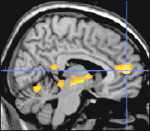
Raz et al. Hypnotic suggestion reduces conflict in the human brain, Proceedings of the National Academy of Sciences 2005;
Abstract: Many studies have suggested that conflict monitoring involves the anterior cingulate cortex (ACC). We previously showed that a specific hypnotic suggestion reduces involuntary conflict and alters information processing in highly hypnotizable individuals. Hypothesizing that such conflict reduction would be associated with decreased ACC activation, we combined neuroimaging methods to provide high temporal and spatial resolution and studied highly and less-hypnotizable participants both with and without a suggestion to interpret visual words as nonsense strings. Functional MRI data revealed that under posthypnotic suggestion, both ACC and visual areas presented reduced activity in highly hypnotizable persons compared with either no-suggestion or less-hypnotizable controls. Scalp electrode recordings in highly hypnotizable subjects also showed reductions in posterior activation under suggestion, indicating visual system alterations. Our findings illuminate how suggestion affects cognitive control by modulating activity in specific brain areas, including early visual modules, and provide a more scientific account relating the neural effects of suggestion to placebo.
16:00 Posted in Meditation & brain | Permalink | Comments (0) | Tags: Positive Technology, meditation
The Health e-Technologies Initiative
The Health e-Technologies Initiative is a $10.3-million National Program Office of The Robert Wood Johnson Foundation. The program of funded research aims to advance the discovery of scientific knowledge regarding the effectiveness of interactive applications (i.e., Internet, interactive TV and voice response systems, kiosks, personal digital assistants, CD-ROMs, DVDs) for health behavior change and chronic disease management.

Link to the initiative
15:22 Posted in Research institutions & funding opportunities | Permalink | Comments (0) | Tags: Positive Technology