




Oct 14, 2005
Feel like an expert surgeon
 Trauma Center: Under the Knife puts the gamer in the role of a surgeon fighting a deadly epidemic. Funny, but as noted by Wired's reporter Chris Kohler, the
 19:40 Posted in Cyberart | Permalink | Comments (0) | Tags: Positive Technology
3rd European Conference on Positive Psychology
From Monday July 3rd to Thursday July 6th, 2006, University of Minho (Portugal) will host the 3rd European Conference on Positive Psychology. In this new century, Positive Psychology has become one of the major approaches to the study of individual behaviour and social processes. In this innovative and promising scientific field, a growing number of theoretical, empirical and applied projects are investigating positive psychological issues such as the subjective well-being, creativity, leisure, personal strengths and resources, and their implications on individual, social and community development. This Third European Conference on Positive Psychology provides an opportunity to discuss and develop new theoretical and empirical perspectives, to foster networking among scholars, and to explore new applications of Positive Psychology.
For more information visit the conference's web site
19:18 Posted in Positive Technology events | Permalink | Comments (0) | Tags: Positive Technology
Oct 13, 2005
Free Survey - Human Movement Tracking and Stroke Rehab
This free-downloadable report by Huiyu Zhou and Huosheng Hu from Essex University (UK) reviews recent progress in human movement tracking systems in general, and stroke rehabilitation in particular.
It is a wonderful resource for all researchers interested in technology-enhanced rehabilitation after stroke
17:20 Posted in Cybertherapy | Permalink | Comments (0) | Tags: Positive Technology, virtual reality, cybertherapy
Pervasive Health Conference
Pervasive Healthcare Conference 2006 will be held in Innsbruck, Austria (dates to be defined). Pervasive Healthcare is emerging both as a solution to many existing healthcare problems such as significant number of medical errors, considerable stress on healthcare providers, and partial coverage of healthcare services in rural and underserved areas worldwide, and as an opportunity to provide better healthcare services to an increasing number of people using limited financial and human resources.  Pervasive healthcare can be defined as healthcare to anyone, anytime, and anywhere by removing locational, time and other restraints while increasing both the coverage and quality of healthcare.
Conference topics include, but are not limited to: technologies situated "on the patient", technologies situated "in the environment", medical aspects of pervasive healthcare, and management of pervasive healthcare.
For more information visit the conference website
 Tags: pervasive healthcare
11:50 Posted in Pervasive computing | Permalink | Comments (0) | Tags: Positive Technology, Ambient intelligence
Intetain 2005 Conference
11:41 Posted in Positive Technology events | Permalink | Comments (0) | Tags: Positive Technology
Oct 12, 2005
Sensory threads
Sensory Threads aims to stimulate and inform a public debate on how personal biosensor data is collected and used in biomedical science. It will combine an artistic with an evidence-based approach, building and testing a prototype body biosensor network that uploads data to Urban Tapestries.
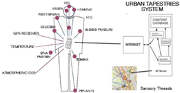
This will allow participants to map experiential and emotional annotations to their readings – adding a whole new layer of sentient knowledge to machine data. It is intended to demystify how data is collected, what it produces and how we can correlate it to other factors affecting health such as environmental pollution.
Principal Investigators: Giles Lane (Proboscis) & George Roussos (Birkbeck)
Team: Alice Angus, Orlagh Woods, Sarah Thelwall, George Papamarkos, Dikaios Papadogkonas
Partners: Proboscis, Birkbeck College Computer Science Dept.
15:25 Posted in Cyberart | Permalink | Comments (0) | Tags: Positive Technology
Dimensionality explores new dimensions of space
Dimensionality takes assumptions of perspective is coming to an end, or mutating under new environmental pressures—video games, computer animation, 3-D computer models as its generative trope. Curator, Andy Patton has assembled a group of artists whose specific practices address the new spaces of digital realities. The works in the exhibition are often diagrammatic and stripped of worldly detail.  They declare an involvement with information instead of sensuous phenomena. The participating artists don’t produce the sort of naturalist space we've seen for the last few centuries, rather, their space is structured like that of video games—a space that’s only convincing if it streams rapidly by, before its too-generalized surfaces can be inspected. deep and convincing, as though you could walk into it. As Patton states, "Star Trek was wrong: space is the initial frontier"
Featuring: Sheila Ayearst, Robert Fones, Morna Gamblin, Nestor Kruger, Angela Leach, Kristen Peterson, David Reed
Starts: Sep 10, 2005 Ends: Oct 22, 2005
At: YYZ Artists' Outlet, 401 Richmond Street West, Suite 140, Toronto
Times: 11:00 AM - 5:00 PM
Cost: Free
15:10 Posted in Cyberart | Permalink | Comments (0) | Tags: Positive Technology
Oct 11, 2005
The neural basis of human moral cognition
An interesting review article* on the neural basis of moral cognition has been published on October 2005 issue of Nature Reviews Neuroscience by Jorge Moll, Roland Zahn, Ricardo de Oliveira-Souza, Frank Krueger and Jordan Grafman.

17:40 Posted in Telepresence & virtual presence | Permalink | Comments (0) | Tags: Positive Technology, social cognitive neuroscience
The Whole Brain Atlas
The Whole Brain Atlas has been awarded the Scientific American Science and Technology Web Awards 2005
The site is an information resource for central nervous system imaging which integrates clinical information with magnetic resonance (MR), x-ray computed tomography (CT), and nuclear medicine images.  The site presents high-resolution images of various types of strokes, tumors, degenerative disorders and infectious diseases as they affect the brain over time.
Another award has gone to Mind Hacks, a blog that reports on the latest developments in neuroscience, taking a fun approach to dissemination.
17:25 Posted in Research tools | Permalink | Comments (0) | Tags: Positive Technology, research tools
Games for Health Conference
The Washington Post reports about the second annual Games for Health Conference, at University of Maryland School of Medicine in Baltimore:
 But some physicians, psychiatrists and public health experts see a more positive side: They're betting electronic games can be adapted as tools to ease medical treatments, improve patient outcomes and boost fitness and knowledge for users young and old. Government agencies including the National Institute on Drug Abuse, the Office of Naval Research and other branches of the Department of Defense are placing bets of their own, funding the development of health-related video games. Some of those projects and others were on display recently at the second annual Games for Health conference at the University of Maryland School of Medicine in Baltimore. Between lectures, participants crowded into two windowless rooms for a first-hand look. In one, they could test themselves on the Kilowatt, an isometric exercise device in which players use body strength to interact with scenes on a video screen - for instance, muscling a car around a race track. In another room, attendees donned a virtual-reality helmet for a simulated plunge into FreeDive, a fantasy underwater world meant to distract pediatric patients from pain or anxiety.
More to explore
17:12 Posted in Positive Technology events | Permalink | Comments (0) | Tags: Positive Technology