



Jun 29, 2005
Bionic Arm Technology is advancing
From Medgadget
Mr. Jesse Sullivan is the world's first "Bionic Man", according to the Rehabilitation Institute of Chicago (RIC). In May 2001, Mr. Sullivan lost both of his upper extremities as a result of an accident. The technology that allows this patient to control his artificial arms has been developed by RIC's Neural Engineering Center for Artificial Limbs (NECAL).
Developed within the Neural Engineering Center for Artificial Limbs (NECAL) at RIC, Dr. Todd Kuiken, MD, PhD, pioneered the muscle reinnervation procedure which takes an amputee's own nerves and connects them to a healthy muscle. In this case, four of Mr. Sullivan's nerves were dissected from the shoulder and transferred to the muscles of his chest. Doing so allows the user to move his or her prosthetic arm as if it were a real limb--by simply thinking about what they want the arm to do. The "Bionic Arm," or myoelectric arm, is driven using electrical signals from the muscles of the chest, now activated by the user's own thought-generated nerve impulses. These impulses are sensed, via surface electrodes, from the pectoral muscle and carried through to the mechanical arm, causing the arm to move.
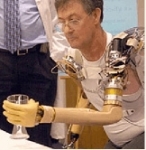
NECAL uses nerve-muscle grafts in amputees to gain added control signals for an artificial arm. Doctors take nerves that used to go to the arm and move those nerves onto chest muscles. The nerves grow into the chest muscles, so when the patient thinks "close hand," a portion of his chest muscle contracts and electrodes that detect this muscle activity tell the computerized arm when to close the hand. Thus, the patient thinks "close hand" and his artificial hand closes...
Researchers at RIC have learned that although the limb is lost with an amputation, the control signals to that limb remain accessible in the residual peripheral nerves. Grafting the residual nerves of an upper-limb amputee to spare muscles produces additional control signals, allowing for simultaneous operation of multiple functions in an externally powered prosthesis with a more natural feel than is possible with conventional prostheses.
The "Bionic Arm" technology has been very successful so far in both significantly improving the function of artificial limbs as well as allowing the skin to be reinnervated with nerves form the arm. The first patient to undergo the new procedure, Jesse Sullivan, has experienced significant improvements in the functioning of his prosthetic arms. While previously moving his artificial arms was slow and cumbersome, today he is able to do many of the routine tasks he took for granted before his accident, including putting on socks, shaving, eating dinner, taking out the garbage, carrying groceries and vacuuming.
18:35 Posted in Brain-computer interface | Permalink | Comments (0) | Tags: brain-computer interface
Jun 27, 2005
Tennis for the visually impaired
From Near near future
Tennis Sensation is a tennis game that allows a wide variety of users, particularly the visually impaired, to compete fairly.
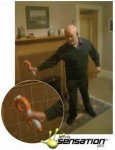
It uses spatial (3D) audio, to represent sounds at locations in space, enabling the user to locate the virtual ball. The handle of the "racquet" shows correct orientation and grip through contours and materials.
Skill and physical ability can be altered to allow use by the elderly and disabled. A handicapping level selection enables a grandparent to play with their grandchild. The game can be played by people in different locations. When gripped from the charger the product turns on and connects to the headphones automatically. It can connect through an internet connection or use the 3G phone network. Menus are navigated by tilting and options selected by squeezing the grip. Vibropads in the grip give the subtle vibrations associated with good and bad tennis shots, and haptics give the feel of a ball on the racquet at virtual impact. Banks of LEDs explode on impact, with colour representing the quality of the shot. A dedicated synthesiser generates the stereo sound and audio cues, and a Motorola RISC microprocessor performs the calculations.
13:15 Posted in Brain training & cognitive enhancement | Permalink | Comments (0) | Tags: Positive Technology, Cognitive prosthetics