




Mar 31, 2005
Biofeedback - improve health using signals from your own body
Biofeedback is a treatment technique in which people are trained to improve their health
by using signals from their own bodies. Physical therapists use biofeedback to help stroke
victims regain movement in paralyzed muscles. Psychologists use it to help tense and
anxious clients learn to relax. Specialists in many different fields use biofeedback to help
their patients cope with pain.
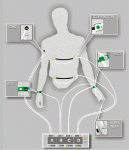 Research has demonstrated that biofeedback can help in the treatment of many diseases and painful conditions. It has shown that we have more control over so-called involuntary bodily function than we once though possible. But it has also shown that nature limits the extent of such control. Scientists are now trying to determine just how much voluntary control we can exert.
Clinical biofeedback techniques that grew out of the early laboratory procedures are now
widely used to treat an ever-lengthening list of conditions. These include:
·Migraine headaches, tension headaches, and many other types of pain
·Disorders of the digestive system
·High blood pressure and its opposite, low blood pressure
·Cardiac arrhythmias (abnormalities, sometimes dangerous, in the rhythm of the heartbeat)
·Raynaud's disease (a circulatory disorder that causes uncomfortably cold hands)
·Epilepsy
·Paralysis and other movement disorders
Low-cost biofeedback devices and products
ProComp Infiniti
Powerful 8 channel encoder provides real-time biofeedback and data acquisition in any clinical setting.

The Journey to Wild Divine
Learn to relax while playing this immersive new biofeedback videogame. Take a deep breath...

RESPeRATE
RESPeRATE is the only FDA-cleared, non-drug, medical device clinically proven to lower high blood pressure with no side effects.

Freeze-Framer
You'll appreciate all you can learn about the power of your heart. It's also just plain fun to play the games while you learn.

Mini C2+
This tiny 6 channel unit is an affordable, powerful multi-modality biofeedback system.

More to explore
Biofeedback Foundation of Europe
The Association for Applied Psychophysiology and Biofeedback
Society for the Study of Neuronal Regulation
The Biofeedback Certification Institute of America
13:35 Posted in Biofeedback & neurofeedback | Permalink | Comments (0) | Tags: Positive Technology, Biofeedback
Mar 29, 2005
Captology: The science of Persuasive Technology
Can computers change what you think and do? Can they motivate you to stop smoking, persuade you to buy insurance, or convince you to join the Army?
The Stanford Persuasive Technology Lab, founded by BJ Fogg, an experimental psychologist, is trying to answer these questions. The lab creates insight into how computing products -- from websites to mobile phone software -- can be designed to change what people believe and what they do.
Like human persuaders, persuasive interactive technologies can bring about positive changes in many domains, including health, business, safety, and education. With such ends in mind, we are creating a body of expertise in the design, theory, and analysis of persuasive technologies, an area called "captology."
This is how Fogg describes the key concepts of his vision:
"Captology is the study of computers as persuasive technologies. This includes the design, research, and analysis of interactive computing products created for the purpose of changing people's attitudes or behaviors. As the graphic shows, captology describes the area where computing technology and persuasion overlap.
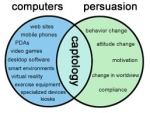
In the last few years we've seen this area grow quickly. Each week more computing products are designed to change what users think and do. We expect this trend to continue, especially as mobile phones become more capable of running third-party software applications.

We've identified over 100 uses for persuasive technology. Hundreds of other uses exist. Whenever there is a need to change what people believe or how they behave, persuasive technology may very well play a role"
More to explore
The web site of the Lab: http://captology.stanford.edu/
Fogg's book "Persuasive Technology"
18:15 Posted in Pervasive computing | Permalink | Comments (0) | Tags: Positive Technology, Ambient intelligence