



Mar 24, 2005
Animator Makes Waves as Artist
From WIRED
by Rachel Metz
NEW YORK -- If beauty is in the eye of the beholder, oversized heads, alarmingly cherry-red lips, blotchy skin and sharp scroll-like claws are en vogue, at least in the digital world of artist Ray Caesar.
Caesar, a Toronto-based former animator and graphic artist for a children's hospital, is making waves in the world of pop art with his haunting, surreal digital prints, all produced just 18 months after he decided to pursue art full time. His works combine varied aspects of his life experiences, including the sorrow and inspiration brought by deaths of loved ones, and his years spent viewing photos of and working with abused, neglected and deformed children. His prints also benefit from Caesar's expertise with animation software and his exposure to animal research.

The prints are both grotesque and beautiful. As Caesar explains it, it's like facing something unpleasant with calm and looking beyond what you're viewing to see the beauty within.
Exhibits of Caesar's work are as real as it gets, because his art is created and manipulated digitally on his Dell 8300 computer and then printed on his massive, wide-format Epson 7600 printer. The "original" exists only on Caesar's hard drive and can be repositioned and changed at his whim. He uses the animation program Maya to compose his pieces.

A selection of Caesar's works were presented Saturday March 19, at the evening opening of his latest show, Hidden Doors and Secret Rooms, at the Jonathan LeVine Gallery in New York City's Chelsea neighborhood.
The show, which runs through April 18, had an impressive opening for an artist so new to his field. Throngs of curious visitors milled around, chatting and viewing pieces showcasing Caesar's signature haunted style.
To craft his prints, Caesar makes a digital doll model with an invisible inner skeleton. He can then pose the dolls or refine parts of their skeletons.
He embellishes the blank models with clothing he builds in Maya. At home in Toronto, Caesar visits a textile warehouse where he borrows swatches or buys yards of fabrics that strike his fancy. He then photographs the cloth and manipulates it in Photoshop.
Similarly, Caesar collects skin images he shoots with a digital camera and then maneuvers them in Photoshop before applying the images as a model's epidermis.
Furniture designs are inspired by things like antiques, Richie Rich comics, and items that surrounded him in his childhood homes, first in England and later in Canada, he said.
Because of the way his pieces come together, "I kind of feel like I'm doing reverse animation," Caesar said, later explaining, "There's so much movement, and yet in I'm ending up with a still image."
Besides movement, Caesar is a fan of digital recycling -- anything he can reuse, he does, he said, like elements of an image of an airplane, sewing machine or distant building. He's also big on detail, as is evident in intricate tattoos, tiny table-top knickknacks and seemingly 3-D textures of subjects' dresses.
READ FULL ARTICLE
About the artist
Information about Ray Caesar can be found on the artist's official web site
12:50 Posted in Cyberart | Permalink | Comments (0)
Mar 23, 2005
Wearable kinesthetic system for capturing upper limb movements
Tognetti and his collaborators at The Interdepartmental Research Center "E. Piaggio", University of Pisa, have recently developed a wearable kinesthetic system for capturing upper limb movements in post-stroke rehabilitation. In this system (see picture below), a lycra shirt has been equipped with a sensing apparatus. Sensors have been spread on the fabric by employing an electrically conductive elastomer.
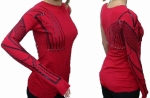
This material does not change the mechanical characteristics of the fabric preserving the wearability and it confers to the fabric piezoresistive properties related to mechanical solicitations.
Read the full article recently published on the Journal of Neuroengineering and Rehabilitation
11:30 Posted in Wearable & mobile | Permalink | Comments (0) | Tags: Positive Technology, wearable
Considerate computing
Ambient Intelligence will radically change how people interact with technology. In AmI, people will be surrounded by a multitude of interconnected embedded systems. These devices will be able to locate and recognize objects and people, as well as people’s intentions.
Following this view, AmI researchers are beginning to design computing devices that adapt the volume and timing of their communications to the cognitive needs of user. Such systems with a deep understanding of user attention have been referred to as Attentive User Interfaces

In AmI spaces these systems will proactively undertake speculative or anticipatory actions to hide the overall system complexity, by delivering to the users only information which is rich with meanings and contexts and provide stable functionality whenever requested
This article by Wayt Gibbs, recently published on Scientific American, show how engineers are testing computers, phones and cars that sense when you are busy and spare you from distractions...
More to explore
Attentive User Interfaces. Special section. Edited by Roel Vertegaal in Communications of the ACM, Vol. 46, No. 3, pages 30–72; March 2003.
Learning and Reasoning about Interruption. Eric Horvitz and Johnson Apacible. Proceedings of the Fifth International Conference on Multimodal Interfaces, November 2003. Proceedings of the International Workshop on Progress and Future Directions of Adaptive Driver Assistance Research. Washington, D.C., May 2004. Available online at www.volpe.dot.gov/opsad/saveit/
A variety of relevant technical articles are available online at http://interruptions.net
11:15 Posted in Pervasive computing | Permalink | Comments (0) | Tags: Positive Technology, Ambient intelligence
VR for PTSD rehabilitation in Israel
From Israel21c, "A focus beyond conflict"
Watching it - in three dimensions and full sound while wearing a head-mounted display helmet -may help hundreds of Israelis who have witnessed real terror attacks overcome post-traumatic stress disorder (PTSD), and is the basis of a new therapy for treating particularly resistant cases of PTSD.

The treatment is just one of dozens of novel applications of virtual reality (VR) technology which were demonstrated recently at the University of Haifa during the Third VR Symposium. Weiss, the person who brought together many of the world's leading VR wizards - and who is herself involved in several cutting edge VR applications, is a strictly observant Israeli who lives in the ultra-Orthodox neighborhood of B'nai Brak.
"It's not exactly normal," admits Weiss to ISRAEL21c, laughing at the contrast between her traditional way of life and the 'Brave New World' that characterizes her professional pursuits.
But Weiss sees no contradiction between the two. "I have always been interested in different technologies and my goal has always been to help people," says the researcher, whose library has volumes of Psalms and kinesiology textbooks side by side.
An occupational therapist by training, Weiss grew up in Canada and taught at McGill University in Montreal for many years, before immigrating to Israel in 1991 with her Israel-born husband. For the last four years she has been a researcher and lecturer at the University of Haifa, and a member of its newly-established Laboratory for Innovations in Rehabilitation Technology.
Weiss's interest in VR was piqued when she read an article by one of the pioneers in the field, Prof. Albert 'Skip' Rizzo of the University of Southern California, nearly a decade ago. That ultimately led to a close collaboration with Rizzo, who also attended this month's symposium.
What interests her about the field? "Look at this," says Weiss, showing a videotape of a woman with a spinal cord injury doing traditional physiotherapy. The therapist hands her a plastic ring which she must grasp without losing her balance - then another ring, and another, and another. "Let's face it. It's very static and very boring."
Now she shows a videotape of another patient who is also learning to balance himself - only he is watching himself on a giant screen, against a breath-taking mountain backdrop, swatting at balls in the sky. Every ball he hits turns into a colourful bird. The scene is virtual, but the man's movements - he is leaping and swatting with increasing determination - are very real.
"It's interesting and motivating," explains Weiss. "I have yet to meet a patient - of any age - who didn't like it. So it's very effective." (In a newer version, she notes excitedly, patients will wear a glove which vibrates whenever they make contact with a virtual ball - further increasing the sense of realness.)
The symposium Weiss organized, which brought leading VR experts from the US, Canada, Europe, Japan and Israel, to Haifa showed the dizzying range of new VR technologies dedicated to health and rehabilitation - from a robotic dog, who can be a reliable companion for the elderly - "no need to feed him or take him for walks," noted the researcher who demonstrated the small, black, yelping Sony invention - to 3D interactive games that could some day be used for early diagnoses of Alzheimer's disease, treatment of attention deficit disorder, and rehabilitation of patients who have suffered central nervous system injuries.
"Virtual reality has completely revolutionized the field of occupational therapy," says Weiss, who is personally involved in several innovative VR projects, including the simulated bus bombing program designed to treat Israelis suffering from severe post-traumatic stress.
That program - developed together with Dr. Naomi Josman, Prof.Eli Somer and Ayelet Reisberg, all of the University of Haifa, as well as with American researchers - is designed to expose patients in a controlled manner to the traumatic incident which they are often unable to remember, but which has a powerful and debilitating effect on their lives.
The realistic rendering of the bus bombing triggers the patient's memories - the first vital step on the path to overcoming trauma. (The simulation does not include all the gruesome details of the attack, but rather just enough to help the patient recall what happened.)
It was Josman who first came up with the idea of using such a treatment in Israel. She was attending a conference in the United States when she saw how University of Washington Prof. Hunter Hoffman had applied VR to successfully treat Americans suffering from PTSD following the 9/11 attack on the Twin Towers.
Similar programs have also been used recently to help American veterans traumatized by their tour of duty in Iraq, and even Vietnam veterans for whom no other treatment has proven effective.
Through close collaboration with Hoffman, the U. of Haifa team developed an Israeli version of the program which is now being used to treat the first few patients.
"If our pilot study is effective, we will launch a full-scale clinical trial," says Weiss, "and hopefully we will be able to provide a solution for those PTSD patients who have been resistant to more traditional cognitive therapy."
In another application of VR technology, Weiss and U. of Haifa colleagues have developed a program to help stroke victims relearn the basic skills required to shop on their own. The patient composes a grocery list and makes his or her way through a 'virtual supermarket,' seeking the right products, pulling them off the shelves and into a shopping cart, while announcements of sales are broadcast on the loudspeaker system.
"It's the first such program designed to improve both cognitive and motor skills of stroke victims," she notes.
Last week, the American Occupational Therapy Foundation (AOTF) invited Weiss to join its Academy of Research, the highest scholarly honor that the AOTF confers.
"Your work clearly helps to move the profession ahead, and demonstrates powerful evidence of the importance of assistive technology in helping persons with disabilities participate in the occupations of their choice, while improving the quality of their lives," the AOTF wrote in its letter to Weiss.
For Weiss, virtual reality is not only the focus of research, but a way of life - at least in her work. She communicates with her colleagues around the world by tele-conference and, of course, email - and notes that she has never even met her close collaborator Hoffman even though they have been
communicating several times a week for years. She also taught an entire university course last semester - without ever attending a lecture hall. Instead, she sat in the comfort of her B'nai Brak home, wearing a headset and microphone to deliver a weekly videoconferenced lesson on assistance technology to students who sat in their own homes.
"They could see a video of me, and whenever a student wanted to speak I would see the icon of a hand being raised. We even had guest lecturers from abroad. The students really appreciated not having to come to the university late at night for the course," says Weiss, who was pleased to be able to - once again - harness technology to help make people's lives a little easier.
10:30 Posted in Cybertherapy | Permalink | Comments (0) | Tags: Positive Technology, virtual reality, cybertherapy
Mar 22, 2005
Virtual reality games alleviate pain in children
From BioMed Central
Immersion in a virtual world of monsters and aliens helps children feel less pain during the treatment of severe injuries such as burns, according to a preliminary study by Karen Grimmer and colleagues from the Women's and Children's Hospital in Adelaide, Australia.
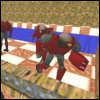
A virtual reality game is a computer game especially designed to completely immerse the user in a simulated environment. Unlike other computer games, the game is played wearing a special headset with two small computer screens and a special sensor, which allows the player to interact with the game and feel a part of its almost dreamlike world. "Owing to its ability to allow the user to immerse and interact with the artificial environment that he/she can visualize, the game-playing experience is engrossing", explain the authors.
Children with severe burns suffer great pain and emotional trauma, especially during the cleaning and dressing of their wounds. They are usually given strong painkiller drugs, muscle relaxants or sedatives, but these are often not enough to completely alleviate pain and anxiety. These medications also have side effects such as drowsiness, nausea or lack of energy.
Grimmer and colleagues asked seven children, aged five to eighteen, to play a virtual reality game while their dressing was being changed. The children were also given the usual amount of painkillers. The researchers assessed the pain the children felt when they were playing and then compared it to the amount of pain felt when painkillers were used alone.
To measure the intensity of the pain, the team used the Faces Scale, which attributes a score from 0 to 10, wherein 10 represents maximum pain, to a facial manifestation of pain. For younger children they used 5 different faces representing no pain to very bad pain. The researchers also interviewed the nurses and parents present during the dressing change.
The average pain score when the children received painkillers alone was 4.1/10. It decreased to 1.3/10 when the children had played a game and been given painkillers. Because the sample size was so small the researchers analysed their results per child, and they found that all but one child lost at least 2 points on the scale when they were playing the game. The parents and nurses confirmed these results and said that the children clearly showed less signs of pain when they played the game.
"We found that virtual reality coupled with analgesics was significantly more effective in reducing pain responses in children than analgesic only" conclude the authors.
This is only a preliminary study, but the researchers are hopeful. They propose to test virtual reality on more subjects, possibly with games appropriate to each age group, in the hope that it could one day greatly reduce, if not completely replace, the use of painkillers.
This press release is based on the article:
The efficacy of playing a virtual reality game in modulating pain for children with acute burn injuries: A single blinded randomized controlled trial Debashish Das, Karen Grimmer, Tony Sparnon, Sarah McRae, Bruce Thomas BMC Pediatrics 2005 4:27 (3 March 2005)
19:30 Posted in Cybertherapy | Permalink | Comments (0) | Tags: virtual reality, cybertherapy