




Nov 08, 2005
Regional brain activation evoked when approaching a virtual human on a virtual walk
Authors: Morris JP, Pelphrey KA, McCarthy G
Abstract. We investigated the necessity of biological motion for activation of the posterior superior temporal sulcus (pSTS) in circumstances in which the rapid approach of the observer to a virtual human induced the observer to make inferences about the characters intentions. Using a virtual reality environment, subjects experienced themselves walking towards a complex scene composed of animate and/or inanimate objects. During "person" trials, the scene contained a virtual human either making a simple gesture such as scratching his face (Study 1) or standing completely still (Study 2). During "object" trials, the scenes contained items such as furniture, a face portrait, and a clock, but not the virtual human. Using functional MRI to measure brain activity, we demonstrated strong activity in the pSTS while the observer approached the social scene, but only when the virtual human was making gestures. This result emphasizes the importance of biological motion in inferring the intentions of others.
17:25 Posted in Virtual worlds | Permalink | Comments (0) | Tags: Positive Technology, virtual reality
Sending and receiving emotions
eMoto is a mobile messaging service for sending and receiving affective messages. The application extends on both the input and output channels when sending text messages between mobile phones. 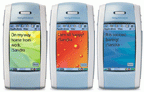 The aim is to convey more of the emotional content through the very narrow channel that a text message otherwise provides. Emotional communication between people meeting physically in the "real world" make use of many different channels, such as facial expression, body posture, gestures, or tone of voice, little of this physicality of emotions is used in a similar digital context. In eMoto users therefore use affective gestures to convey the emotional content of their messages which are then translated and communicated in colors, shapes and animations.
17:20 Posted in Telepresence & virtual presence | Permalink | Comments (0) | Tags: Positive Technology, social presence
Promising results from internet-based self-help for depression
A study recently published by Andersson and co-workers in British Journal of Psychiatry has found that psychological treatment for depression, delivered over the internet, is reliable and effective. 
117 people with mild to moderate depression who met a number of inclusion criteria were included in this randomised controlled trial. The majority came from smaller cities, villages and places outside the larger cities (where university clinics are usually based). 36 participants in the treatment group and 49 in the control group completed post-treatment measures. In total the rate of withdrawal from the programme was 27%. The main reason given was that the treatment was too demanding. Thus the rates of withdrawal differed between the treatment group (37%) and the control group (18%).
It was found that the active treatment, which included standard cognitive-behavioural approaches and behavioural changes, resulted in decreased depressive symptoms immediately after treatment and at the six-month follow-up. There were also benefits in terms of anxiety symptoms and quality of life.
Reference
Andersson G, Bergstrom J, Hollandare F, Carlbring P, Kaldo V and Ekselius L (2005) Internet based self-help for depression: randomised controlled trial, British Journal of Psychiatry, 187, 456-461.
17:15 Posted in Cybertherapy | Permalink | Comments (0) | Tags: Positive Technology, virtual reality, cybertherapy