



Nov 03, 2005
Using RFID tags to capture human behavior patterns
Via Smart Mobs
At WPC EXPO 2005, Tagged World Project has presented a system that captures human behavior patterns using RFID tags, stores them in an XML format, and uses the data for predicting users' future behavior patterns. The system then provides services proactively.
A scenario: everything in your room is RFID-tagged and you have a mobile RFID reader. If you forget to lock the door, the system alarts you (If you don't touch your room key before leaving the room, the system can detect it).
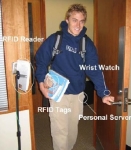
A similar approach has been recently proposed by Gaetano Borriello and co-workers at University of Washington. They have built a prototype of a smartwatch that works using RFID tags to help people keep track of their stuff. Here is a picture of a user walking through a doorway with several tagged objects. An RFID reader is visible on the left (white box on black stand); tags are visible on the notebooks in his hand; his personal server is in his front left pants pocket; and, our wristwatch UI is on his left wrist." Here is the link to the full paper
23:05 Posted in Brain training & cognitive enhancement | Permalink | Comments (0) | Tags: Positive Technology, Cognitive prosthetics
My favourite poet brought back to life
via BBC news
My favourite poet Dylan Thomas is being brought back to life in the form of a computer-generated 3D moving image by art student Bernard Mitchell. The image was created from his death mask. 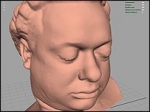 To re-create Thomas face, the death mask of the poet was first skanned at the hospital's maxillofacial department. Next, the scans were used Swansea-based 3D animators iCreate to apply a virtual skin around the structure.
For those who would like to have more info, visit the project's web site
22:30 Posted in Cyberart | Permalink | Comments (0) | Tags: Positive Technology
New asynchronous brain computer interface
Via Smart Mobs
An asynchronous brain computer interface is under development at Oxford University, with the collaboration of Southampton and Essex universities. The system should allow a more effective way of controlling robotic arms and wheelchairs, as opposed to the less natural on/off mode of existing synchronous BCI technology. But the real novelty of this BCI apparatus is that it will use only one electrode.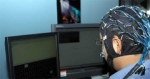
The two-year project has been funded £180,000 by the EPSRC. According to project's leader Prof. Stephen Roberts (Oxford University), the new BCI system could improve the quality of life of severely disabled, but potential applications of this technology range from the gaming and entertainment industries to the automotive sector.
Read full article on the Engineer Online
More to explore
This page offers some introductory links to sources of information on the Web about the BCI
A list of BCI research lab
22:15 Posted in Brain-computer interface | Permalink | Comments (0) | Tags: Positive Technology, brain-computer interface
Benefits of activity and virtual reality based balance exercise programmes for adults with traumatic brain injury: Perceptions of participants and their caregivers
Brain Inj. 2005 Nov;19(12):989-1000
Authors: Thornton M, Marshall S, McComas J, Finestone H, McCormick A, Sveistrup H
21:45 Posted in Cybertherapy | Permalink | Comments (0) | Tags: Positive Technology, virtual reality, cybertherapy
Mirror therapy for alleviating chronic pain
via Medgadget
McCabe and co-workers from the University of Bath and the Royal National Hospital for Rheumatic Diseases (RNHRD)have published in the journal Clinical Medicine the results of a study, which has investigated the use of mirror as a therapeutic mean to alleviate pain. The treatment consists in asking patients patients suffering from complex regional pain syndrome to carry out routine exercises in front of a mirror.
Results showed that more than half experienced pain relief during and after the exercise and further investigations indicated that even greater improvements can be achieved if the tasks are practiced beforehand.
McCabe explain these findings with the ‘cortical’ model of pain. According to this theory, the brain’s image of the body can become faulty, resulting in a mismatch between the brain’s movement control systems and its sensory systems, causing a person to experience pain when they move a particular hand, foot or limb.
Mirror therapy has proven effective also in the treatment of post-stroke hemiplegia as well as in the rehabilitation of "phantom limb" and visual hemineglect.
More to explore
Sathian K, Greenspan AI, Wolf SL. Doing it with mirrors: a case study of a novel approach to neurorehabilitation.
Neurorehabil Neural Repair. 2000;14(1):73-6.
| Ramachandran VS, Altschuler EL, Stone L, Al-Aboudi M, Schwartz E, Siva N. |
Can mirrors alleviate visual hemineglect? Med Hypotheses. 1999 Apr;52(4):303-5.
Altschuler EL, Wisdom SB, Stone L, Foster C, Galasko D, Llewellyn DM, Ramachandran VS.
Rehabilitation of hemiparesis after stroke with a mirror. Lancet. 1999 Jun 12;353(9169):2035-6.
00:45 Posted in Mental practice & mental simulation | Permalink | Comments (0) | Tags: Positive Technology, mental practice, motor imagery