




Sep 12, 2005
Social Networks as Health Feedback Displays
In this paper published on September/October issue of IEEE Pervasive Computing Journal Margaret E. Morris describes how social-networking and pervasive computing technologies can be used to help reduce feelings of social isolation and depression in elderly individuals. 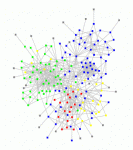 In this approach, sensor data measuring phone calls and visits are used to derive public displays of social interactions with relatives and friends, which they introduced into select elders’ homes. According to Morris and colleagues, as people see their social interactions illustrated in these feedback displays, their feeling of social isolation is reduced.
Margaret E. Morris. "Social Networks as Health Feedback Displays," IEEE Pervasive Computing Journal, vol. 9, no. 5, pp. 29-37, September/October 2005.
Abstract
Social networks have thus far served primarily as analytic tools for social scientists. Leveraging pervasive computing, this new research transforms social-network models into behavioral feedback displays. These ambient displays, which reflect data on remote and face-to-face interaction gathered by wireless sensor networks, were intended to raise awareness of social connectedness as a dynamic and controllable aspect of well-being. An interdisciplinary health technology research group at Intel recently developed and tested prototypes in the homes of older adults and their caregivers. This article reviews the psychological rationale for the project and highlights some reactions of participants to the displays.
15:20 Posted in Information visualization | Permalink | Comments (0) | Tags: Positive Technology, complex networks
Virtual goggles can help alleviate patients' anxiety during dental procedures
Via Wired
Dentists are starting to use eyeglass systems for easing patients' anxiety and pain during dental procedures. Introducing a distraction has long been known to help reduce pain for some people during surgical operations.  Because virtual reality is a uniquely effective new form of distraction, it makes an ideal candidate for pain control.
More to explore
Virtual reality in pain therapy
15:15 Posted in Cybertherapy | Permalink | Comments (0) | Tags: Positive Technology, virtual reality