




Aug 03, 2005
Downloading video from the brain
Using cats selected for their sharp vision, in 1999 Garret Stanley and his team recorded signals from a total of 177 cells in the lateral geniculate nucleus - a part of the brain's thalamus (the thalamus integrates all of the brains sensory input and forms the base of the seven-layered thalamocortical loop with the six layered neocortex) - as they played 16 second digitized (64 by 64 pixels) movies of indoor and outdoor scenes.
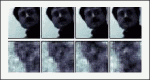 Using simple mathematical filters, Dr. Stanley and his colleagues decoded the signals to generate movies of what the cats actually saw. This finding has enormous implications in the fields of neurorehabilitation and neural repair. For example, it could allow to wire artificial limbs directly into the brain, or to develop artificial brain extensions.
More to explore
Garrett B. Stanley, Fei F. Li, and Yang Dan, Reconstruction of Natural Scenes from Ensemble Responses in the Lateral Geniculate Nucleus. Journal of Neuroscience, 1999; 19: 8036 - 8042 Link to the full-text PDF
20:10 Posted in Brain-computer interface | Permalink | Comments (0) | Tags: Positive Technology, brain-computer interface
You can walk and there is no limit
Via the Presence-L Listserv
(From The Seattle Times)
Christina Siderius, Monday, July 25, 2005
Walk in cyberspace: With virtual-reality software, users feel like they're moving even if they're actually sitting on the couch. VirtuSphere wanted to create a device that would allow the user to move limitlessly while using such software — without bumping into walls or falling over. The solution: VirtuSphere, founded in November, created a giant hollow ball that works like a spinning hamster wheel.
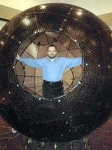 Wearing a head-mounted display, a user can step inside the 8.5-foot-tall sphere and experience physical movements while the mind is in cyberspace. "The purpose is to enable natural motion," said Palladin. "You can walk and there is no limit."
How it works: As the user moves, the ball rolls, sending coordinates to a computer. The computer evaluates the information and relays it back to the user's display in the form of a changed view. The sphere, which costs between $50,000 and $100,000, can be made compatible with any computer-based simulations.. READ THE FULL ARTICLE
19:20 Posted in Cybertherapy | Permalink | Comments (0) | Tags: Positive Technology, virtual reality
Tim Hawkinson's presence-evoking art
Via the Presence-L Listserv
By Christopher Knight, Times Staff Writer
For his mid-career survey exhibition at the Los Angeles County Museum of Art, Tim Hawkinson has suspended wires and electrical cords high overhead throughout the capacious ground-floor galleries of the Anderson Building. The wiring is there to provide power for the machinery and computers that operate his often kinetic art. Think of it as a homemade power grid — a replica in miniature of something vast on which we all rely but about which we pay little attention until it's not there. 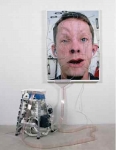 Hawkinson's art is sort of like that too. As a garage band is to a philharmonic orchestra, so Hawkinson's technological tinkering is to science and industry. His art speaks to social experience and human mortality. But part of the work's attraction is the way it peels back its systems of operation like layers of an onion, displaying them for your contemplation.
Take "Emoter," a self-portrait of the artist as a young cyborg. A cut-up inkjet print showing the artist's face is mounted on a panel of plastic and foam core, which hangs on the wall. Electrodes fastened to the face are connected to mechanical components, mounted like a high school science project on a nearby stepladder. There, light sensors are affixed to a television monitor, and they send random signals in response to the broadcast program.
Walk up to Hawkinson's portrait and, accompanied by soft buzzing and whirring, his face begins to change expressions. Eyebrows rise. Nostrils flare. Lips part. Some expressions are familiar, some freakish.
 While you're puzzling over the portrait's apparent reaction to your presence in the room, and how the goofy effect is accomplished, it suddenly dawns that grins, a furrowed brow and other bemused expressions are washing over your own face too. Who's the real "emoter" here? Hawkinson or his audience?
Who is responding to what — the picture to you or you to the picture? Is the title a pun for e-motor — that is, an electronic motor, which reacts mechanically to outside stimuli? Does the flickering TV tube reside at the heart of this emotional circuitry? How mechanical (or preprogrammed) are our own responses to experience?
"Emoter" also puts you in mind of multi-user computer programs, the kind that run over the Internet and allow multiple users to participate in role-playing games. In virtual reality, "to emote" is to indicate the performance of an action, usually with a facial expression of emotional state. Hawkinson's theatrical self-portrait represents the face of a new world — familiar and freakish, but one we all now inhabit... READ THE FULL ARTICLE
More to explore
Tim Hawkinson's interview and works
Art:21 Film on Tim Hawkinson
Tim Hawkinson essay and images
Tim Hawkinson art books (Amazon)
19:11 Posted in Cyberart | Permalink | Comments (0) | Tags: Positive Technology