




Jul 21, 2005
Ubiquitous computing for cognitive decline
Cognitive decline is one of the most taxing health problems in terms of both its relation to elders' overall functioning and the cost of care. The loss of their abilities to use everything from a coffee maker to a computer may lead to social isolation, a decreased motivation, and increasing dependence on skilled support for assistance in routine activities. Prevention, early detection, and assistance for cognitive decline may be a useful application for ubiquitous computing technologies.
Ubicomp solutions typically involve multiple invisible devices embedded in the physical environment, all connected together to respond in transparent ways to the users in the context of everyday events. Ubicomp may match the challenge of providing elders pervasive support throughout the home, and adaptable levels of support.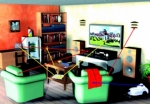
For example, Intel's Proactive Health Research initiative is exploring location and activity tracking technologies to support elders' indipendence and safety monitoring by caregivers. The programme also aims at investigating technologies that facilitate social connectedness and continuation of meaningful activities.
More to explore
Free full-text publications on pervasive computing
16:05 Posted in Pervasive computing | Permalink | Comments (0) | Tags: Positive Technology, Ambient intelligence
VR is going to be cheap
Virtual Reality Therapy (VRT) offers treatment using simulated real life experience provided in a confidential setting. VRT has shown its effectiveness in several common phobias, including claustrophobia, fear of heights, fear of spiders, fear of driving, fear of flying, and fear of public speaking. As a person goes through the VR program, the therapist teaches the client relaxation techniques to deal with the symptoms provoked by exposure to the virtual environment.
However, until recently, the use of VRT was severely limited by the lack of inexpensive immersive equipment. This opportunity could come along in the fourth quarter of this year, when 3001AD, a company that builds high-end VR machines for large-scale entertainment centers, will introduce a headset that can be used in combination with the Xbox and the Playstation game consoles and several blockbuster game titles.  The system, called "Trimersion" and recently demonstrated at the E3 trade show, promises 360-degree head tracking, uses a binocular video subsystem and delivers a QVGA resolution (320 x 240). Mark Rifkin, senior vice president of 3001 AD suggested retail pricing to come in just under $500.
More to explore:
Cybertherapy.info the reference site for VR therapy
Virtual reality in behavioral neuroscience and beyond, Nature Neuroscience, 1089-1092, Oct. 2002
Virtual Reality Therapy, Harvard Mental Health Letter, on-line, April 2003
Fake worlds offer real medicine, Journal of the American Medical Association, 290 (10), 2107-2109, 22/29 Oct 2003
15:15 Posted in Cybertherapy | Permalink | Comments (0) | Tags: Positive Technology, virtual reality