




Oct 06, 2014
Is the metaverse still alive?
In the last decade, online virtual worlds such as Second Life and alike have become enormously popular. Since their appearance on the technology landscape, many analysts regarded shared 3D virtual spaces as a disruptive innovation, which would have rendered the Web itself obsolete.
This high expectation attracted significant investments from large corporations such as IBM, which started building their virtual spaces and offices in the metaverse. Then, when it became clear that these promises would not be kept, disillusionment set in and virtual worlds started losing their edge. However, this is not a new phenomenon in high-tech, happening over and over again.
The US consulting company Gartner has developed a very popular model to describe this effect, called the “Hype Cycle”. The Hype Cycle provides a graphic representation of the maturity and adoption of technologies and applications.
It consists of five phases, which show how emerging technologies will evolve.
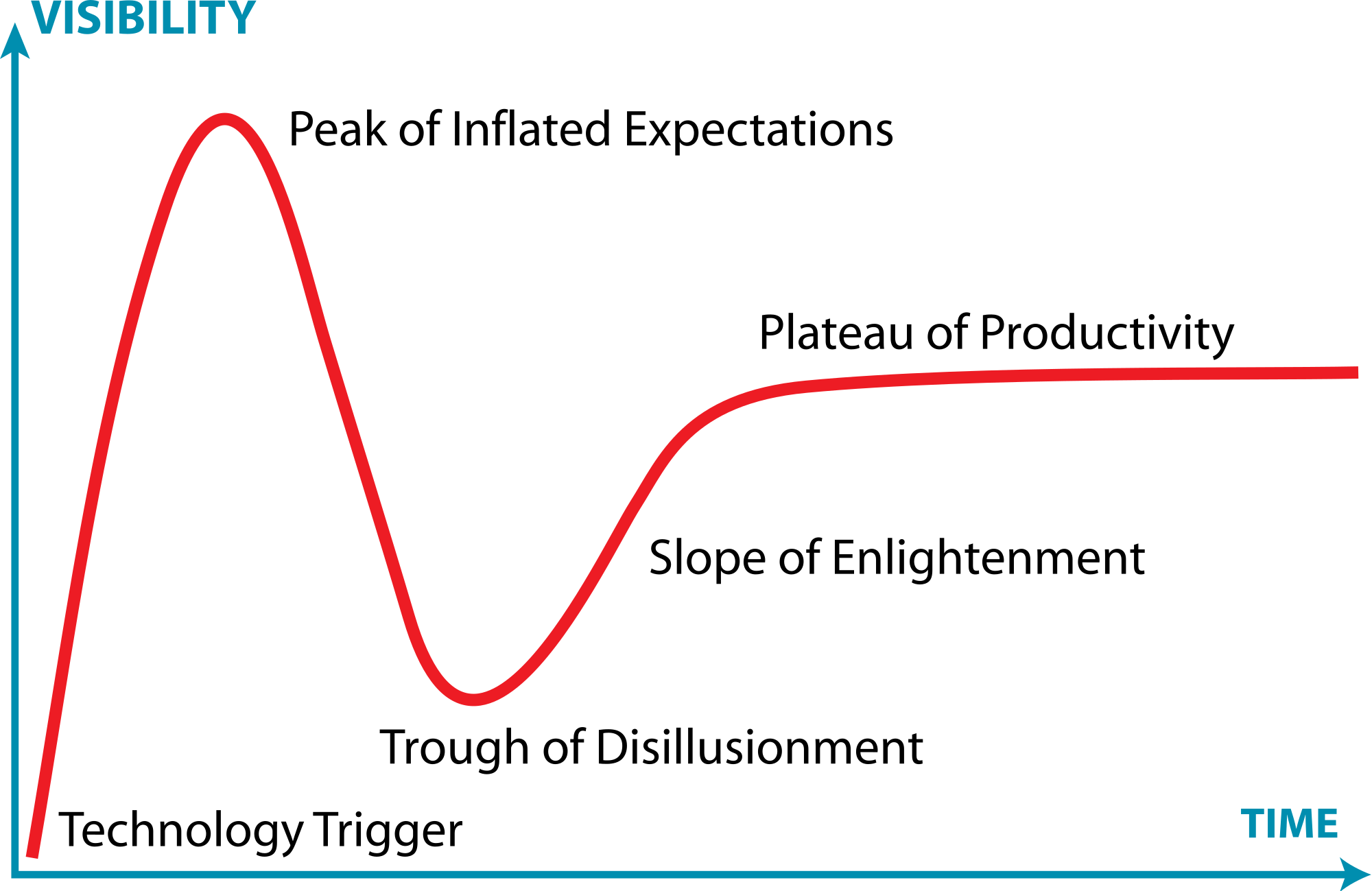
In the first, “technology trigger” phase, a new technology is launched which attracts the interest of media. This is followed by the “peak of inflated expectations”, characterized by a proliferation of positive articles and comments, which generate overexpectations among users and stakeholders.
In the next, “trough of disillusionment” phase, these exaggerated expectations are not fulfilled, resulting in a growing number of negative comments generally followed by a progressive indifference.
In the “slope of enlightenment” the technology potential for further applications becomes more broadly understood and an increasing number of companies start using it.
In the final, “plateau of productivity” stage, the emerging technology established itself as an effective tool and mainstream adoption takes off.
So what stage in the hype cycle are virtual worlds now?
After the 2006-2007 peak, metaverses entered the downward phase of the hype cycle, progressively loosing media interest, investments and users. Many high-tech analysts still consider this decline an irreversible process.
However, the negative outlook that headed shared virtual worlds into the trough of disillusionment maybe soon reversed. This is thanks to the new interest in virtual reality raised by the Oculus Rift (recently acquired by Facebook for $2 billion), Sony’s Project Morpheus and alike immersive displays, which are still at the takeoff stage in the hype cycle.
Oculus Rift's chief scientist Michael Abrash makes no mystery of the fact that his main ambition has always been to build a metaverse such the one described in Neal Stephenson's (1992) cyberpunk novel Snow Crash. As he writes on the Oculus blog
"Sometime in 1993 or 1994, I read Snow Crash and for the first time thought something like the Metaverse might be possible in my lifetime."
Furthermore, despite the negative comments and deluded expectations, the metaverse keeps attracting new users: in its 10th anniversary on June 23rd 2013, an infographic reported that Second Life had over 1 million users visit around the world monthly, more than 400,000 new accounts per month, and 36 million registered users.
So will Michael Abrash’s metaverse dream come true? Even if one looks into the crystal ball of the hype cycle, the answer is not easily found.
22:36 Posted in Blue sky, Serious games, Telepresence & virtual presence, Virtual worlds | Permalink | Comments (0)
Bionic Vision Australia’s Bionic Eye Gives New Sight to People Blinded by Retinitis Pigmentosa
Via Medgadget
Bionic Vision Australia, a collaboration between of researchers working on a bionic eye, has announced that its prototype implant has completed a two year trial in patients with advanced retinitis pigmentosa. Three patients with profound vision loss received 24-channel suprachoroidal electrode implants that caused no noticeable serious side effects. Moreover, though this was not formally part of the study, the patients were able to see more light and able to distinguish shapes that were invisible to them prior to implantation. The newly gained vision allowed them to improve how they navigated around objects and how well they were able to spot items on a tabletop.
The next step is to try out the latest 44-channel device in a clinical trial slated for next year and then move on to a 98-channel system that is currently in development.
This study is critically important to the continuation of our research efforts and the results exceeded all our expectations,” Professor Mark Hargreaves, Chair of the BVA board, said in a statement. “We have demonstrated clearly that our suprachoroidal implants are safe to insert surgically and cause no adverse events once in place. Significantly, we have also been able to observe that our device prototype was able to evoke meaningful visual perception in patients with profound visual loss.”
Here’s one of the study participants using the bionic eye:
First direct brain-to-brain communication between human subjects
Via KurzweilAI.net
An international team of neuroscientists and robotics engineers have demonstrated the first direct remote brain-to-brain communication between two humans located 5,000 miles away from each other and communicating via the Internet, as reported in a paper recently published in PLOS ONE (open access).
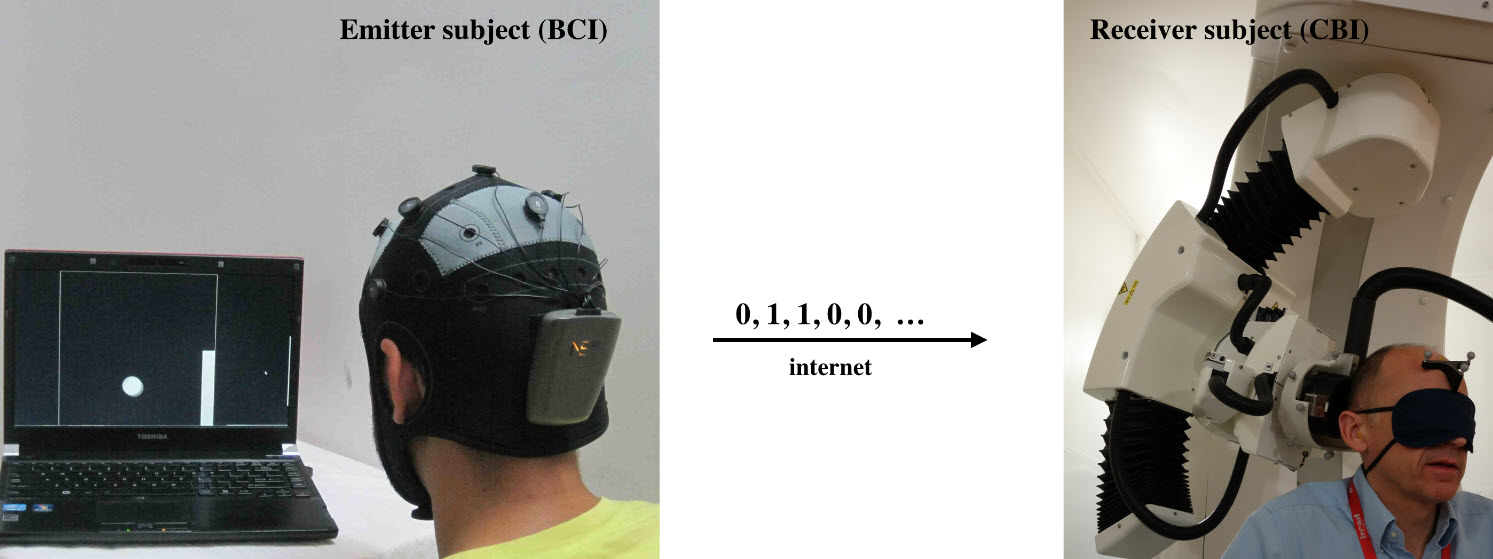
Emitter and receiver subjects with non-invasive devices supporting, respectively, a brain-computer interface (BCI), based on EEG changes, driven by motor imagery (left) and a computer-brain interface (CBI) based on the reception of phosphenes elicited by neuro-navigated TMS (right) (credit: Carles Grau et al./PLoS ONE)
In India, researchers encoded two words (“hola” and “ciao”) as binary strings and presented them as a series of cues on a computer monitor. They recorded the subject’s EEG signals as the subject was instructed to think about moving his feet (binary 0) or hands (binary 1). They then sent the recorded series of binary values in an email message to researchers in France, 5,000 miles away.
There, the binary strings were converted into a series of transcranial magnetic stimulation (TMS) pulses applied to a hotspot location in the right visual occipital cortex that either produced a phosphene (perceived flash of light) or not.
“We wanted to find out if one could communicate directly between two people by reading out the brain activity from one person and injecting brain activity into the second person, and do so across great physical distances by leveraging existing communication pathways,” explains coauthor Alvaro Pascual-Leone, MD, PhD, Director of the Berenson-Allen Center for Noninvasive Brain Stimulation at Beth Israel Deaconess Medical Center (BIDMC) and Professor of Neurology at Harvard Medical School.
A team of researchers from Starlab Barcelona, Spain and Axilum Robotics, Strasbourg, France conducted the experiment. A second similar experiment was conducted between individuals in Spain and France.
“We believe these experiments represent an important first step in exploring the feasibility of complementing or bypassing traditional language-based or other motor/PNS mediated means in interpersonal communication,” the researchers say in the paper.
“Although certainly limited in nature (e.g., the bit rates achieved in our experiments were modest even by current BCI (brain-computer interface) standards, mostly due to the dynamics of the precise CBI (computer-brain interface) implementation, these initial results suggest new research directions, including the non-invasive direct transmission of emotions and feelings or the possibility of sense synthesis in humans — that is, the direct interface of arbitrary sensors with the human brain using brain stimulation, as previously demonstrated in animals with invasive methods.

Brain-to-brain (B2B) communication system overview. On the left, the BCI subsystem is shown schematically, including electrodes over the motor cortex and the EEG amplifier/transmitter wireless box in the cap. Motor imagery of the feet codes the bit value 0, of the hands codes bit value 1. On the right, the CBI system is illustrated, highlighting the role of coil orientation for encoding the two bit values. Communication between the BCI and CBI components is mediated by the Internet. (Credit: Carles Grau et al./PLoS ONE)
“The proposed technology could be extended to support a bi-directional dialogue between two or more mind/brains (namely, by the integration of EEG and TMS systems in each subject). In addition, we speculate that future research could explore the use of closed mind-loops in which information associated to voluntary activity from a brain area or network is captured and, after adequate external processing, used to control other brain elements in the same subject. This approach could lead to conscious synthetically mediated modulation of phenomena best detected subjectively by the subject, including emotions, pain and psychotic, depressive or obsessive-compulsive thoughts.
“Finally, we anticipate that computers in the not-so-distant future will interact directly with the human brain in a fluent manner, supporting both computer- and brain-to-brain communication routinely. The widespread use of human brain-to-brain technologically mediated communication will create novel possibilities for human interrelation with broad social implications that will require new ethical and legislative responses.”
This work was partly supported by the EU FP7 FET Open HIVE project, the Starlab Kolmogorov project, and the Neurology Department of the Hospital de Bellvitge.
Google Glass can now display captions for hard-of-hearing users
Georgia Institute of Technology researchers have created a speech-to-text Android app for Google Glass that displays captions for hard-of-hearing persons when someone is talking to them in person.
“This system allows wearers like me to focus on the speaker’s lips and facial gestures, “said School of Interactive Computing Professor Jim Foley.
“If hard-of-hearing people understand the speech, the conversation can continue immediately without waiting for the caption. However, if I miss a word, I can glance at the transcription, get the word or two I need and get back into the conversation.”
Captioning on Glass display captions for the hard-of-hearing (credit: Georgia Tech)
The “Captioning on Glass” app is now available to install from MyGlass. More information here.
Foley and the students are working with the Association of Late Deafened Adults in Atlanta to improve the program. An iPhone app is planned.