



Ok

By continuing your visit to this site, you accept the use of cookies. These ensure the smooth running of our services. Learn more.

Mar 31, 2012

Blogging from my iPad

BlogSpirit has developed a nice app that allows posting from the iPad/iPhone.

I am just trying it out.

If you are able to read this post, well, it does work (btw, this is Matilde)

mobile_picture

17:03 Posted in Social Media | Permalink | Comments (0)

Barriers to and mediators of brain-computer interface user acceptance

Barriers to and mediators of brain-computer interface user acceptance: focus group findings.

Ergonomics. 2012 Mar 29

Authors: Blain-Moraes S, Schaff R, Gruis KL, Huggins JE, Wren PA

Abstract. Brain-computer interfaces (BCI) are designed to enable individuals with severe motor impairments such as amyotrophic lateral sclerosis (ALS) to communicate and control their environment. A focus group was conducted with individuals with ALS (n=8) and their caregivers (n=9) to determine the barriers to and mediators of BCI acceptance in this population. Two key categories emerged: personal factors and relational factors. Personal factors, which included physical, physiological and psychological concerns, were less important to participants than relational factors, which included corporeal, technological and social relations with the BCI. The importance of these relational factors was analysed with respect to published literature on actor-network theory (ANT) and disability, and concepts of voicelessness and personhood. Future directions for BCI research are recommended based on the emergent focus group themes. Practitioner Summary: This manuscript explores human factor issues involved in designing and evaluating brain-computer interface (BCI) systems for users with severe motor disabilities. Using participatory research paradigms and qualitative methods, this work draws attention to personal and relational factors that act as barriers to, or mediators of, user acceptance of this technology.

How Stephen Wolfram Spent the Last 22 Years (behind the Computer)

Via Infoesthetics

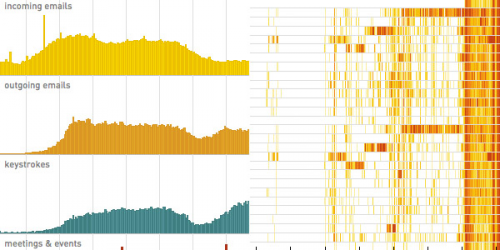
Stephen Wolfram, the chief designer of Mathematica and the Wolfram Alpha computational knowledge engine, has been setting a new norm in the fields of lifelogging, the quantified self and personal analytics, by accumulating several Nicholas Felton-amounts of data during his personal life.

Stephen has recently posted several graphs, dotplots and timelines, in an attempt to make some sense out of his 1 million outgoing email messages since 1989 (containing about 33,000 distinct words), 100 million keystrokes since 2002, every calendar event and scheduled meeting since 2000, all phone calls since 2004, and all his physical activity since 2004. To top all that off, Stephen has also several backups of his computer filesystems going back to 1980, and managed to somehow digitize about 230,000 paper documents, resulting in an immense mountain of potentially useful and revealing information about his historical work habits.

Not surprisingly, the overall patterns are quite straightforward: meetings and collaborative work during the day, a dinner-time break, more meetings and collaborative work, and then in the later evening more individual work. Most larger scale trends and patterns relate to according shifts in attention towards new projects.

Everywhere I've Been: Mapping 3 Years Worth of Location Tracking

Via InfoAestetics

qeoloqi_map.jpg

Co-founder of Geoloqi Aaron Parecki is showing of the core services of this mobile platform for tracking and sharing location data, in the blog post "Everywhere I've Been".

The resulting maps are generated entirely from 2.5 million unique GPS points (about 1 point per 2 to 6 seconds), which were tracked by his iPhone or Android phone for the past 3.5 years (resulting also in some interesting battery issues).

The trajectories and itineraries on the maps have been colored by year, in order to reveal how his physical footprint changes over time due to the different locations of his house.

Hyper(reality) - The Last Tuesday Society

Project's description: Embodying the concept theorized by hyperrealism theories, the helmet provides a digital experience, immersing the user in an alternative version of reality seen through the helmet. Instead of having a static point of view, the user becomes able to navigate through the 3D environment enabling new behaviours specific to the hyperreal world while still having to physically interact with the real environment. Thus it creates an odd interface between these two states.

Hyper(reality) - The Last Tuesday Society from Maxence

The suit is composed of an helmet with high definition video glasses, an arduino glove with force sensors controlling the 3D view and a harness for the kinect. Each user experience is recorded and analysed, portraiting user behaviours during the experience. Immersed into this dream-like virtual space, the user gradually discovers the collection of curiosities. Behaviours are being modified, the notion of scale is being distorted, all this pushing the boundaries of the physical space. Venitian masks, stuffed animals and old scultpures start floating in the air around the user creating a new sensorial experience.


OutRun: Augmented Reality Driving Video Game

Impact of meditation training on the default mode network during a restful state

Impact of meditation training on the default mode network during a restful state.

Soc Cogn Affect Neurosci. 2012 Mar 24

Authors: Taylor VA, Daneault V, Grant J, Scavone G, Breton E, Roffe-Vidal S, Courtemanche J, Lavarenne AS, Marrelec G, Benali H, Beauregard M

Abstract. Mindfulness meditation has been shown to promote emotional stability. Moreover, during the processing of aversive and self-referential stimuli, mindful awareness is associated with reduced medial prefrontal cortex (MPFC) activity, a central default mode network (DMN) component. However, it remains unclear whether mindfulness practice influences functional connectivity between DMN regions and, if so, whether such impact persists beyond a state of meditation. Consequently, this study examined the effect of extensive mindfulness training on functional connectivity within the DMN during a restful state. Resting-state data were collected from 13 experienced meditators (with over 1000 h of training) and 11 beginner meditators (with no prior experience, trained for 1 week before the study) using functional magnetic resonance imaging (fMRI). Pairwise correlations and partial correlations were computed between DMN seed regions' time courses and were compared between groups utilizing a Bayesian sampling scheme. Relative to beginners, experienced meditators had weaker functional connectivity between DMN regions involved in self-referential processing and emotional appraisal. In addition, experienced meditators had increased connectivity between certain DMN regions (e.g. dorso-medial PFC and right inferior parietal lobule), compared to beginner meditators. These findings suggest that meditation training leads to functional connectivity changes between core DMN regions possibly reflecting strengthened present-moment awareness.

Neurofeedback for insomnia: a pilot study of Z-score SMR and individualized protocols

Neurofeedback for insomnia: a pilot study of Z-score SMR and individualized protocols.

Appl Psychophysiol Biofeedback. 2011 Dec;36(4):251-64

Authors: Hammer BU, Colbert AP, Brown KA, Ilioi EC

Abstract. Insomnia is an epidemic in the US. Neurofeedback (NFB) is a little used, psychophysiological treatment with demonstrated usefulness for treating insomnia. Our objective was to assess whether two distinct Z-Score NFB protocols, a modified sensorimotor (SMR) protocol and a sequential, quantitative EEG (sQEEG)-guided, individually designed (IND) protocol, would alleviate sleep and associated daytime dysfunctions of participants with insomnia. Both protocols used instantaneous Z scores to determine reward condition administered when awake. Twelve adults with insomnia, free of other mental and uncontrolled physical illnesses, were randomly assigned to the SMR or IND group. Eight completed this randomized, parallel group, single-blind study. Both groups received fifteen 20-min sessions of Z-Score NFB. Pre-post assessments included sQEEG, mental health, quality of life, and insomnia status. ANOVA yielded significant post-treatment improvement for the combined group on all primary insomnia scores: Insomnia Severity Index (ISI p<.005), Pittsburgh Sleep Quality Inventory (PSQI p<.0001), PSQI Sleep Efficiency (p<.007), and Quality of Life Inventory (p<.02). Binomial tests of baseline EEGs indicated a significant proportion of excessively high levels of Delta and Beta power (p<.001) which were lowered post-treatment (paired z-tests p<.001). Baseline EEGs showed excessive sleepiness and hyperarousal, which improved post-treatment. Both Z-Score NFB groups improved in sleep and daytime functioning. Post-treatment, all participants were normal sleepers. Because there were no significant differences in the findings between the two groups, our future large scale studies will utilize the less burdensome to administer Z-Score SMR protocol.

Stress, uncertainty and decision confidence

Stress, uncertainty and decision confidence.

Appl Psychophysiol Biofeedback. 2011 Dec;36(4):273-9

Authors: Heereman J, Walla P

Abstract. We successfully manipulated decision confidence in a probabilistic prediction task by means of stress as induced by excessive cognitive demands. In particular, our results indicate that decisions (based on high and low, but not intermediate levels of uncertainty) made under stress (confirmed by skin conductance measures) are associated with increased confidence when outcome probabilities are incompletely known (20% residual uncertainty). A different pattern was found when outcome probabilities were completely known (0% residual uncertainty). Here, stress led to decreased decision confidence when decisions were associated with intermediate levels of uncertainty but had no effect in case of high and low levels of uncertainty. In addition we provide evidence for ambiguity--(understood as implicit-risk) assessment being impaired under stress conditions.

Microsoft patents projector eyewear for Xbox and beyond

Via KurzweilAI

[+]mshmspatent

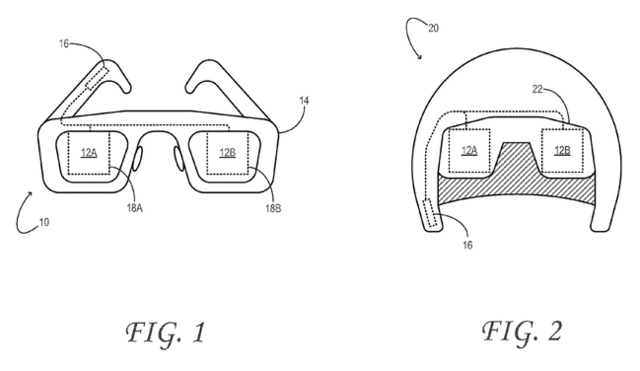
Illustrations from Microsoft's patent show the rough schematics for both a helmet-based display and one embedded in a pair of glasses (credit: Microsoft)

According to Patent Bolt, Microsoft has been secretly working on a video headset since September 2010.

A New Microsoft patent reveals that they’ve been working two styles of headset: an aviation styled helmet aimed at Xbox gamers, and one that resembles a pair of sunglasses for use with smartphones, MP3 players and other future devices.

In the patent, Microsoft states that a compact display system may be coupled into goggles, a helmet, or other eyewear. These configurations enable the wearer to view images from a computer, media player, or other electronic device with privacy and mobility. When adapted to display two different images concurrently — one for each eye — the system may be used for stereoscopic display (e.g., virtual-reality) applications.

Paul G. Allen adding $300M to expand the Allen Institute for Brain Science

Paul G. Allen has donated additional $300 million to the Allen Institute for Brain Science to expand its scientific programs, the Institute announced Wednesday March 21.

The Institute was established with a 2003 contribution of $100 million from the former Microsoft executive, who then donated another $100 million. The latest contribution of $300 million will support the first four years of a 10-year plan to address critical questions about how the brain works.

Bringing his total commitment to date to $500 million, Allen has charged the Institute with tackling some of the most fundamental and complex questions in brain science today.

Mar 28, 2012

Emotizer

Emotizer is a new emotional social network that allows you to bookmark places, people, objects, dreams and thoughts and link them to the emotions you're feeling within.


Istantanea iPhone 1
 
 
Istantanea iPhone 2