




Apr 24, 2008
Human area network (HAN) technology
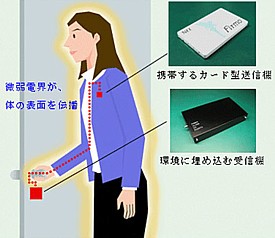
A new product by NTT, called “Firmo,” allows users to communicate with electronic devices by touching them. A card-sized transmitter carried in the user’s pocket transmits data across the surface of the human body. When the user touches a device, the electric field is converted back into a data signal that can be read by the device.
For now, a set of 5 card-sized transmitters and 1 receiver goes for around 800,000 yen ($8,000), but NTT expects the price to come down when they begin mass production.
Read more
13:12 Posted in Future interfaces | Permalink | Comments (0) | Tags: future interfaces
Apr 23, 2008
Honda's walking assist device
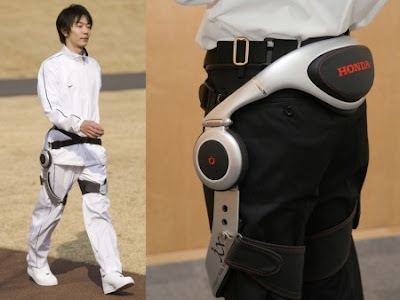
23:15 Posted in Wearable & mobile | Permalink | Comments (0) | Tags: assistive device
The effect of biofeedback training on affective regulation and simulated car-racing performance
The effect of biofeedback training on affective regulation and simulated car-racing performance: A multiple case study analysis.
J Sports Sci. 2008 May;26(7):761-73
Authors: Edmonds WA, Tenenbaum G, Mann DT, Johnson M, Kamata A
The foundation of this study was based on an idiosyncratic concept, which uses probabilistic determinations (Kamata, Tenenbaum, & Hanin, 2002) to verify the utility and effectiveness of a biofeedback intervention by manipulating affective performance states in a race-car simulator. Nine males completed five separate time-trials of a simulated racing task and were then randomly assigned to one of three arousal regulation treatment conditions: (1) optimal, (2) poor, and (3) attention control. Following the biofeedback intervention, participants underwent another series of race trials to determine the effectiveness of the arousal regulation intervention. The results indicated that there were relative similarities in the strength and direction of the perceived and physiological states between the participants; however, the subtle details of the participants' unique performance zones and the probability of achieving each zone were revealed to be unique among the participants. The results also indicated that: (a) the biofeedback manipulation resulted in the expected changes for each participant, and (b) there were some large individual differences among the participants, necessitating the idiosyncratic approach. Limitations and future directions are also addressed.
23:08 Posted in Biofeedback & neurofeedback | Permalink | Comments (0) | Tags: biofeedback
Neural activation in cognitive motor processes
Neural activation in cognitive motor processes: comparing motor imagery and observation of gymnastic movements.
Exp Brain Res. 2008 Apr 19;
Authors: Munzert J, Zentgraf K, Stark R, Vaitl D
16:46 Posted in Mental practice & mental simulation | Permalink | Comments (0) | Tags: mental practice
Apr 21, 2008
Interactive Architect - London
Glass Partnership is looking to appoint a permanent experienced Interactive Architect. You’ll have the opportunity to work across a range of leading edge projects for our client base of brands including American Express, Virgin, San Miguel, Nokia and the NHS.
Glass is one of the new kids on the ‘digital’ block. With 24 full time employees, they have been trading for a couple of years and have been named as the NMA ‘one to watch’. They have a growth plan in place for 2008 and are looking for a Studio Manager to join the team, managing the resources and workflow in their busy studio.
We are looking to appoint an experienced Interactive Architect on a permanent basis. You’ll have the opportunity to work across a range of leading edge projects for our client base of brands including American Express, Virgin, San Miguel and Nokia, as well as institutions such as the NHS and charities such asYouthnet.
Do you know digital media, production and interaction design inside out? Brimming with energy, creativity and enthusiasm? Passionate about user experience and information theory? Capable and confident enough to get the best in information architecture and user experience from any brief across a range of large brand clients and sectors? An aptitude for getting stuck in, stacks of initiative, emphasis on quality, delivery and client satisfaction whilst keeping innovation and the user journey at the fore are all part of the deal. Sound like you? Get in touch…
THE ROLE
- Evaluating clients' functional and business requirements.
- Conducting primary and secondary research to evaluate user needs.
- Performing usability inspections of existing systems and conducting competitive research.
- Developing information architecture, system vocabulary, task flows, navigation systems, and producing detailed wireframe layouts.
- Documenting screen-level interactions.
- Presenting and justifying interaction designs to clients.
- Developing paper or digital prototypes for early user testing.
- Creating project-specific user experience guidelines that assist clients in making future design decisions.
- Working with content writers, visual designers, and developers to ensure a smooth transition of the interactive design into development.
SKILLS /EXPERIENCE REQUIRED
- At least 3 years experience in complex web application interaction design.
- Education in user-centered design (UCD) or ability to display a formal understanding of UCD theory and practice.
- Ability to blend both user goals and business goals to create an effective interactive experience.
- Working knowledge of browser-based technology constraints/capabilities (e.g. HTML, JavaScript, Flash, AJAX).
- Experience with a range of software development practices, including agile and use-case based methods.
- Superlative oral and written communication skills.
- Experience working directly with clients in a consulting role, including leading client meetings.
- Working knowledge of visual design tools (e.g.Visio or alternative).
- Experience designing and conducting usability studies is an asset.
21:29 Posted in Research institutions & funding opportunities | Permalink | Comments (0) | Tags: funding opportunities