




Apr 23, 2008
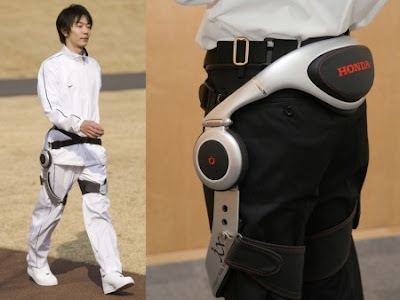
Honda's walking assist device
23:15 Posted in Wearable & mobile | Permalink | Comments (0) | Tags: assistive device
The effect of biofeedback training on affective regulation and simulated car-racing performance
The effect of biofeedback training on affective regulation and simulated car-racing performance: A multiple case study analysis.
J Sports Sci. 2008 May;26(7):761-73
Authors: Edmonds WA, Tenenbaum G, Mann DT, Johnson M, Kamata A
The foundation of this study was based on an idiosyncratic concept, which uses probabilistic determinations (Kamata, Tenenbaum, & Hanin, 2002) to verify the utility and effectiveness of a biofeedback intervention by manipulating affective performance states in a race-car simulator. Nine males completed five separate time-trials of a simulated racing task and were then randomly assigned to one of three arousal regulation treatment conditions: (1) optimal, (2) poor, and (3) attention control. Following the biofeedback intervention, participants underwent another series of race trials to determine the effectiveness of the arousal regulation intervention. The results indicated that there were relative similarities in the strength and direction of the perceived and physiological states between the participants; however, the subtle details of the participants' unique performance zones and the probability of achieving each zone were revealed to be unique among the participants. The results also indicated that: (a) the biofeedback manipulation resulted in the expected changes for each participant, and (b) there were some large individual differences among the participants, necessitating the idiosyncratic approach. Limitations and future directions are also addressed.
23:08 Posted in Biofeedback & neurofeedback | Permalink | Comments (0) | Tags: biofeedback
Neural activation in cognitive motor processes
Neural activation in cognitive motor processes: comparing motor imagery and observation of gymnastic movements.
Exp Brain Res. 2008 Apr 19;
Authors: Munzert J, Zentgraf K, Stark R, Vaitl D
16:46 Posted in Mental practice & mental simulation | Permalink | Comments (0) | Tags: mental practice