




Aug 07, 2007
MATES

mates is a location-based social networking system in the form of a robust web service, or Relationship Engine, and an optional rich media client application, or Relationship Space Navigator.


from the project's website:
Our objective in creating mates has been to build an open infrastructure to introduce and connect individuals based on the intersection of physical location and other properties they might have in common.
mates is different than the wide range of existing social networking and instant messaging applications. We strive to create an open infrastructure that will allow existing software to harness the power of location based social networking
The current version of mates is geared towards the academic community, focusing on course registration and academic interests. This set of properties could easily be extended to encompass professional or social environments with hooks into LDAP directories or existing social networking applications. and a platform on top of which other new, powerful applications can be developed.
20:05 Posted in Social Media | Permalink | Comments (0) | Tags: social computing
Free web application for brainstorming online
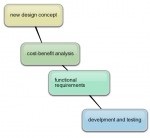
Bubbl.us is a (free) web application that lets you brainstorm online. Key features include:
- Create colorful mind maps online
- Share and work with friends
- Embed your mind map in your blog or website
- Email and print your mind map
- Save your mind map as an image
Here is an example:
19:49 Posted in Creativity and computers | Permalink | Comments (0) | Tags: creativity and computers
How good are current HMDs?
Via VRoot

Sensics, a company that develops head-mounted displays, (HMD) has conducted a survey amongst academic, commercial, and government users of virtual reality system to understand desired performance characteristics of what was termed a “goodenough” HMD.
Key survey findings include:
- Most existing HMDs are not ‘good enough’ according to survey participants. Commonplace horizontal field of view (50 degrees or lower) and commonplace vertical field of view (30 degrees or lower) are considered ‘good enough’ by fewer than 10% of surveyed population.
- The lack of ‘good enough’ performance is cited in practically all the cases where buyers with appropriate budgets considered purchasing head-mounted displays yet ultimately did not do so.
- Users consider the most important HMD attributes to be: panoramic field of view (over 100 degrees horizontal), large vertical field of view (over 50 degrees), very fast dynamic response (no smear or fade effects), high contrast display, high resolution display and a lightweight design
Read the full survey report
19:30 Posted in Virtual worlds | Permalink | Comments (0) | Tags: virtual reality, head-mounted display
Experimental evidence for mixed reality states
Via Science Daily
I was fashinated by this physics experiment, which is the first attempt to create a linked virtual/real system. Vadas Gintautas and Alfred Hübler of the Center for Complex Systems Research at the University of Illinios achieved this result by coupling a real-world pendulum with a virtual version that moved under time-tested equations of motion. In their "mixed reality" system, the two pendulums swing as one. To get the two pendulums to communicate, the physicists fed data about the real pendulum to the virtual one, and information from the virtual pendulum is transferred to a motor that affects the motion of the real pendulum.

Mixed reality can occur only when the two systems are sufficiently similar, but a system having unknown parameters could be coupled to a virtual system whose parameters are set by the experimenters. The unknown variables in the real system could then be determined by adjusting the virtual system until the two systems shift from dual reality to mixed reality, enabling good estimates for the values of the unknown parameters.
Here is the study abstract:
Experimental evidence for mixed reality states in an interreality system.
Phys Rev E Stat Nonlin Soft Matter Phys. 2007 May;75(5-2):057201
Authors: Gintautas V, Hübler AW
We present experimental data on the limiting behavior of an interreality system comprising a virtual horizontally driven pendulum coupled to its real-world counterpart, where the interaction time scale is much shorter than the time scale of the dynamical system. We present experimental evidence that, if the physical parameters of the simplified virtual system match those of the real system within a certain tolerance, there is a transition from an uncorrelated dual reality state to a mixed reality state of the system in which the motion of the two pendula is highly correlated. The region in parameter space for stable solutions has an Arnold tongue structure for both the experimental data and a numerical simulation. As virtual systems better approximate real ones, even weak coupling in other interreality systems may produce sudden changes to mixed reality states.
19:05 Posted in Research tools | Permalink | Comments (0) | Tags: mixed reality
An MEG-based brain-computer interface (BCI)
An MEG-based brain-computer interface (BCI).
Neuroimage. 2007 Jul 1;36(3):581-93
Authors: Mellinger J, Schalk G, Braun C, Preissl H, Rosenstiel W, Birbaumer N, Kübler A
Brain-computer interfaces (BCIs) allow for communicating intentions by mere brain activity, not involving muscles. Thus, BCIs may offer patients who have lost all voluntary muscle control the only possible way to communicate. Many recent studies have demonstrated that BCIs based on electroencephalography (EEG) can allow healthy and severely paralyzed individuals to communicate. While this approach is safe and inexpensive, communication is slow. Magnetoencephalography (MEG) provides signals with higher spatiotemporal resolution than EEG and could thus be used to explore whether these improved signal properties translate into increased BCI communication speed. In this study, we investigated the utility of an MEG-based BCI that uses voluntary amplitude modulation of sensorimotor mu and beta rhythms. To increase the signal-to-noise ratio, we present a simple spatial filtering method that takes the geometric properties of signal propagation in MEG into account, and we present methods that can process artifacts specifically encountered in an MEG-based BCI. Exemplarily, six participants were successfully trained to communicate binary decisions by imagery of limb movements using a feedback paradigm. Participants achieved significant mu rhythm self control within 32 min of feedback training. For a subgroup of three participants, we localized the origin of the amplitude modulated signal to the motor cortex. Our results suggest that an MEG-based BCI is feasible and efficient in terms of user training.
18:50 Posted in Brain-computer interface | Permalink | Comments (0) | Tags: brain-computer interface
Aug 06, 2007
Beyond the Console: Virtual worlds, interactive experiences and gaming
From Creative Technology Network website
6 September 2007
Cross-sector seminar/workshop to generate new ideas for products, services and collaborations in the interactive arena
2pm - 5.30pm followed by drinks| Venue: Watershed, Bristol |
From alternative reality games to located mediascapes, the internet offers a wealth of opportunity for collaboration around gaming and interactive experiences, and with its blend of digital creatives and highly skilled computer programmers, Bristol should be in a unique position to ride and exploit this wave.
Recent research commissioned by South West Screen highlights the significant number of SMEs working in disciplines like animation, education, interactive media and post-production who are already supporting the games industry. How do we network these producers and create opportunities to engage with emerging disciplines such as mobile gaming, pervasive media and serious games?
Showcasing a diverse array of Bristol based talent, this afternoon seminar/workshop will bring together experts and professionals from a mix of disciplines to explore innovation, content distribution and opportunities for collaboration in gaming and virtual worlds.
14:30 Posted in Positive Technology events | Permalink | Comments (0) | Tags: creativity and computers