




Jun 24, 2007
Toward a Metaverse
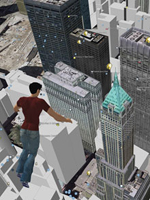
In this interesting article recently published in Technology Review, Wade Roush predicts that the line between the real world and its virtual representations will soon start blurring. Here is an excerpt from the article:
[...] The first, relatively simple step toward a Second Earth, many observers predict, will be integrating Second Life's avatars, controls, and modeling tools into the Google Earth environment. Groups of users would then be able to walk, fly, or swim across Google's simulated landscapes and explore intricate 3-D representations of the world's most famous buildings ... A second alternative would be to expand the surface area of Second Life by millions of square kilometers and model the new territory on the real earth, using the same topographical data and surface imagery contained in Google Earth ... That's a much more difficult proposition ...
[W]ithin 10 to 20 years--roughly the same time it took for the Web to become what it is now--something much bigger than either of these alternatives may emerge: a true Metaverse ... It will look like the real earth, and it will support even more users than the Snow Crash cyberworld, functioning as the agora, laboratory, and gateway for almost every type of information-based pursuit. It will be accessible both in its immersive, virtual-reality form and through peepholes like the screen of your cell phone as you make your way through the real world. And like the Web today, it will become "the standard way in which we think of life online..."
While Second Life and Google Earth are commonly mentioned as likely forebears of the Metaverse, no one thinks that Linden Lab and Google will be its lone rulers. Their two systems are interesting mainly because they already have many adherents, and because they exemplify two fundamentally different streams of technology that will be essential to the Metaverse's construction...
"Google Earth itself is really neat," comments Jamais Cascio, the Metaverse Roadmap coauthor. "But Google Earth coupled with millions of sensors around the world, offering you real-time visuals, real-time atmospheric data, and so on--that's transformative."
Indeed, it's important to remember that alongside the construction of the Metaverse, a complementary and equally ambitious infrastructure project is under way. It's the wiring of the entire world, without the wires: tiny radio-connected sensor chips are being attached to everything worth monitoring, including bridges, ventilation systems, light fixtures, mousetraps, shipping pallets, battlefield equipment, even the human body ... "Augmented reality and sensor nets will blend right into virtual worlds," predicts Linden Lab's Ondrejka. "That's when the line between the real world and its virtual representations will start blurring."
23:30 Posted in Virtual worlds | Permalink | Comments (0) | Tags: virtual worlds, second life
Towards a Social Science of Web 2.0 - York, UK
Via Usability News
A 2-day event is being organised by the Social Informatics Research Unit (SIRU), Department of Sociology, University of York in collaboration with the Taylor and Francis Journal Information, Communication & Society (iCS) and the ESRC e-Society Programme.
Keynote speakers include Andrew Keen (author of 'The Cult of the Amateur') and Charles Leadbeater.
The conference will cover the full range of Web 2.0 resources that fall into the categories that include wikis, folksonomies, mashups and, especially, Social Networking Sites (SNS). So if you are involved in social scientific or cultural research on Myspace, Facebook, Bebo, YouTube, Flikr, Second Life, Del.icio.us or other similar applications then please consider coming along.
The aim of the event will be to develop critical, theoretical and empirically informed accounts of Web 2.0 not just as a business model but as a complex, ambivalent and dynamic phenomena laden with tensions and of increasing social and cultural significance. The event is intended to provide opportunities for those working on a social science of Web 2.0 to discuss their ideas and to begin to work through the processes and possible consequences of its rhetoric of ‘social participation’, ‘communal intelligence’, and ‘collaborative cultures’.
• How can social science deal with Web 2.0?
• How can Web 2.0 applications be used as research tools?
• How can we conceptualise the heterogeneous spaces of Web 2.0?
• What terminology can we find to account for Web 2.0, should we even be labelling it as such?
• How can the fast and ephemeral cultures of Web 2.0 be captured by the rather slower processes of academia and the policy process?
• Does Web 2.0 allow for methodological innovation?
• What are the implications of Web 2.0 for welfare and citizenship?
• What are the implications for privacy and surveillance?
• What are the consequences for localities, senses of belonging, and everyday connections?
• What linkages can be made between Web 2.0 and other social and cultural shifts of recent times?
• How will the inclusion of GPS and other technologies shape social behaviour?
23:19 Posted in Positive Technology events | Permalink | Comments (0) | Tags: web 2.0
DVE Tele-Immersion Room Debuts At Telepresence World
Via Vroot

A new teleimmersive technology was launched at the Telepresence World Conference, being held in San Diego, US.
From the company website:
The patented DVE Tele-Immersive Room is the world’s most realistic group-teleconferencing experience where the conferees appear in the 3D space of the room. After analysis of total needs of corporations for their high-end communications requirements, DVE created the DVE-Tele-Immersion RoomTM that provides:
- True augmented reality conferencing
- Eye level mounted camera behind the image
- Full presentation environment
- Fully immersive where the imaged people can be seen sitting and standing in the physical room
- High end digital cinema
- Stunning corporate marketing tool with recorded presentation for visiting clients
- Volumetric 3D visualization of 3D objects up to 9 feet wide floating in air
- Optional stereoscopic 3D visualization
23:13 Posted in Telepresence & virtual presence | Permalink | Comments (0) | Tags: telepresence, virtual presence
Jun 20, 2007
Prometeus - The Media Revolution
a thought-provoking video about the media revolution
00:00 Posted in Future interfaces | Permalink | Comments (0)
Jun 19, 2007
NeuroVR presented to the US congress
a little self-promotion... ;-)
last week we presented NeuroVR, an open-source virtual reality software platform for clinical and neuroscience applications, to the Congressional Modeling & Simulation Caucus , during the CyberTherapy Reception.
The Reception was held on Wednesday, June 13 from 5-7 pm in the foyer of the Rayburn House Office Building, Washington, DC, USA.
read the full news release
23:48 Posted in Cybertherapy, Research tools, Virtual worlds | Permalink | Comments (0) | Tags: virtual reality, telepresence, virtual presence, cybertherapy