




Nov 25, 2007
Brain2Robot

Electrodes attached to the patient's scalp measure the brain's electrical signals, which are amplified and transmitted to a computer. Highly efficient algorithms analyze these signals using a self-learning technique. The software is capable of detecting changes in brain activity that take place even before a movement is carried out. It can recognize and distinguish between the patterns of signals that correspond to an intention to raise the left or right hand, and extract them from the pulses being fired by millions of other neurons in the brain. These neural signal patterns are then converted into control instructions for the computer. "The aim of the project is to help people with severe motor disabilities to carry out everyday tasks. The advantage of our technology is that it is capable of translating an intended action directly into instructions for the computer," says team leader Florin Popescu. The Brain2Robot project has been granted around 1.3 million euros in research funding under the EU's sixth Framework Programme (FP6). Its focus lies on developing medical applications, in particular control systems for prosthetics, personal robots and wheelchairs. The researchers have also developed a "thought-controlled typewriter", a communication device that enables severely paralyzed patients to pick out letters of the alphabet and write texts. The robot arm could be ready for commercialization in just a few years' time.
Press release:Brain2Robot
Project page:Brain2Robot
23:50 Posted in AI & robotics, Brain-computer interface, Cybertherapy | Permalink | Comments (0) | Tags: brain-computer interface
Quasi-movements: A novel motor-cognitive phenomenon
Quasi-movements: A novel motor-cognitive phenomenon.
Neuropsychologia. 2007 Oct 22;
Authors: Nikulin VV, Hohlefeld FU, Jacobs AM, Curio G
We introduce quasi-movements and define them as volitional movements which are minimized by the subject to such an extent that finally they become undetectable by objective measures. They are intended as overt movements, but the absence of the measurable motor responses and the subjective experience make quasi-movements similar to motor imagery. We used the amplitude dynamics of electroencephalographic alpha oscillations as a marker of the regional involvement of cortical areas in three experimental tasks: movement execution, kinesthetic motor imagery, and quasi-movements. All three conditions were associated with a significant suppression of alpha oscillations over the sensorimotor hand area of the contralateral hemisphere. This suppression was strongest for executed movements, and stronger for quasi-movements than for motor imagery. The topography of alpha suppression was similar in all three conditions. Proprioceptive sensations related to quasi-movements contribute to the assumption that the "sense of movement" can originate from central efferent processes. Quasi-movements are also congruent with the postulated continuity between motor imagery and movement preparation/execution. We also show that in healthy subjects quasi-movements can be effectively used in brain-computer interface research leading to a significantly smaller classification error ( approximately 47% of relative decrease) in comparison to the errors obtained with conventionally used motor imagery strategies.
23:42 Posted in Mental practice & mental simulation | Permalink | Comments (0) | Tags: mental practice
Cognitive enhancement on BMA
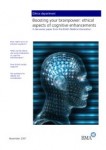
23:35 Posted in Brain training & cognitive enhancement | Permalink | Comments (0) | Tags: cognitive enhancement
Virtual Eve
Researchers from Massey University have created a virtual teacher called Eve, that can ask questions, give feedback, discuss solutions, and express emotions. To develop the software for this system the Massey team observed children and their interactions with teachers and captured them on thousands of images. From these images of facial expression, gestures and body movements they developed programs that would capture and recognise facial expression, body movement, and significant bio-signals such as heart rate and skin resistance.

(Massey University)
23:30 Posted in Emotional computing | Permalink | Comments (0) | Tags: virtual humans