




Nov 18, 2007
Smart Phone Suggests Things to Do
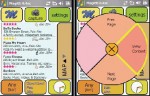
researchers at Palo Alto Research Center (PARC) have developed a mobile application, called Magitti, that uses a combination of cues - including the time of day, a person's location, her past behaviors, and even her text messages - to infer her interests. It then shows a helpful list of suggestions, including concerts, movies, bookstores, and restaurants
23:10 Posted in Wearable & mobile | Permalink | Comments (0) | Tags: mobile phones
The role of psychophysiology in forensic assessments: Deception detection, ERPs, and virtual reality mock crime scenarios
The role of psychophysiology in forensic assessments: Deception detection, ERPs, and virtual reality mock crime scenarios.
Psychophysiology. 2007 Nov 7;
Authors: Mertens R, Allen JJ
Few data are available to address whether the use of ERP-based deception detection alternatives have sufficient validity for applied use. The present study was designed to replicate and extend J. P. Rosenfeld, M. Soskins, G. Bosh, and A. Ryan's (2004) study by utilizing a virtual reality crime scenario to determine whether ERP-based procedures, including brain fingerprinting, can be rendered less effective by participant manipulation by employing a virtual reality crime scenario and multiple countermeasures. Bayesian and bootstrapping analytic approaches were used to classify individuals as guilty or innocent. Guilty subjects were detected significantly less frequently compared to previous studies; countermeasures further reduced the overall hit rates. Innocent participants remained protected from being falsely accused. Reaction times did not prove suitable for accurate classification. Results suggested that guilty verdicts from ERP-based deception detection approaches are likely to be accurate, but that innocent (or indeterminate) verdicts yield no useful interpretation in an applied setting.
23:01 Posted in Research tools | Permalink | Comments (0) | Tags: virtual reality
Virtual reality hardware and graphic display options for brain-machine interfaces
Virtual reality hardware and graphic display options for brain-machine interfaces.
J Neurosci Methods. 2007 Sep 29;
Authors: Marathe AR, Carey HL, Taylor DM
22:59 Posted in Brain-computer interface, Virtual worlds | Permalink | Comments (0) | Tags: virtual reality, brain-computer interface