




Nov 04, 2007
Beat wartime empathy device
Via Pasta & Vinegar
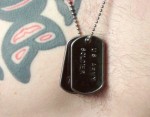
Designer Dominic Muren has created a device that allows a civilian to feel the heartbeat of a soldier:
I think we can all agree that war has become too impersonal. Media coverage emphasizes our distance, and most decision makers in congress don't have children who fight. Beat connects you very directly to a single soldier by thumping their recorded heartbeat against your chest. If they are calm, or worried, or under stress, you feel it. If they die, the heartbeat you feel dies too. If we are going to continue to fight wars, we need better methods of feedback like this one so the costs are more visceral and real for us. Imagine if all politicians were required to wear one of these!!
19:25 Posted in Emotional computing | Permalink | Comments (0) | Tags: affective computing
Time Magazine names Apple iPhone `Invention of the Year'

TIME magazine has named the iPhone "Invention of the Year."
19:15 Posted in Wearable & mobile | Permalink | Comments (0) | Tags: mobile, wearable
Tactile Video Displays
Via Medgadget
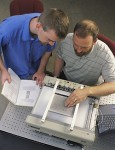
Researchers at National Institute of Standards and Technology have developed a tactile graphic display to help visually impaired people to perceive images.
From the NIST press release
ELIA Life Technology Inc. of New York, N.Y., licensed for commercialization both the tactile graphic display device and fingertip graphic reader developed by NIST researchers. The former, first introduced as a prototype in 2002, allows a person to feel a succession of images on a reusable surface by raising some 3,600 small pins (actuator points) into a pattern that can be locked in place, read by touch and then reset to display the next graphic in line. Each image-from scanned illustrations, Web pages, electronic books or other sources-is sent electronically to the reader where special software determines how to create a matching tactile display. (For more information, see "NIST 'Pins' Down Imaging System for the Blind".)
An array of about 100 small, very closely spaced (1/10 of a millimeter apart) actuator points set against a user's fingertip is the key to the more recently created "tactile graphic display for localized sensory stimulation." To "view" a computer graphic with this technology, a blind or visually impaired person moves the device-tipped finger across a surface like a computer mouse to scan an image in computer memory. The computer sends a signal to the display device and moves the actuators against the skin to "translate" the pattern, replicating the sensation of the finger moving over the pattern being displayed. With further development, the technology could possibly be used to make fingertip tactile graphics practical for virtual reality systems or give a detailed sense of touch to robotic control (teleoperation) and space suit gloves.
Press release: NIST Licenses Systems to Help the Blind 'See' Images
18:40 Posted in Future interfaces | Permalink | Comments (0) | Tags: future interfaces
As soon as the bat met the ball, I knew it was gone
"As soon as the bat met the ball, I knew it was gone": outcome prediction, hindsight bias, and the representation and control of action in expert and novice baseball players.
Psychon Bull Rev. 2007 Aug;14(4):669-75
Authors: Gray R, Beilock SL, Carr TH
A virtual-reality batting task compared novice and expert baseball players' ability to predict the outcomes of their swings as well as the susceptibility of these outcome predictions to hindsight bias--a measure of strength and resistance to distortion of memory for predicted action outcomes. During each swing the simulation stopped when the bat met the ball. Batters marked where on the field they thought the ball would land. Correct feedback was then displayed, after which batters attempted to remark the location they had indicated prior to feedback. Expert batters were more accurate than less-skilled individuals in the initial marking and showed less hindsight bias in the postfeedback marking. Furthermore, experts' number of hits in the previous block of trials was positively correlated with prediction accuracy and negatively correlated with hindsight bias. The reverse was true for novices. Thus the ability to predict the outcome of one's performance before such information is available in the environment is not only based on one's overall skill level, but how one is performing at a given moment.
17:41 Posted in Research tools, Virtual worlds | Permalink | Comments (0) | Tags: virtual reality
High loads induce differences between actual and imagined movement duration
High loads induce differences between actual and imagined movement duration.
Exp Brain Res. 2007 Nov 1;
Authors: Slifkin AB
Actual and imagined action may be governed by common information and neural processes. This hypothesis has found strong support from a range of chronometric studies showing that it takes the same amount of time to actually move and to imagine moving. However, exceptions have been observed when actual and imagined movements were made under conditions of inertial loading: sometimes the equivalency of actual and imagined movement durations (MDs) has been preserved, and other times it has been disrupted. The purpose of the current study was to test the hypothesis that the appearance and magnitude of actual-imagined MD differences in those studies was dependent on the level of load relative to the maximum loading capacity of the involved effector system [the maximum voluntary load (MVL)]. The experiment required 12 young, healthy humans to actually produce, and to imagine producing, single degree of freedom index finger movements under a range of loads (0, 5, 10, 20, 40, and 80% MVL). As predicted, statistically significant actual-imagined MD differences were absent at lower loads (0-20% MVL), but differences appeared and increased in magnitude with further increases in %MVL (40 and 80% MVL). That pattern of results may relate to the common, everyday experience individuals have in interacting with loads. Participants are likely to have extensive experience interacting with very low loads, but not high loads. It follows that the control of low inertial loads should be governed by complete central representations of action, while representations should be less complete for high loads. A consequence may be increases in the uncertainty of predicting motor output with increases in load. Compensation for the increased uncertainty may appear as increases in the MD values selected during both the preparation and imagery of action-according to a speed-uncertainty trade-off. Then, during actual action, MD may be reduced if movement-related feedback indicates that a faster movement would succeed.
12:39 Posted in Mental practice & mental simulation | Permalink | Comments (0) | Tags: mental practice
Using movement imagery and electromyography-triggered feedback in stroke rehabilitation
Effects of movement imagery and electromyography-triggered feedback on arm hand function in stroke patients in the subacute phase.
Clin Rehabil. 2007 Jul;21(7):587-94
Authors: Hemmen B, Seelen HA
OBJECTIVE: To investigate the effects of movement imagery-assisted electromyography (EMG)-triggered feedback (focused on paretic wrist dorsiflexors) on the arm-hand function of stroke patients. DESIGN: Single-blinded, longitudinal, multicentre randomized controlled trial. Measurements were performed (on average) 54 days post stroke (baseline), three months later (post training) and at 12 months post baseline. SETTING: Two rehabilitation centres. SUBJECTS: Twenty-seven patients with a first-ever, ischaemic, subacute stroke. INTERVENTIONS: A reference group received conventional electrostimulation, while the experimental group received arm-hand function training based on EMG-triggered feedback combined with movement imagery. Both groups were trained for three months, 5 days/week, 30 minutes/day, in addition to their therapy as usual. MAIN MEASURES: Arm-hand function was evaluated using the upper extremity-related part of the Brunnstrom Fugl-Meyer test and the Action Research Arm test. RESULTS: During training, Brunnstrom Fugl-Meyer scores improved 8.7 points and Action Research Arm scores by 19.4 points (P < 0.0001) in both groups relative to baseline results, rising to 13.3 and 28.4 points respectively at one year follow-up (P < 0.0001). No between-group differences were found at any time. CONCLUSIONS: EMG-triggered feedback stimulation did not lead to more arm-hand function improvement relative to conventional electrostimulation. However, in contrast to many clinical reports, a significant improvement was still observed in both groups nine months after treatment ceased.
12:35 Posted in Biofeedback & neurofeedback, Mental practice & mental simulation | Permalink | Comments (0) | Tags: mental practice
The use of videotape feedback after stroke
Motor learning and the use of videotape feedback after stroke.
Top Stroke Rehabil. 2007 Sep-Oct;14(5):28-36
Authors: Gilmore PE, Spaulding SJ
BACKGROUND: Efforts have been made to apply motor learning theories to the rehabilitation of individuals following stroke. Motor learning poststroke has not been well investigated in the literature. This research attempted to fill the gap regarding motor learning applied to practice. PURPOSE: This two-group research study attempted to determine the effectiveness of an experimental therapy combining videotape feedback with occupational therapy compared to only occupational therapy in learning the motor skill of donning socks and shoes after stroke. METHOD: Ten participants were randomly assigned to one of the two groups and all participants were videotaped during pretest and up to 10 treatment sessions aimed at donning socks and shoes. Only one group viewed their videotape replay. The acquisition of donning socks and shoes was measured using the socks and shoes subtests of the Klein-Bell Activities of Daily Living Scale and their scores on the Canadian Occupational Performance Measure. RESULTS: There was no significant difference between the two groups and both groups improved. However, the group that received videotape feedback thought they performed better and were more satisfied with their ability to don shoes, lending support for the use of videotape feedback poststroke to improve satisfaction with performance.
12:34 Posted in Cybertherapy | Permalink | Comments (0) | Tags: cybertherapy, rehabilitation