




Oct 12, 2007
The Hands-on Computer

Perceptive Pixel’s Interactive Media Wall (aka the Multi-Touch wall) got the 2007 Breakthrough Award, the annual prize assigned by the journal Popular Mechanics to "cutting-edge projects and ideas leading to a better world". The Minority Report interface supports diverse functions, such as navigate, locate, and manipulate information, all handled through multi-touch gesturing.
22:10 Posted in Future interfaces | Permalink | Comments (0) | Tags: future interfaces
Cue-exposure therapy to decrease alcohol craving in virtual environment
Cue-exposure therapy to decrease alcohol craving in virtual environment.
Cyberpsychol Behav. 2007 Oct;10(5):617-23
Authors: Lee JH, Kwon H, Choi J, Yang BH
During abstinence from alcohol, craving is elicited by the cues and contexts previously associated with alcohol, which contribute to relapse. To prevent the craving and relapse experienced by alcoholics, cue-exposure therapy (CET) has been used to extinguish the association between alcohol and alcohol-related cues and contexts. This study applied CET, using a virtual reality (VR) system, to eight members of an Alcoholics Anonymous group for eight sessions. Cues and contexts most likely to elicit an urge to drink were selected through a preliminary survey in order to compose VR-CET scenarios: a glass, a bottle, food, and a bar were judged to be the most tempting for people in alcohol dependence and abstinence. Using these cues and contexts, a Japanese-style pub and a western bar were created. Each session was administered for 30 minutes by a psychiatrist and included an introduction, immersion, VR navigation, interviews about feelings, and self-report questionnaires about cravings. The eight sessions consisted of initial and closing sessions and person-, object-, and situation-focused sessions. As a result, a reduction in cue-elicited craving after VR-CET was reported. A mean score of 15.75 (SD = 10.91) on the Alcohol Urge Questionnaire in the first session decreased to 11.50 (SD = 5.76) in the final session. This study suggests that using virtual reality can enhance the effectiveness of CET.
21:52 Posted in Cybertherapy | Permalink | Comments (0) | Tags: virtual reality, cybertherapy
Psychosocial stress evoked by a virtual audience
Psychosocial stress evoked by a virtual audience: relation to neuroendocrine activity.
Cyberpsychol Behav. 2007 Oct;10(5):655-62
Authors: Kelly O, Matheson K, Martinez A, Merali Z, Anisman H
A modified version of the Trier Social Stress Test (TSST) was employed to determine whether exposure to a virtual audience using virtual reality (VR) technology would prompt an increase of neuroendocrine activity comparable to that prompted by a real audience. Following an anticipatory period, participants completed a speech or a speech-plus-math challenge in front of either a virtual audience, a panel of judges they were led to believe was behind a one-way mirror, or an audience comprised of confederates. An additional group that had prepared a speech was simply directed to observe the virtual audience but did not deliver the speech. Finally, a control group completed questionnaires for the duration of the experiment. Cortisol samples were obtained upon arrival to the laboratory, just before the challenge, and 15 and 30 minutes after the task. Participants also completed a measure assessing stressor appraisals of the task before and after the challenge. Anticipation of the task was associated with a modest increase of cortisol levels, and a further rise of cortisol was evident in response to the challenge. The neuroendocrine changes evoked by the virtual audience were comparable to those elicited by the imagined audience (behind the one-way mirror) but less than changes evoked by the panel of confederates. Stressor appraisals were higher post-challenge compared to those reported prior to the task; however, appraisals were similar across each group. These data suggest that VR technology may be amenable to evaluating the impact of psychosocial stressors such as the TSST.
21:51 Posted in Virtual worlds | Permalink | Comments (0) | Tags: virtual reality
Stop smoking programs go mobile
Via Textually.org [via Reuters]
Colorado's STEPP and Denver-based ad agency Cactus developed a message system on cell phones with an Internet quit program.
Initially aimed at high school students in Colorado, the state hopes to soon share its fledgling FixNixer program as a technique for all age groups and geographies.
QuitNet.com, one of the most established Web sites for quitting, is also considering more tailored messages to users of its site and a foray into mobile, while quit support groups are popping up on social networks MySpace and Facebook.
18:08 Posted in Persuasive technology | Permalink | Comments (0) | Tags: persuasive technology
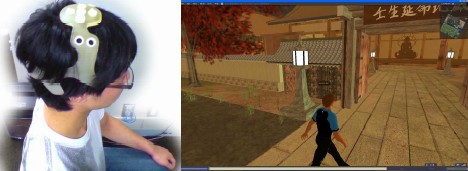
Brain-computer interface for Second Life
18:04 Posted in Brain-computer interface, Virtual worlds | Permalink | Comments (0) | Tags: brain-computer interface, virtual worlds