



Oct 09, 2007
Concentrative meditation enhances preattentive processing
Concentrative meditation enhances preattentive processing: a mismatch negativity study.
Neuroreport. 2007 Oct 29;18(16):1709-1712
Authors: Srinivasan N, Baijal S
23:21 Posted in Meditation & brain | Permalink | Comments (0) | Tags: meditation, neuroscience
Preservation of motor programs in paraplegics
Preservation of motor programs in paraplegics as demonstrated by attempted and imagined foot movements.
Neuroimage. 2007 Aug 23;
Authors: Hotz-Boendermaker S, Funk M, Summers P, Brugger P, Hepp-Reymond MC, Curt A, Kollias SS
Execution and imagination of movement activate distinct neural circuits, partially overlapping in premotor and parietal areas, basal ganglia and cerebellum. Can long-term deafferented/deefferented patients still differentiate attempted from imagined movements? The attempted execution and motor imagery network of foot movements have been investigated in nine chronic complete spinal cord-injured (SCI) patients using fMRI. Thorough behavioral assessment showed that these patients were able to differentiate between attempted execution and motor imagery. Supporting the outcome of the behavioral assessment, fMRI disclosed specific patterns of activation for movement attempt and for motor imagery. Compared with motor execution data of healthy controls, movement attempt in SCI patients revealed reduced primary motor cortex activation at the group level, although activation was found in all single subjects with a high variability. Further comparisons with healthy subjects revealed that during attempt and motor imagery, SCI patients show enhanced activation and recruitment of additional regions in the parietal lobe and cerebellum that are important in sensorimotor integration. These findings reflect central plastic changes due to altered input and output and suggest that SCI patients may require additional cognitive resources to perform these tasks that may be one and the same phenomenon, or two versions of the same phenomenon, with quantitative differences between the two. Nevertheless, the retained integrity of movement attempt and motor imagery networks in SCI patients demonstrates that chronic paraplegics can still dispose of the full motor programs for foot movements and that therefore, attempted and imagined movements should be integrated in rehabilitative strategies.
23:20 Posted in Mental practice & mental simulation | Permalink | Comments (0) | Tags: mental practice
Serious Games approaches to challenging racism in the workplace
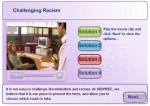
The Institute of Digital Learning at the University of Wales, Newport (UK) has been successfully applying serious games positive technologies as a mechanism of empowering workers with virtual experience and knowledge transfer that allows them to deal with situations relating to Equality & Diversity as they arise in a workplace settings.
For further information and to access the serious games and wider etraining as free resources please visit http://equal.newport.ac.uk
Matt Chilcott and Nick Savage
Institute of Digital Learning, University of Wales, Newport
10:47 Posted in Serious games | Permalink | Comments (0) | Tags: serious gaming