




Feb 19, 2007
Mindfulness in mood disorders
The application of mindfulness-based cognitive interventions in the treatment of co-occurring addictive and mood disorders.
CNS Spectr. 2006 Nov;11(11):829-51
Authors: Hoppes K
This article reviews the theory, clinical application, and empirical findings on mindfulness-based cognitive therapy (MBCT) for mental health and addictive disorders. Expanding upon the research demonstrating the efficacy of cognitive-behavioral therapy (CBT) for addiction, this article develops and explores the rationale for combining mindfulness-based interventions with evidence-based CBTs in treating addictive disorders, with an emphasis on substance use disorders with co-occurring mood disorders. This article proposes that deficits in affect--regulation related to the behavioral and emotional effects of neurobiological changes that occur with long-term substance abuse--pose a unique set of challenges in early recovery. Prolonged use of addictive substances impairs the brain pathways that mediate certain affect regulation functions. These functions involve attention and inhibitory control, the saliency of and response to addictive versus natural reward stimuli, and the ability to detach or maintain perspective in response to strong emotional states. In treating this affective dysregulation, which can contribute to the vulnerability to relapse in the early stages of recovery, the affect-regulation-specific focus of MBCT adds a valuable element to augment CBT for addiction. Summarizing magnetic resonance imaging and positron emission tomography findings on the effects of MBCT and the neurobiology of drug addiction, this article outlines directions for further research on potential benefits of MBCT for the recovering individual. Finally, this article describes a structured protocol, developed at the Mount Sinai School of Medicine in New York City, which combines CBT with mindfulness-based intervention, for the treatment of affect-regulation issues specific to co-occurring addictive and mood disorders.
20:25 Posted in Meditation & brain | Permalink | Comments (0) | Tags: meditation
Low-cost telepresence for collaborative virtual environments
Low-cost telepresence for collaborative virtual environments.
IEEE Trans Vis Comput Graph. 2007 Jan-Feb;13(1):156-66
Authors: Rhee SM, Ziegler R, Park J, Naef M, Gross M, Kim MH
We present a novel low-cost method for visual communication and telepresence in a CAVE -like environment, relying on 2D stereo-based video avatars. The system combines a selection of proven efficient algorithms and approximations in a unique way, resulting in a convincing stereoscopic real-time representation of a remote user acquired in a spatially immersive display. The system was designed to extend existing projection systems with acquisition capabilities requiring minimal hardware modifications and cost. The system uses infrared-based image segmentation to enable concurrent acquisition and projection in an immersive environment without a static background. The system consists of two color cameras and two additional b/w cameras used for segmentation in the near-IR spectrum. There is no need for special optics as the mask and color image are merged using image-warping based on a depth estimation. The resulting stereo image stream is compressed, streamed across a network, and displayed as a frame-sequential stereo texture on a billboard in the remote virtual environment.
00:31 Posted in Telepresence & virtual presence | Permalink | Comments (0) | Tags: telepresence, virtual presence
Virtual Reality Exposure Therapy for PTSD Symptoms
Virtual Reality Exposure Therapy for PTSD Symptoms After a Road Accident: An Uncontrolled Case Series.
Behav Ther. 2007 Mar;38(1):39-48
Authors: Beck JG, Palyo SA, Winer EH, Schwagler BE, Ang EJ
This report examined whether Virtual Reality Exposure Therapy (VRET) could be used in the treatment of posttraumatic stress disorder (PTSD) symptoms in the aftermath of a serious motor vehicle accident. Six individuals reporting either full or severe subsyndromal PTSD completed 10 sessions of VRET, which was conducted using software designed to create real-time driving scenarios. Results indicated significant reductions in posttrauma symptoms involving reexperiencing, avoidance, and emotional numbing, with effect sizes ranging from d=.79 to d=1.49. Indices of clinically significant and reliable change suggested that the magnitude of these changes was meaningful. Additionally, high levels of perceived reality ("presence") within the virtual driving situation were reported, and patients reported satisfaction with treatment. Results are discussed in light of the possibility for VRET to be useful in guiding exposure in the treatment of PTSD following road accidents.
00:30 Posted in Cybertherapy | Permalink | Comments (0) | Tags: cybertherapy
Some notable moments in recorded life
Recent progresses in miniaturization and storage capability have made it possible to record, access, retrieve, and potential sharing, all the generated information of a user's or object's life experience.
Two of the most important projects in this area are Lifelogs (initially funded by DARPA, then killed by the Pentagon in 2004) and Microsoft MyLifeBits
I am fashinated by how these new technologies could radically change psychotherapy and, more generally, how they could fundamentally affect our life.
In this article entitled On the Record, All the Time, Scott Carlson thaces the story and the implications of the introduction of LifeLogging. In the article I found a list of some notable moments in "recorded life":
1900s: The Brownie camera makes photography available to the masses.
1940: President Franklin D. Roosevelt begins recording press conferences and some meetings.
1945: Vannevar Bush, a prominent American scientist, predicts a time when scientists will be photographing their lab work and storing their correspondence in a machine called a "memex."
1960s: Presidents John F. Kennedy and Lyndon B. Johnson record meetings and phone conversations for posterity, which later provides hundreds of hours of programming for C-Span.
1969: The microcassette goes on the market and becomes the voice-recording medium of choice.
1973: An American Family, documenting the domestic drama of the Louds, is the first reality-TV show.
1973-74: President Richard Nixon releases the Watergate tapesjust some of more than 3,500 hours of conversations that he had recordedwhich leads to his resignation.
Late 1970s: Steve Mann, a professor at the University of Toronto, begins dabbling in wearable computing.
Mid-1980s: Fitness nuts are wearing stretch pants and leggings, along with wristwatch-sized devices that measure heart rate and blood pressure. The heart monitors can cost $200 or more.
1991: The first Webcam goes online.
Mid-1990s: Cellphones, digital cameras, and the Internet become commonplace.
1995: Gordon Bell, a computer engineer and entrepreneur, gets involved with Microsoft Research and begins work that will lead him to record various aspects of his life for the MyLifeBits project.
1999: Microsoft Research invents prototype SenseCams, cameras that hang around the neck and continuously snap pictures.
2000: Scrapbooking has a renaissance, leading to new retail stores devoted to a hobby industry now worth $2-billion.
2003: MySpace debuts. 2004: The Final Cut, starring Robin Williams, describes a future where memories are recorded on implanted chips. The Defense Advanced Research Projects Agency drops a lifelogging project amid a furor over privacy. A workshop on the "Continuous Archival and Retrieval of Personal Experiences" convenes at Columbia University.
2005: YouTube appears.
2006: Nokia releases Lifeblog 2.0, which allows people to upload audio notes, photographs, location information, and other records of life events to a database.
00:25 Posted in Research tools | Permalink | Comments (0) | Tags: future interfaces
I4: Interactivity / Information / Interfaces / Immersion
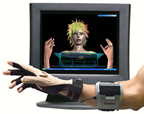
I4: Interactivity / Information / Interfaces / Immersion: International Research Conference, J W Goethe University, Institute of Cultural Anthropology and European Ethnology: Organized by the Research Network for Media Anthropology / FAME, Frankfurt: October 24-26, 2007.
Even before the emergence of social software, web logs and wikis, it was clear that digital communication technologies are, in essence, complex social software programs with the power to change people's perception, the way people experience their environment, their ability to abstract, their rules of trust, and much more besides. Whereas the 1980s and 1990s were marked by "quasi-social" connections between people that occurred en passant, by strategies of urban artistic "repurposing" (Digital Amsterdam), by a conspiracy of Internet-using consumers, and by a user-based cyber society, the situation has now changed fundamentally.
There has been a shift from technology-driven systems to media-driven systems and then to user/project-generated content. As the empiricism of the artificial becomes a global given, social, cultural, economic and political frames of reference are shifting. Countless new and unparalleled means of modeling social factors are emerging within a mesh of agencies around the world. Digital natives - those who have grown up with computer and internet applications - have spawned a societal and cultural paradigm shift. Societal and cultural geography is being extended by a global scenography of cultural artifacts. However, this raises important issues concerning the logic of the continuity of interaction, of a reliable and sustained presence, of adaptive learning and abstraction - issues that have become social markers in the programming, utilization, and onward development of applications, platforms and environments.
Increasingly, today's designs and programs for digital worlds face the challenge of delivering complex, multisensory, transcultural, and global interaction capabilities in a robust technology-based environment. The changes are creating a need for the explicit modeling of human collaboration and cultural interaction which, increasingly, is causing software production to move out of the high-tech niche of computer science and media design into the realm of cultural and social anthropology. At the same time, there is a growing need to know more about the logic of construction (v. Glaserfeld) of culture and to be able to apply that knowledge. The need for explicit and programmable cultural concepts is moving closer to the science of the artificial as proposed by Herbert A. Simon and echoes Norbert Elias's call for the scientific presentation of a developmental theory of abstraction.
Clearly, it would be wrong to assume that explicit, programmed models for collaboration, the creation of cultures, abstraction and artificial environments can eradicate the complexities of chance relationships, interaction, imagination, fiction, routine, or forgetfulness. Nonetheless, the possibilities they offer will be changed fundamentally by the emergence of programmed worlds and environments. All over the globe, artificial cybernetic spaces are something now taken for granted. Computer technology is designed to be ubiquitous, and the direct control of computers by means of brain waves is supplanting control by means of a pointing device or the human eye. Presence and telepresence, key concepts in earlier research, are receding into the background with the advent of computer technologies which can be inserted under the skin, into clothing, and into the eyes and ears or can generate realities in their own right without which the frames of reference of today's and tomorrow's realities will become meaningless. Ten years ago, S. Jones asked, "Where are we when we are online?" and J. Meyrowitz noted "being elsewhere." Electronic games, e-sports, and around a billion people working in countless local area networks all exist in a vireality (M. Klein). What are the living, communication and working circumstances in these virealities? How should virtual spaces be designed in order to provide sufficiently complex environments for perception, design, decision-making, routine, trust, etc.?
The > I4
We assume that all human sensory and mental capabilities and the ability to abstract, conceive and implement things are, and have been, involved in the development of human ability to use media.
The concept of media encompasses perception, abstraction, storage, rules for the retention of information - of texts and holytexts, the great sagas, manifestations of cultural memory - and progression beyond existing knowledge paradigms. It is impossible to determine how perception and interaction will impact on media, either qualitatively or quantitatively. If the notion of a uniting organization is seen as a selection method or principle, the weight of these ideas becomes clear. They show that every form of interactive reciprocity is a selector and that the uniting force of interactivity lies in the definition of selection, distribution and retention criteria. This applies to methods of hearing, reading, writing, tasting, thinking, making music, and much more besides.
Increasingly, we expect and demand more from media - more information, more breadth of choice, more freedom of choice, more world, more closeness, more entertainment, more biography, more community: We want media to address us, entertain us, inform us. This is about more than consuming media. Our sense of reality has long since been subsumed into a sense of media; our sense of reality is embodied in our sense of media. We take the world presented through media seriously, we recognize the reality of information; we trust the information and the rules that make it credible.
The conference will be devoted to questions surrounding digital environments and the technology-based generation of cultural patterns in four areas: Interactivity / Information / Interfaces / Immersion.
We invite submissions which explore these issues and offer answers to such questions as:What connections can we currently identify between software development and cultural evolution? What significance can be attached to co-evolutionary processes in perception, abstraction, forms of virtualization, digital technologies and communication capabilities? What kinds of virtual spaces are developing? How are digital communication spaces influencing urbanization processes and the architecture of buildings? What significance does game software have in creating new social and cultural contexts? What kinds of cooperative and collaborative processes are developing? What are the defining properties of an explicit model of social constructs in a technology-based media environment? How are means of digital communication influencing children's and adults' living spaces and interior architecture? How can a transition from the idiocy of the masses and the knowledge of the crowd into a knowledge-generating virtual community be explained? Can we see signs of an emerging virtual civilization? How will network-integrated community building be important in the future? How are learning and the structure and legitimation of knowledge changing?
Please submit ideas for topics and papers (500 words max.) by March 31, 2007
Initiators and contacts:
Prof. Manfred Faßler
FAME - Frankfurt/ Research Network for Media Anthropology, Institute of Cultural Anthropology and European Ethnology J W. Goethe University fasslermanfred[at]aol.comDr. Mark Mattingley-Scott
Institute of Cultural Anthropology and European Ethnology
J W. Goethe University
scott[at]de.ibm.com
00:05 Posted in Positive Technology events | Permalink | Comments (0) | Tags: social computing