




Jan 25, 2007
Second Life gets virtual mobile operator
From Textually.org

Vodafone is planning to launch itself as a mobile operator in the game Second Life alongside its Vodafone Island area within the popular virtual world, reports TechDigest
"Second Life users will be able to use branded handsets to call each other within the world, as well as send text messages."
Second Life Cell Phones can SMS real world Phones
22:06 Posted in Virtual worlds, Wearable & mobile | Permalink | Comments (0) | Tags: virtual reality, second life
Prospero - A "Visual Commons" Framework for Community-Aware Public Displays
Re-blogged from Networked Performance
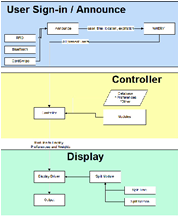
Information about the community as a commons and about commons in the community can be useful for promoting a sense of shared fate and shared identity. In addition, as mobility increases, information about how a community moves into, out of, and through its spaces (such as public commons) can be a useful source of community feedback. A new project at the University of Michigan investigates using public displays to understand and represent community dynamics and preferences:
Prospero is an infrastructure to enable public displays to reflect evolving public participation. The objectives of the Prospero project arise from two primary motivations: one descriptive, the other normative. First, technologies that foster cooperation enhance our relationship to our surroundings. Many of these technologies incorporate user feedback in real-time.
Second, our team members believe that a society in which collective decision-making is based on participatory democracy and public resources should be allocated not by top-down or centrally-controlled mechanisms, but on the basis of the expressed desires and needs of participants. As cooperation increases, we have seen a resurgence of "the commons," i.e. that public sphere in which community values are expressed.
In our project, we shall explore this theme through its instantiation in the specific domain area of public displays. In much of modern life, public spaces, public media and public art are designed to send us messages that we passively receive, process and absorb. However, we believe that in a democracy, citizens must actively shape the public sphere. This necessitates "talking back" to the elements that constitute the public sphere. Public displays, that is, displays located in public spaces and accessible to a public, constitute an increasingly important element of the public sphere. We will develop an infrastructure for community-aware public displays that are controlled by users' expressed needs and preferences; we see our endeavor as part of an ongoing, democratic reclaiming, by citizens, of control over an increasing number of aspects of the public sphere in general.
Thus, by making a public display that is attentive to its community of users, a Visual Commons, it becomes possible for the community to escape the present hegemony of one-way communication, or "broadcast," of generic information (such as the time, or stock prices) or the barrage of mass-media advertising (such as occurs in New York City's Times Square). In effect, dynamic processing of community feedback regarding the contents of the display enables it to become more than just a billboard.
22:00 Posted in Information visualization, Social Media | Permalink | Comments (0) | Tags: social computing
Neurofeedback
Annotation: Neurofeedback - train your brain to train behaviour.
J Child Psychol Psychiatry. 2007 Jan;48(1):3-16
Authors: Heinrich H, Gevensleben H, Strehl U
Background: Neurofeedback (NF) is a form of behavioural training aimed at developing skills for self-regulation of brain activity. Within the past decade, several NF studies have been published that tend to overcome the methodological shortcomings of earlier studies. This annotation describes the methodical basis of NF and reviews the evidence base for its clinical efficacy and effectiveness in neuropsychiatric disorders. Methods: In NF training, self-regulation of specific aspects of electrical brain activity is acquired by means of immediate feedback and positive reinforcement. In frequency training, activity in different EEG frequency bands has to be decreased or increased. Training of slow cortical potentials (SCPs) addresses the regulation of cortical excitability. Results: NF studies revealed paradigm-specific effects on, e.g., attention and memory processes and performance improvements in real-life conditions, in healthy subjects as well as in patients. In several studies it was shown that children with attention-deficit hyperactivity disorder (ADHD) improved behavioural and cognitive variables after frequency (e.g., theta/beta) training or SCP training. Neurophysiological effects could also be measured. However, specific and unspecific training effects could not be disentangled in these studies. For drug-resistant patients with epilepsy, significant and long-lasting decreases of seizure frequency and intensity through SCP training were documented in a series of studies. For other child psychiatric disorders (e.g., tic disorders, anxiety, and autism) only preliminary investigations are available. Conclusions: There is growing evidence for NF as a valuable treatment module in neuropsychiatric disorders. Further, controlled studies are necessary to establish clinical efficacy and effectiveness and to learn more about the mechanisms underlying successful training.
21:46 Posted in Biofeedback & neurofeedback | Permalink | Comments (0) | Tags: neurofeedback