




Dec 20, 2006
Mobile social networking growing
Re-blogged from Mobile blog
ABI Research have released news that they believe users of mobile social networking will rise to more than 170 million by 2011, up from the estimated 50 million now."
The rapid rise of online social communities - gathering places such as MySpace and Facebook - has done more than bring the 'pen pal' concept into the 21st century," says vice president of research Clint Wheelock. "It has created a new paradigm for personal networking. In a logical progression, many social communities are now based on the mobile phone and other portable wireless devices instead of (or as well as) the PC. Such mobile social communities extend the reach of electronic social interaction to millions of people who don't have regular or easy access to computers."
23:00 Posted in Social Media | Permalink | Comments (0) | Tags: mobile social software
WE (you) are TIME's Person of the Year

You -- Yes, You -- Are TIME's Person of the Year by Lev Grossman
22:58 | Permalink | Comments (0) | Tags: time person of the year
Mobile Presence
From Networked Performance (via Pasta and Vinegar)
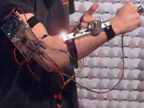
MoPres: Sense and contribute to the ghosty presences around you by Jane Oh, Alex Bisceglie:
MoPres brings out the residual presence of the people who occupied your current location. It is a geotagging project with the humanized `context' of the locations. The raw data is from bio-metric sensers rather than the conscious, forceful, and mostly inaccurate logging which will provide a more creative and sophisticated flexibility of interpretation on the experiences of people
User Scenario: People wear the vest with embedded sensor package [heart rate and body temperature sensors], and the data is logged through the cell phone with geo tagging [gps and/or cell-tower id]. Once the mobile application reads the pattern of the data in relation to locations, it triggers the output devices embedded in the vest [heater and the pulse motor] with relevant residual patterns so that people can experience others' past experiences at the given spot.
22:57 Posted in Wearable & mobile | Permalink | Comments (0) | Tags: mobile, wereable, mediated social presence
Key players in mobile social software
key players in the MoSoSo arena:
Dodgeball, Enpresence, Jambo Networks, Loopt, Mologogo, My MoSoSo, Pinppl, PlaceSite, Plazes, Saki Mobile, Nokia Sensor, Microsoft SLAM, Vixo, Zingku
22:45 Posted in Social Media, Wearable & mobile | Permalink | Comments (0) | Tags: mobile social software
Top 25 Questions About Brain Fitness
Elkhonon Goldberg, Alvaro Fernandez and Caroline Latham (Sharpbrains) have written Brain Fitness for Sharp Brains: Your New New Year Resolution, an introductory guide to the concept, science, and practice of brain fitness
A free copy of the report can be ordered here
22:30 Posted in Brain training & cognitive enhancement | Permalink | Comments (0) | Tags: brain training, cognitive enhancement
Positive effects of cognitive training on daily function and cognitive abilities
Via Smart Mobs
The Journal of the American Medical Association (JAMA) has published a study entitled "Long-term Effects of Cognitive Training on Everyday Functional Outcomes in Older Adults" that shows the positive effects of cognitive training on daily function and cognitive abilities.
Authors: Sherry L. Willis, PhD; Sharon L. Tennstedt, PhD; Michael Marsiske, PhD; Karlene Ball, PhD; Jeffrey Elias, PhD; Kathy Mann Koepke, PhD; John N. Morris, PhD; George W. Rebok, PhD; Frederick W. Unverzagt, PhD; Anne M. Stoddard, ScD; Elizabeth Wright, PhD.
JAMA. 2006;296:2805-2814.
Context. Cognitive training has been shown to improve cognitive abilities in older adults but the effects of cognitive training on everyday function have not been demonstrated. Objective. To determine the effects of cognitive training on daily function and durability of training on cognitive abilities. Design, Setting, and Participants. Five-year follow-up of a randomized controlled single-blind trial with 4 treatment groups. A volunteer sample of 2832 persons (mean age, 73.6 years; 26% black), living independently in 6 US cities, was recruited from senior housing, community centers, and hospitals and clinics. The study was conducted between April 1998 and December 2004. Five-year follow-up was completed in 67% of the sample. Interventions. Ten-session training for memory (verbal episodic memory), reasoning (inductive reasoning), or speed of processing (visual search and identification); 4-session booster training at 11 and 35 months after training in a random sample of those who completed training. Main Outcome Measures. Self-reported and performance-based measures of daily function and cognitive abilities. Results. The reasoning group reported significantly less difficulty in the instrumental activities of daily living (IADL) than the control group (effect size, 0.29; 99% confidence interval [CI], 0.03-0.55). Neither speed of processing training (effect size, 0.26; 99% CI, –0.002 to 0.51) nor memory training (effect size, 0.20; 99% CI, –0.06 to 0.46) had a significant effect on IADL. The booster training for the speed of processing group, but not for the other 2 groups, showed a significant effect on the performance-based functional measure of everyday speed of processing (effect size, 0.30; 99% CI, 0.08-0.52). No booster effects were seen for any of the groups for everyday problem-solving or self-reported difficulty in IADL. Each intervention maintained effects on its specific targeted cognitive ability through 5 years (memory: effect size, 0.23 [99% CI, 0.11-0.35]; reasoning: effect size, 0.26 [99% CI, 0.17-0.35]; speed of processing: effect size, 0.76 [99% CI, 0.62-0.90]). Booster training produced additional improvement with the reasoning intervention for reasoning performance (effect size, 0.28; 99% CI, 0.12-0.43) and the speed of processing intervention for speed of processing performance (effect size, 0.85; 99% CI, 0.61-1.09). Conclusions. Reasoning training resulted in less functional decline in self-reported IADL. Compared with the control group, cognitive training resulted in improved cognitive abilities specific to the abilities trained that continued 5 years after the initiation of the intervention.
Link to full-text article
Link to Washington Post report about the study
22:10 Posted in Brain training & cognitive enhancement | Permalink | Comments (0) | Tags: brain training, cognitive enhancement
Integration of motor imagery and physical practice in PD patients
Integration of motor imagery and physical practice in group treatment applied to subjects with Parkinson's disease.
Neurorehabil Neural Repair. 2007 Mar;21(1):68-75
Authors: Tamir R, Dickstein R, Huberman M
BACKGROUND: and PURPOSE: The application of motor imagery practice in the treatment of Parkinson's disease (PD) is a novel treatment approach for improving motor function. The purpose of this study was to compare group treatment using a combination of physical and motor imagery practice with group treatment using only physical practice in subjects with PD. METHODS: . Of 23 patients with idiopathic PD, 12 received combined therapy, whereas 11 received physical therapy alone. Exercises for both groups were applied during 1-h sessions held twice a week for 12 weeks. Comparable motor tasks provided to both groups included callisthenic exercises, functional tasks, and relaxation exercises. However, the experimental group was treated with both imagery and real practice, whereas the control group received only physical exercises. Outcome measures included the time required to complete sequences of movements, the performance of balance tasks, impairment and functional scores on the Unified Parkinson's Disease Rating Scale (UPDRS), and specific cognitive abilities (Stroop and clock drawing tests). RESULTS: . Following the intervention, the combined treatment group exhibited significantly faster performance of movement sequences than the control group. In addition, the experimental subjects demonstrated higher gains in the mental and motor subsets of the UPDRS and in the cognitive tests. Both groups improved on the activities of daily living scale. CONCLUSIONS: . The combination of motor imagery and real practice may be effective in the treatment of PD, especially for reducing bradykinesia. The implementation of this treatment regimen allows for the extension of practice time with negligible risk and low cost.
21:37 Posted in Mental practice & mental simulation | Permalink | Comments (0) | Tags: mental practice
Studies of advanced stages of meditation in the tibetan buddhist and vedic traditions
Studies of advanced stages of meditation in the tibetan buddhist and vedic traditions. I: a comparison of general changes.
Evid Based Complement Alternat Med. 2006 Dec;3(4):513-21
Authors: Hankey A
This article is the first of two comparing findings of studies of advanced practitioners of Tibetan Buddhist meditation in remote regions of the Himalayas, with established results on long-term practitioners of the Transcendental Meditation programs. Many parallel levels of improvement were found, in sensory acuity, perceptual style and cognitive function, indicating stabilization of aspects of attentional awareness. Together with observed increases in EEG coherence and aspects of brain function, such changes are consistent with growth towards a state of total brain functioning, i.e. development of full mental potential. They are usually accompanied by improved health parameters. How they may be seen to be consistent with growth of enlightenment will be the subject of a second article.
21:36 Posted in Meditation & brain | Permalink | Comments (0) | Tags: meditation
ESP: Emotional Social Intelligence Prosthesis
Technology does not naturally sense nonverbal cues such as facial expressions and tone of voice, and does not easily acquire common sense knowledge about people. These "mindreading" functions also do not come naturally for some people, such as those diagnosed with autism. ESP is an affective wearable system that explores ways to augment and enhance the wearer's emotional-social intelligence. ESP's computational model of mind-reading infers in real time affective-cognitive mental states from nonverbal cues such as head and facial displays of people, and communicates these inferences to the wearer via visual, sound, and tactile feedback.
Our work leverages the advances in affect sensing and perception to (1) develop technologies that are sensitive to people's affective-cognitive states; (2) advance autism research and (3) create new technologies that enhance the social-emotional intelligence of people diagnosed with autism, as well as those who are not.
The project addresses open research challenges pertaining to whether machines can augment social interactions in a way that improves human to human communication. A longer term aim is to use the prosthesis as an assistive and therapeutic device for people with Autism Spectrum Disorder.
00:27 Posted in Emotional computing | Permalink | Comments (0) | Tags: emotional computing