




Sep 21, 2006
OpenStim: The Open Noninvasive Brain Stimulator
Via The Neurodudes
The goal of the project "OpenStim" is to design a simple, safe, effective transcranial magnetic stimulation (TMS) for modulation of emotion, sleep, attention, and other central nervous system properties. TMS system price often exceeds $50.000. The project's team aims to develop a TMS device that will be constructable by a practitioner skilled in electrical engineering, for less than $400.
Also, all the knowledge generated by the project is released under the Creative Commons “Attribution and Sharealike” license. This is a new model for “open source” medical device development — which may move it beyond the domain of simply creating “cool toys,” and to creating real devices.
From the OpenStim website:
The project comprises at least the following 8 components. The logical way to begin is to A) figure out the field geometry desired at the specific depth under the skull, B) design a prototype coil, preferably with standardized values, C) pick the capacitor and resistor adjoining, D) work your way back to the power supply. 1. a reinforced coil (e.g., of copper wire) geometrically appropriate for stimulating the brain (e.g., a figure-8 coil, containing two circular loops, between 3 and 7 cm in diameter),
1b. a testing tank which would hold saline, to mimic the volume conductor of the brain, and thereby permit the electric field to be mapped for various coils and pulse protocols,
2. the control circuitry for charging up a high-capacity capacitor or bank of capacitors, via a power supply
3. mechanical hardware for holding and positioning the coil with respect to the head,
4. safety circuitry that limits the current discharged and the repetition rate of the stimulator,
5. an optional measurement device (e.g., fluxgate magnetometer) to measure the magnetic field induced, and
6. computer software and interface hardware for connecting a computer to the control circuitry, and for displaying hardware status and/or error events.
7. integration with EEG or IR was brought up by many attendees of the session at Foo Camp. The contributors decided this should be built in, a priori.
8. OTHER THOUGHT: transcranial direct current stimulation (tDCS) has, like TMS, been shown to improve working memory and mood. Shall we design our TMS device with the capability of doing simultaneous tDCS? It could complicate things somewhat. Hoewver, the methodology is dead simple — apply a DC current across two electrodes, attached to the scalp! system connected to an AC wall source or battery source, and then controlling the discharge of the capacitor into the coil,
20:07 Posted in Neurotechnology & neuroinformatics | Permalink | Comments (0) | Tags: transcranial magnetic stimulation
Electrical stimulation of the brain can create the sensation of a "shadow person"
Via KurzweilAI.net
Olaf Blanke and colleagues at the Federal Polytechnic School of Lausanne have found electrical stimulation of the brain can create the sensation of a "shadow person" mimicking one's bodily movements.
During a neurological assessment of a woman, doctors stimulated the left temporoparietal junction area of the brain. This stimulation caused her to believe a person was standing behind her. The patient reported that "person" adopted the same bodily positions as her, although she didn't recognize the effect as an illusion.
The discovery, reported in this week's issue of the journal Nature, might foster the understanding of psychiatric phenomena such as feelings of paranoia, persecution and alien control, Swiss researchers say.
19:57 Posted in Neurotechnology & neuroinformatics | Permalink | Comments (0) | Tags: brain stimulation
Follow-up study of learning-disabled children treated with neurofeedback or placebo
Follow-up study of learning-disabled children treated with neurofeedback or placebo.
Clin EEG Neurosci. 2006 Jul;37(3):198-203
Authors: Becerra J, Fernández T, Harmony T, Caballero MI, García F, Fernández-Bouzas A, Santiago-Rodríguez E, Prado-Alcalá RA
This report is a 2-year follow-up to a previous study describing positive behavioral changes and a spurt of EEG maturation with theta/alpha neurofeedback (NFB) training in a group of Learning Disabled (LD) children. In a control paired group, treated with placebo, behavioral changes were not observed and the smaller maturational EEG changes observed were easily explained by increased age. Two years later, the EEG maturational lag in Control Group children increased, reaching abnormally high theta Relative Power values; the absence of positive behavioral changes continued and the neurological diagnosis remained LD. In contrast, after 2 years EEG maturation did continue in children who belonged to the Experimental Group with previous neurofeedback training; this was accompanied by positive behavioral changes, which were reflected in remission of LD symptoms.
19:33 Posted in Biofeedback & neurofeedback | Permalink | Comments (0) | Tags: neurofeedback
E-garments
Via WMMNA
Philips Design has prototyped two garments that demonstrate how electronics can be incorporated into fabrics and clothes to express the emotions and personality of the wearer.
Bubelle, the "blushing dress" comprises two layers, the inner one is equipped with sensors that respond to changes in the wearer's emotions and projects them onto the outer textile. It behaves differently depending on who is wearing it. The other prototype is Frison, a body suit that reacts to being blown on by igniting a private constellation of tiny LEDs. Both measure skin signals and change light emission through biometric sensing technology.
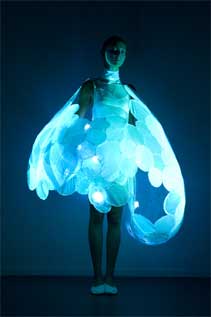
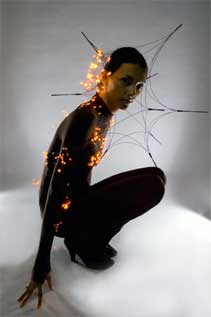
Design Probe is an in-house far-future research program that considers what lifestyles might be like in 2020.The SKIN probe project is part of the program and challenges the notion that our lives are automatically better because they are more digital. It looks at more 'analog' phenomena like emotional sensing, exploring technologies that are 'sensitive' rather than 'intelligent'. Two outfits have been developed as part of SKIN to identify a new way of communicating with those around us by using garments as proxies to convey deep feelings that are difficult to express in words.
The Bubelle - Blush Dress comprises two layers, the inner layer of which is equipped with sensors that respond to changes in the wearer's emotions and projects them onto the outer textile. The body suit Frisson has LEDs that illuminate according to the wearer's state of excitement. Both measure skin signals and change light emission through biometric sensing technology.
Download images here
Read the full press release
10:35 Posted in Emotional computing, Wearable & mobile | Permalink | Comments (0) | Tags: emotional computing, wearable