




Jul 05, 2006
Awareness and Accountability in MM Online Worlds
Doing Virtually Nothing: Awareness and Accountability in Massively Multiplayer Online Worlds
Robert J. Moore , Nicolas Ducheneaut and Eric Nickell.
To date the most popular and sophisticated types of virtual worlds can be found in the area of video gaming, especially in the genre of Massively Multiplayer Online Role Playing Games (MMORPG). Game developers have made great strides in achieving game worlds that look and feel increasingly realistic. However, despite these achievements in the visual realism of virtual game worlds, they are much less sophisticated when it comes to modeling face-to-face interaction. In face-to-face, ordinary social activities are "accountable," that is, people use a variety of kinds of observational information about what others are doing in order to make sense of others' actions and to tightly coordinate their own actions with others. Such information includes: (1) the real-time unfolding of turns-at-talk; (2) the observability of embodied activities; and (3) the direction of eye gaze for the purpose of gesturing. But despite the fact that today's games provide virtual bodies, or "avatars," for players to control, these avatars display much less information about players' current state than real bodies do. In this paper, we discuss the impact of the lack of each type of information on players' ability to tightly coordinate their activities and offer guidelines for improving coordination and, ultimately, the players' social experience.
23:43 Posted in Telepresence & virtual presence | Permalink | Comments (0) | Tags: social presence
Panasonic Emotions Testing Line
Re-blogged from Networked Performance
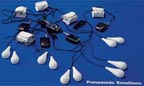
The Panasonic Emotions Testing Line, by "nomadic" development designer JIŘÍ ČERNICKÝ, is a conceptual SD audio-prosthesis that aims to grasp the issue of the emotional deficits in society.
The device is a substitute, personal container for the emotions of users who are not able, or do not want, to experience life through their own emotional perceptions. It looks like a Walkman-type device with headphones that does not play music inside, but rather outside, of the head. The device facilitates the user's emotional communication with the world around him. It is not designed for his/her personal use only but is equipped with a tiny amplifier.
The memory of the SD Audio Player chip card contains a great amount of data containing recordings of authentic human emotions. For instance, if the user finds himself in a situation where he has to argue with someone, yet he does not want to get into confrontation and to waste his own emotions, he locates a password on his SD Audio Player representing an appropriate emotional response, which he then applies accordingly.
The SD Audio Player can also record and thus appropriate other people's emotions: sniveling, peevishness, sobbing, moaning, crying, gradual emotional collapse, breakdown, yelling by a beaten person, the state of mind between laughter and crying, the hysterical family argument from Fellini's film Amarcord, pubescent giggling, comforting and fondling of a baby, a feeling of well-being, enthusiastic effusions, wearing somebody out, cuddling, soothing, etc. Such recordings, including those from movies, can be further edited and modified on a computer. In this way, the user can appropriate the emotions that are conveyed by celebrities and other prominent individuals.

23:35 Posted in Emotional computing | Permalink | Comments (0) | Tags: emotional computing
Handheld Augmented Reality
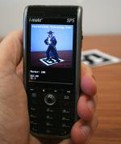 Handheld Augmented Reality: A standard, off-the-shelf Personal Digital Assistant (PDA) constitutes a cost-effective and lightweight hardware platform for Augmented Reality (AR). A PDA provides a simple, well-known user interface, and is fully equipped with a touch-screen and camera for providing a video see-through Magic Lens metaphor of interaction. In our Handheld AR framework, all interactive processing is done exclusively on the PDA without relying on a server infrastructure, which makes this solution highly scalable. Because of the low cost and suitable ergonomic properties of the PDA platform, massive multi-user AR application become possible for the first time.
23:32 Posted in Augmented/mixed reality, Wearable & mobile | Permalink | Comments (0) | Tags: augmented reality
The MagicBook
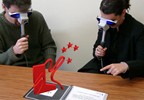
The MagicBook explores seamless transition between reality and virtual reality. When users look at the pages of a real book through a hand held display, they are able to see virtual content superimposed over the real pages, that is augmented reality. When they see an augmented reality scene they like, users can fly into the scene and experience it as an immersive virtual environment. Currently the user can transition smoothly between these two fixed viewing modes: the augmented-reality view and the virtual-reality view.
23:29 Posted in Augmented/mixed reality | Permalink | Comments (0) | Tags: augmented reality
Hearing with Your Eyes
Via Medgadget
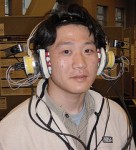
Manabe Hiroyuki has developed a machine that could eventually allow you to control things in your environment simply by looking at it. From the abstract:
A headphone-type gaze detector for a full-time wearable interface is proposed. It uses a Kalman filter to analyze multiple channels of EOG signals measured at the locations of headphone cushions to estimate gaze direction. Evaluations show that the average estimation error is 4.4® (horizontal) and 8.3® (vertical), and that the drift is suppressed to the same level as in ordinary EOG. The method is especially robust against signal anomalies. Selecting a real object from among many surrounding ones is one possible application of this headphone gaze detector. Soon we'll be able to turn on the Barry Manilow and turn down the lights with a simple sexy stare.
23:17 Posted in Future interfaces | Permalink | Comments (0) | Tags: future interfaces