




May 15, 2006
Daegu to Launch 'Ubiquitous' Health Monitoring
From Smart Mobs
Daegu in South Korea "will be the first city in the country to provide a “ubiquitous” healthcare service in which so-called wearable computers will be used to monitor the health of elderly people living alone and patients with chronic diseases,"this article says."The devices,in the form of shirts,alert medical staff in real time when an emergency occurs.Daegu City said Thursday that it will launch its groundbreaking “U-Healthcare Service” in cooperation with the Ministry of Information and Communication.The city will distribute the bio-shirts to some 100 elderly people and patients with chronic diseases later this year.The shirts have embedded sensors that register vital signs and send the information to medical centers through the network. They also permit self-diagnosis, distance monitoring, emergency care and medical consultation for users in an environment of ubiquitous connectivity"
Daegu to Launch 'Ubiquitous' Health Monitoring
22:22 Posted in Wearable & mobile | Permalink | Comments (0) | Tags: Positive Technology
Powered Shoes
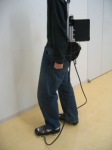
It has often been suggested that the best locomotion mechanism for virtual worlds would be walking, and it is well known that the sense of distance or orientation while walking is much better than while riding in a vehicle. However, the proprioceptive feedback of walking is not provided in most virtual environments. Powered Shoes is a revolutionary advance for entertainment and simulation applications, because it provides this proprioceptive feedback.
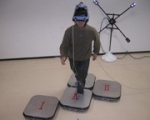
CirculaFloor is a locomotion interface using a group of movable floors. The movable floors employ a holonomic mechanism that achieves omni-directional motion. Circulation of the floors enables users to walk in arbitrary directions in a virtual environment while their positions are maintained
22:05 Posted in Virtual worlds | Permalink | Comments (0) | Tags: Positive Technology
Group Cognition

Innovative uses of global and local networks of linked computers make new ways of collaborative working, learning, and acting possible. In Group Cognition Gerry Stahl explores the technological and social reconfigurations that are needed to achieve computer-supported collaborative knowledge building--group cognition that transcends the limits of individual cognition. Computers can provide active media for social group cognition where ideas grow through the interactions within groups of people; software functionality can manage group discourse that results in shared understandings, new meanings, and collaborative learning. Stahl offers software design prototypes, analyzes empirical instances of collaboration, and elaborates a theory of collaboration that takes the group, rather than the individual, as the unit of analysis.
Stahl's design studies concentrate on mechanisms to support group formation, multiple interpretive perspectives, and the negotiation of group knowledge in applications as varied as collaborative curriculum development by teachers, writing summaries by students, and designing space voyages by NASA engineers. His empirical analysis shows how, in small-group collaborations, the group constructs intersubjective knowledge that emerges from and appears in the discourse itself. This discovery of group meaning becomes the springboard for Stahl's outline of a social theory of collaborative knowing. Stahl also discusses such related issues as the distinction between meaning making at the group level and interpretation at the individual level, appropriate research methodology, philosophical directions for group cognition theory, and suggestions for further empirical work.
21:50 Posted in Social Media | Permalink | Comments (0) | Tags: Positive Technology
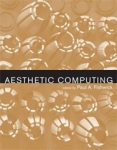
Aesthetic Computing
From Amazon
In Aesthetic Computing, key scholars and practitioners from art, design, computer science, and mathematics lay the foundations for a discipline that applies the theory and practice of art to computing. Aesthetic computing explores the way art and aesthetics can play a role in different areas of computer science. One of its goals is to modify computer science by the application of the wide range of definitions and categories normally associated with making art. For example, structures in computing might be represented using the style of Gaudi or the Bauhaus school. This goes beyond the usual definition of aesthetics in computing, which most often refers to the formal, abstract qualities of such structures--a beautiful proof, or an elegant diagram. The contributors to this book discuss the broader spectrum of aesthetics--from abstract qualities of symmetry and form to ideas of creative expression and pleasure--in the context of computer science. The assumption behind aesthetic computing is that the field of computing will be enriched if it embraces all of aesthetics. Human-computer interaction will benefit--"usability," for example, could refer to improving a user's emotional state--and new models of learning will emerge.
Aesthetic Computing approaches its subject from a variety of perspectives. After defining the field and placing it in its historical context, the book looks at art and design, mathematics and computing, and interface and interaction. Contributions range from essays on the art of visualization and "the poesy of programming" to discussions of the aesthetics of mathematics throughout history and transparency and reflectivity in interface design.
21:45 Posted in Emotional computing | Permalink | Comments (0) | Tags: Positive Technology