




Mar 23, 2006
Virtual reality machine gives police hallucinations
From Desmoinesregister
Tom Alex
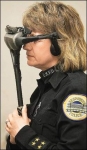 Des Moines Police Officer Paul Tieszen stepped onto a city bus and into a world he's only heard about.
"Things flash out of nowhere. Small voices saying, 'Go get your medication.' The bus driver is talking to you normally and all of a sudden he starts calling you 'Your Highness.' Then he becomes part of the hallucination," says Tieszen. "It's a whole busload of children, then it changes to a busload of adults. There's a nurse involved. You see normal things and then all of a sudden someone pulls up next to you and says, 'Get off the bus.' "
The bus wasn't real, but the officer's reactions were. And he quickly got a glimpse of what it's like to suffer from a severe mental illness.
Tieszen's window into the world of hallucinations was provided by a high-tech virtual reality mask that police use to better understand the mentally ill people they come in contact with.
"You are in the role of the individual on the bus," he said, trying to describe the experience. "You are seeing what is in the mind of someone who is like that."
The device is called a virtual hallucination machine. It was introduced to police by Teresa Bomhoff, president of the National Alliance for the Mentally Ill of Greater Des Moines....
Read the full article
20:45 Posted in Virtual worlds | Permalink | Comments (0) | Tags: Positive Technology
Functional Magnetic Resonance Imaging Investigation of the Effects of Neurofeedback Training on Children
Functional Magnetic Resonance Imaging Investigation of the Effects of Neurofeedback Training on the Neural Bases of Selective Attention and Response Inhibition in Children with Attention-Deficit/Hyperactivity Disorder.
Appl Psychophysiol Biofeedback. 2006 Mar 22;
Authors: Beauregard M, Lévesque J
Two functional magnetic resonance imaging (fMRI) experiments were undertaken to measure the effect of neurofeedback training (NFT), in AD/HD children, on the neural substrates of selective attention and response inhibition. Twenty unmedicated AD/HD children participated to these experiments. Fifteen children were randomly assigned to the Experimental (EXP) group whereas the other five children were randomly assigned to the Control (CON) group. Only subjects in the EXP group underwent NFT. EXP subjects were trained to enhance the amplitude of the SMR (12-15 Hz) and beta 1 activity (15-18 Hz), and decrease the amplitude of theta activity (4-7 Hz). Subjects from both groups were scanned one week before the beginning of NFT (Time 1) and 1 week after the end of NFT (Time 2), while they performed a "Counting Stroop" task (Experiment 1) and a Go/No-Go task (Experiment 2). At Time 1, in both groups, the Counting Stroop task was associated with significant activation in the left superior parietal lobule. For the Go/No-Go task, no significant activity was detected in the EXP and CON groups. At Time 2, in both groups, the Counting Stroop task was associated with significant activation of the left superior parietal lobule. This time, however, there were significant loci of activation, in the EXP group, in the right ACC, left caudate nucleus, and left substantia nigra. No such activation loci were seen in CON subjects. For the Go/No-Go task, significant loci of activation were noted, in the EXP group, in the right ventrolateral prefrontal cortex, right ACcd, left thalamus, left caudate nucleus, and left substantia nigra. No significant activation of these brain regions was measured in CON subjects. These results suggest that NFT has the capacity to functionally normalize the brain systems mediating selective attention and response inhibition in AD/HD children.
18:26 Posted in Biofeedback & neurofeedback | Permalink | Comments (0) | Tags: Positive Technology