




Mar 13, 2006
Computational Models of Creativity in the Arts
Call for Participation: This workshop will bring together practitioners and researchers who are involved in the use of computational systems in the fine and performing arts, lite* the application of computational and generative methodologies in the arts and related creative disciplines. However a very broad list of (non-exclusive) descriptors might include:
* the application of computational and generative methodologies
in the arts and related creative disciplines
* computational approaches to creativity, cognition and
aesthetics
* the application of artificial intelligence and artificial life
* the application of evolutionary and adaptive systems
* cultural applications of computing and digital electronics in
general
Funded by the London Centre for Arts and Cultural Enterprise - LCACE - and the University of Sussex.
21:35 Posted in Creativity and computers | Permalink | Comments (0) | Tags: Positive Technology
Transcranial magnetic stimulation
Via Medgadget
 From Yale School of Medicine:
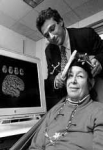
"It appears that stimulating populations of neurons once per second with Transcranial Magnetic Stimulation over many minutes modestly reduces the capacity of these neurons to activate each other," Hoffman said [Ralph Hoffman, M.D., a professor in the Department of Psychiatry and lead investigator of the study -ed.] "As a result, neural populations as a whole become less reactive or excitable. Our study findings suggest that hallucinations can be curtailed using this approach without interfering with normal brain function."
Hoffman recently completed a study testing TMS in different areas of the brain and found that positioning the TMS over what is known as Wernicke's region in the left temporal lobe, and a second region located on the opposite side of the brain, were optimal in reducing these hallucinations. He said these two brain areas, which ordinarily play key roles in perceiving words spoken by other persons, have also been found in other studies to be important in producing hallucinated "voices."
For patients enrolled in the trial, TMS will be administered to these brain areas once per second for 16 minutes daily over a three-week period. One-third of the subjects in the trial will start out receiving a placebo form of TMS. After three weeks, these subjects will also be offered a trial of real TMS. The study will use a magnetic resonance imaging brain scan to precisely position TMS over desired brain regions.
21:28 Posted in Neurotechnology & neuroinformatics | Permalink | Comments (0) | Tags: Positive Technology