




Mar 07, 2006
Near-Field Intrabody Communication
"As electronic devices become smaller, lower in power requirements, and less expensive, we have begun to adorn our bodies with personal information and communication appliances. Such devices include cellular phones, Personal Digital Assistants (PDAS), pocket video games, and pagers. Currently there is no method for these devices to share data. networking these devices can reduce functional i/o redundancies and allow new conveniences and services. The concept of Personal Area Networks (PANS) is presented to demonstrate how electronic devices on and near the human body can exchange digital information by capacitively coupling picoamp currents through the body. A low-frequency carrier (less than 1 megahertz) is used so no energy is propagated, minimizing remote eavesdropping and interference by neighboring pans. A prototype pan system allows users to exchange electronic business cards by shaking hands."
Personal Area Networks: Near-field intrabody communication by T. G. Zimmerman
20:55 Posted in Information visualization | Permalink | Comments (0) | Tags: Positive Technology
An augmented reality game on a cellphone
Via Gizmodo
"Viennese computer scientist Daniel Wagner has figured out a way to show a virtual character on an i-mate SP5 cellphone, and when you move around with the cellphone, it appears that you're floating around this virtual character in 3D. Other people with cellphones can also see this character from their points of view."
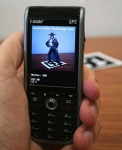
20:38 Posted in Augmented/mixed reality | Permalink | Comments (0) | Tags: Positive Technology
VR to evaluate craving and cue reactivity in cocaine dependent individuals
A preliminary report on the use of virtual reality technology to elicit craving and cue reactivity in cocaine dependent individuals.
Addict Behav. 2006 Mar 1;
Authors: Saladin ME, Brady KT, Graap K, Rothbaum BO
In the present feasibility study, we developed a 3-dimensional virtual "crack" cocaine environment and evaluated the environment's ability to elicit subjective craving and cue reactivity (i.e., subjective emotional responding, heart rate and skin conductance) in 11 crack cocaine dependent individuals. Each of the seven 3-D crack cocaine scenes in the cocaine environment depicted actors engaging in a range of using-related behaviors (i.e., smoking crack) whereas the neutral environment contained scenes depicted 3-D aquariums with active aquatic life (baseline measures were obtained following immersion in the neutral environment). Results indicated that craving was significantly elevated during the cocaine-related scenes as compared to baseline. Craving varied by scene content, with scenes depicting active cocaine use eliciting the highest levels of craving. Heart rate was significantly higher in four of the scenes with drug use content and positive affect (i.e., happiness) ratings were significantly lower during cocaine scenes as compared to baseline. Overall, the results suggest that a standardized and stimulus rich virtual reality environment effectively elicits craving and physiologic reactivity. Such technology has potential utility in the development and refinement of exposure-based behavioral and pharmacological interventions for substance use disorders.
20:32 Posted in Cybertherapy | Permalink | Comments (0) | Tags: Positive Technology
Unilateral cerebellar stroke disrupts movement preparation and motor imagery
Unilateral cerebellar stroke disrupts movement preparation and motor imagery.
Clin Neurophysiol. 2006 Mar 2;
Authors: Battaglia F, Quartarone A, Ghilardi MF, Dattola R, Bagnato S, Rizzo V, Morgante L, Girlanda P
OBJECTIVE: To assess motor cortex excitability, motor preparation and imagery in patients with unilateral cerebellar stroke with damage of the dentate nucleus by using transcranial magnetic stimulation (TMS). METHOD: Eight patients with unilateral cerebellar lesions due to tromboembolic stroke and 10 age matched healthy subjects were enrolled. Resting (RMT) and active (AMT) motor threshold, cortical and peripheral silent period, evaluation of motor imagery, reaction time and premovement facilitation of motor evoked potential (MEP) were tested bilaterally using TMS. RESULTS: The RMT and AMT were found to be increased contra lateral to the affected cerebellar hemisphere while the cortical silent period was prolonged. In addition the amount of MEP facilitation during motor imagery and the pre-movement facilitation were reduced in the motor cortex contra lateral to the affected cerebellar hemisphere. The reaction time, performed with the symptomatic hand, was slower. CONCLUSIONS: On the whole, our data confirm a role for the cerebellum in maintaining the excitability of primary motor area. Furthermore, patients with unilateral cerebellar stroke exhibit lateralized deficit of motor preparation and motor imagery. SIGNIFICANCE: Our results add to evidence that cerebellum contributes to specific aspects of motor preparation and motor imagery.
20:31 Posted in Mental practice & mental simulation | Permalink | Comments (0) | Tags: Positive Technology
Effects of Biofeedback in Phonatory Disorders and Phonatory Performance
Effects of Biofeedback in Phonatory Disorders and Phonatory Performance: A Systematic Literature Review.
Appl Psychophysiol Biofeedback. 2006 Mar 3;
Authors: Maryn Y, De Bodt M, Van Cauwenberge P
20:29 Posted in Biofeedback & neurofeedback | Permalink | Comments (0) | Tags: Positive Technology