




Jan 13, 2006
Brainport: an alternative input to the brain
Brainport: an alternative input to the brain
J Integr Neurosci. 2005 Dec;4(4):537-50
Authors: Danilov Y, Tyler M
Brain Computer Interface (BCI) technology is one of the most rapidly developing areas of modern science; it has created numerous significant crossroads between Neuroscience and Computer Science. The goal of BCI technology is to provide a direct link between the human brain and a computerized environment. The objective of recent BCI approaches and applications have been designed to provide the information flow from the brain to the computerized periphery. The opposite or alternative direction of the flow of information (computer to brain interface, or CBI) remains almost undeveloped. The BrainPort is a CBI that offers a complementary technology designed to support a direct link from a computerized environment to the human brain - and to do so non-invasively. Currently, BrainPort research is pursuing two primary goals. One is the delivery of missing sensory information critical for normal human behavior through an additional artificial sensory channel around the damaged or malfunctioning natural sensory system. The other is to decrease the risk of sensory overload in human-machine interactions by providing a parallel and supplemental channel for information flow to the brain. In contrast, conventional CBI strategies (e.g., Virtual Reality), are usually designed to provide additional or substitution information through pre-existing sensory channels, and unintentionally aggravate the brain overload problem.
12:06 | Permalink | Comments (0) | Tags: Positive Technology
Games and culture
Games and culture is a new academic journal about interactive media:
Games and Culture: A Journal of Interactive Media is a new, quarterly international journal (first issue due January 2006) that aims to publish innovative theoretical and empirical research about games and culture within the context of interactive media. The journal will serve as a premiere outlet for ground-breaking work in the field of game studies.
Games and Culture’s scope will include the socio-cultural, political, and economic dimensions of gaming from a wide variety of perspectives, including textual analysis, political economy, cultural studies, ethnography, critical race studies, gender studies, media studies, public policy, international relations, and communication studies. Other possible arenas include:
- Issues of gaming culture related to race, class, gender, and sexuality
- Issues of game development
- Textual and cultural analysis of games as artifacts
- Issues of political economy and public policy in both US and international arenas
The fist issue is available online
10:44 Posted in Positive Technology events | Permalink | Comments (0) | Tags: Positive Technology
Time for meditation
Via Mind Hacks

Time has an interesting article about neuroscience of meditation. Taking advantage of advanced brain imaging techniques such as fMRI and PET, scholars are casting light on how the practice of meditation affects brain structure and its functions. Moreover, psychological research is collecting evidence that meditation can improve key cognitive capabilities such as attention and memory
10:44 Posted in Meditation & brain | Permalink | Comments (0) | Tags: Positive Technology, meditation
The Prix Ars Electronica 2006

The Prix Ars Electronica - International Competition for Cyberarts is being conducted for the 19th time in 2006. In addition to the classic categories-Interactive Art, Net Vision, Computer Animation / Visual Effects and Digital Musics-Digital Communities and [the next idea] Art and Technology Grant competition that debuted last year will be reprised.
Online Submission Deadline: March 17, 2006; Total Prize Money: 117,500 Euro; 6 Golden Nicas; 12 Awards of Distinction; Up to 12 Honorary Mentions in each category.
INTERACTIVE ART: The "Interactive Art" category is dedicated to interactive works in all forms and formats, from installations to performances. Here, particular consideration is given to the realization of a powerful artistic concept through the especially appropriate use of technologies, the innovativeness of the interaction design, and the work's inherent potential to expand the human radius of action.
COMPUTER ANIMATION/VISUAL EFFECTS
The "Computer Animation / Visual Effects" category has been part of the Prix Ars Electronica since its very inception. It recognizes excellence in independent work in the arts and sciences as well as in high-end commercial productions in the film, advertising and entertainment industries. In this category, artistic originality counts just as much as masterful technical achievement.
DIGITAL MUSICS
Contemporary digital sound productions from the broad spectrum of "electronica" come in for consideration in the "Digital Musics" category, as do works combining sound and media, computer compositions ranging from electro-acoustic to experimental music, or sound installations. This category's programmatic agenda is to expand horizons beyond the confines of individual genres and artistic currents.
NET VISION
The "Net Vision" category singles out for recognition artistic projects in the Internet that display brilliance in how they have been engineered, designed and-especially-conceived, works that are outstanding with respect to innovation, interface design and the originality of their content. The way in which a work of net-based art deals with the online medium is essential in this category.
DIGITAL COMMUNITIES
This category focuses attention on the wide-ranging social impact of the Internet as well as on the latest developments in the fields of social software, mobile communications and wireless networks. "Digital Communities" spotlights bold and inspired innovations impacting human coexistence, bridging the geographical as well as gender-based digital divide, or creating outstanding social software and enhancing accessibility of technological-social infrastructure. This category showcases the political potential of digital and networked systems and is thus designed as a forum for the consideration of a broad spectrum of projects, programs, initiatives and phenomena in which social innovation is taking place, as it were, in real time. A Golden Nica, two Awards of Distinction and up to 12 Honorary Mentions will be awarded in the Digital Communities category in 2006.
[the next idea] Art and Technology Grant
The aim of this grant focusing on the mutually enriching interplay of art and technology is to nurture concepts for the future that young thinkers are coming up with today. This category's target group includes interested persons throughout the world between the ages of 19 and 27, who have developed a not-yet-realized concept in the fields of media art, media design or media technology. The winner will receive a 7,500-euro grant and an invitation to spend a semester as scientific assistant and artist-in-residence at the Ars Electronica Futurelab.
10:28 Posted in Cyberart | Permalink | Comments (0) | Tags: Positive Technology
Managing Multiple Spaces
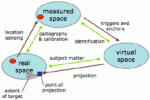
A. Dix, A. Friday, B. Koleva, T. Rodden, H. Muller, C. Randell, A. Steed, Managing Multiple Spaces. In P. Turner, E. Davenport (eds.) Space, Spatiality and Technologies, Kluwer, 2005.
The authors' aim is analyse the way in which multiple spaces, both virtual and physical, can co-exist. By this we mean that people and objects may have locations in and relationships to both physical space and one or more virtual spaces, and that these different spaces together interact to give an overall system behaviour and user experience.
They use 4 cases (City, CityWide, the Drift Table and Ambient Wood) to see how multiple physical and virtual spaces interact. The choice of the different environment is pretty pertinent since there are mobile applications and an interactive table. They then discriminate 3 types of space: real space- the locations and activities of actual objects and people in physical space measured space - the representation of that space in the computer and the representation of locations of objects and people from sensor data, etc. virtual space - electronic spaces created to be portrayed to users, but not necessarily representing explicitly the real world. [...]
10:25 Posted in Pervasive computing | Permalink | Comments (0) | Tags: Positive Technology