




Dec 17, 2005
Mental imagery combined with physical practice of approach shots for golf beginners
Percept Mot Skills. 2005 Aug;101(1):203-11
Authors: Brouziyne M, Molinaro C
Recent research on motor skills of golf have pointed to the usefulness of mental imagery. In golf, such training is rarely used as a teaching technique for beginners on the grounds that only top professionals stand to gain from mental imagery. This study tested whether mental imagery combined with physical practice can improve golf performance for the approach shot. 23 volunteer beginners, 8 women and 15 men, M age 23.4 yr. (SD = 3.7), enrolled in the University Physical and Sporting Activities Department, were divided into three groups, using a combination of physical practice of the approach shot plus mental imagery, physical practice only, and a third group engaging in various sporting activities instead of either mental or physical practice of the chip shot. Analysis showed that the beginners' approach shot performance improved most in the group combining physical practice and mental imagery when compared with the group just physically practising the approach shot. It seems mental training can be used effectively to improve performance even with beginners.
12:40 Posted in Mental practice & mental simulation | Permalink | Comments (0) | Tags: Positive Technology, mental practice, motor imagery
Dec 15, 2005
The Use of Virtual Reality and Audiovisual Eyeglass Systems as Adjunct Analgesic Techniques: A Review of the Literature
Ann Behav Med. 2005;30(3):268-278
Authors: Wismeijer AA, Vingerhoets AJ
Background: This review focuses on the application of technologically advanced methods of audiovisual distraction as adjunct analgesic techniques; more specifically, (a) virtual reality (VR) and (b) audiovisual (A/V) eyeglass systems (A/V distraction). Purpose: It is assumed that distraction taxes the patient's limited attention capacity, resulting in the withdrawal of attention from the noxious stimulus with a subsequent reduction in pain. Methods: Twenty studies evaluating the analgesic potential of both methods in different patient groups and in healthy volunteers were identified in the scientific literature. Results: Although the majority of these studies are hampered by serious methodological drawbacks, particularly a small number of participants, the results nevertheless strongly suggest that both VR and A/V distraction can be a very promising analgesic technique that may be used safely and effectively for the reduction of pain and discomfort during medical procedures. An additional important aspect is that few negative side effects have been reported. Conclusions: Directions for future research are presented.
01:35 Posted in Cybertherapy | Permalink | Comments (0) | Tags: Positive Technology, virtual reality
Improvement and generalization of arm motor performance through motor imagery practice
Neuroscience. 2005 Dec 7;
Authors: Gentili R, Papaxanthis C, Pozzo T
This study compares the improvement and generalization of arm motor performance after physical or mental training in a motor task requiring a speed-accuracy tradeoff. During the pre- and post-training sessions, 40 subjects pointed with their right arm as accurately and as fast as possible toward targets placed in the frontal plane. Arm movements were performed in two different workspaces called right and left paths. During the training sessions, which included only the right path, subjects were divided into four training groups (n=10): (i) the physical group, subjects overtly performed the task; (ii) the mental group, subjects imagined themselves performing the task; (iii) the active control group, subjects performed eye movements through the targets, (iv) the passive control group, subjects did not receive any specific training. We recorded movement duration, peak acceleration and electromyographic signals from arm muscles. Our findings showed that after both physical and mental training on the right path (training path), hand movement duration and peak acceleration respectively decreased and increased for this path. However, motor performance improvement was greater after physical compared with mental practice. Interestingly, we also observed a partial learning generalization, namely an enhancement of motor performance for the left path (non-training path). The amount of this generalization was roughly similar for the physical and mental groups. Furthermore, while arm muscle activity progressively increased during the training period for the physical group, the activity of the same muscles for the mental group was unchanged and comparable with that of the rest condition. Control groups did not exhibit any improvement. These findings put forward the idea that mental training facilitates motor learning and allows its partial transfer to nearby workspaces. They further suggest that motor prediction, a common process during both actual and imagined movements, is a fundamental operation for both sensorimotor control and learning.
01:30 Posted in Mental practice & mental simulation | Permalink | Comments (0) | Tags: Positive Technology, mental practice, motor imagery
Combined use of fMRI and VR to teach pain control
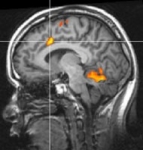
A paper published on Proceedings of National Academy of Science describes results of an experiment, in which virtual reality is used in combination with fMRI to teach subjects to control pain perception. A display inside the fMRImachine depicted a flame whose intensity reflected the activity of participants rostral anterior cingulate cortex (rACC), a brain region that is known to be involved in pain perception. Results showed that the better participants controlled their rACC activity, the better they controlled their pain. By contrast, participants included in a control group without fMRI feedback, failed to control their pain.
Read the full article in PDF format
01:25 Posted in Cybertherapy | Permalink | Comments (0) | Tags: Positive Technology, virtual reality, cybertherapy
Dec 13, 2005
The Use of Virtual Reality and Audiovisual Eyeglass Systems as Adjunct Analgesic Techniques: A Review of the Literature.
Ann Behav Med. 2005;30(3):268-278
Authors: Wismeijer AA, Vingerhoets AJ
23:30 Posted in Cybertherapy | Permalink | Comments (0) | Tags: Positive Technology, virtual reality, cybertherapy
PhD position at CRAFT
CRAFT - School of Computer and Communication Sciences is looking for a PhD student. Here is the announcement:
PROJECT
Group mirrors provide users with a reflection of their collaborative processes. The noise sensitive table is an example of interactive furniture based on the concept of group mirror (http://craftsrv1.epfl.ch/research/interactivetable/). Its matrix of LED, embedded in the physical table, provides users with a representation of their social interactions. The table namely reflects turn-taking patterns when students work collaboratively. The peripheral perception of this feedback allows them reflecting on the group verbal interaction or on individual contributions and, finally, deepening learning and regulating their collaboration. The first prototype of the noise sensitive table showed the interest of the concept. Continuing this project now requires improving the software detecting speech configuration and develop adequate visual grammars for the feed-back. This project overlaps the domains of roomware and computer-supported collaborative learning (CSCL).
POSITION
A PhD position, for 3 years is offered. The gross salary is approx. 3600 Swiss Francs per month. The PhD candidate will participate into a doctoral program at EPFL (12 credits).
PROFILE
The candidate will join the EPFL doctoral program in computer science. He must have a strong background in computers science and interest for research in collaborative activity, roomware or human-computer interaction. Knowledge in signal processing would also be appreciated. Working language is English.
FUNDING
This project in funded by an internal source for three years.
START
Spring 06 (as soon as possible)
23:28 Posted in Research institutions & funding opportunities | Permalink | Comments (0) | Tags: Positive Technology
Dec 12, 2005
1st International Workshop on Physicality - Lancaster, UK
Via Usability News
Deadline: 10 January 2006
Source: UN, 7 December 2005
The 1st International Workshop on Physicality will take place in Lancaster on 6-7 February 2006.
This multidisciplinary workshop will bring together researchers who are interested in the way that physicality of digital artefacts influences their use, or in the way that digitality informs our understanding of the physical. Through invited talks, short research presentations, and group discussion we will discuss views on the fundamental nature of physicality and how this relates to design in areas such as ubiquitous and tangible computing, virtual reality and digital arts.
submission deadline for position papers: 10th January 2006.
21:54 Posted in Positive Technology events | Permalink | Comments (0) | Tags: Positive Technology
Virtually Driving: Are the Driving Environments "Real Enough" for Exposure Therapy with Accident Victims? An Explorative Study
Cyberpsychol Behav. 2005 Dec;8(6):532-537
Authors: Walshe D, Lewis E, O'sullivan K, Kim SI
There is a small but growing body of research supporting the effectiveness of computergenerated environments in exposure therapy for driving phobia. However, research also suggests that difficulties can readily arise whereby patients do not immerse in simulated driving scenes. The simulated driving environments are not "real enough" to undertake exposure therapy. This sets a limitation to the use of virtual reality (VR) exposure therapy as a treatment modality for driving phobia. The aim of this study was to investigate if a clinically acceptable immersion/presence rate of >80% could be achieved for driving phobia subjects in computer generated environments by modifying external factors in the driving environment. Eleven patients referred from the Accident and Emergency Department of a general hospital or from their General Practitioner following a motor vehicle accident, who met DSM-IV criteria for Specific Phobia-driving were exposed to a computer-generated driving environment using computer driving games (London Racer/Midtown Madness). In an attempt to make the driving environments "real enough," external factors were modified by (a) projection of images onto a large screen, (b) viewing the scene through a windscreen, (c) using car seats for both driver and passenger, and (d) increasing vibration sense through use of more powerful subwoofers. Patients undertook a trial session involving driving through computer environments with graded risk of an accident. "Immersion/presence" was operationally defined as a subjective rating by the subject that the environment "feels real," together with an increase in subjective units of distress (SUD) ratings of >3 and/or an increase of heart rate of >15 beats per minute (BPM). Ten of 11 (91%) of the driving phobic subjects met the criteria for immersion/presence in the driving environment enabling progression to VR exposure therapy. These provisional findings suggest that the paradigm adopted in this study might be an effective and relatively inexpensive means of developing driving environments "real enough," to make VR exposure therapy a viable treatment modality for driving phobia following a motor vehicle accident (MVA).
21:50 Posted in Cybertherapy | Permalink | Comments (0) | Tags: Positive Technology, virtual reality, cybertherapy