




Dec 15, 2005
The Use of Virtual Reality and Audiovisual Eyeglass Systems as Adjunct Analgesic Techniques: A Review of the Literature
Ann Behav Med. 2005;30(3):268-278
Authors: Wismeijer AA, Vingerhoets AJ
Background: This review focuses on the application of technologically advanced methods of audiovisual distraction as adjunct analgesic techniques; more specifically, (a) virtual reality (VR) and (b) audiovisual (A/V) eyeglass systems (A/V distraction). Purpose: It is assumed that distraction taxes the patient's limited attention capacity, resulting in the withdrawal of attention from the noxious stimulus with a subsequent reduction in pain. Methods: Twenty studies evaluating the analgesic potential of both methods in different patient groups and in healthy volunteers were identified in the scientific literature. Results: Although the majority of these studies are hampered by serious methodological drawbacks, particularly a small number of participants, the results nevertheless strongly suggest that both VR and A/V distraction can be a very promising analgesic technique that may be used safely and effectively for the reduction of pain and discomfort during medical procedures. An additional important aspect is that few negative side effects have been reported. Conclusions: Directions for future research are presented.
01:35 Posted in Cybertherapy | Permalink | Comments (0) | Tags: Positive Technology, virtual reality
Improvement and generalization of arm motor performance through motor imagery practice
Neuroscience. 2005 Dec 7;
Authors: Gentili R, Papaxanthis C, Pozzo T
This study compares the improvement and generalization of arm motor performance after physical or mental training in a motor task requiring a speed-accuracy tradeoff. During the pre- and post-training sessions, 40 subjects pointed with their right arm as accurately and as fast as possible toward targets placed in the frontal plane. Arm movements were performed in two different workspaces called right and left paths. During the training sessions, which included only the right path, subjects were divided into four training groups (n=10): (i) the physical group, subjects overtly performed the task; (ii) the mental group, subjects imagined themselves performing the task; (iii) the active control group, subjects performed eye movements through the targets, (iv) the passive control group, subjects did not receive any specific training. We recorded movement duration, peak acceleration and electromyographic signals from arm muscles. Our findings showed that after both physical and mental training on the right path (training path), hand movement duration and peak acceleration respectively decreased and increased for this path. However, motor performance improvement was greater after physical compared with mental practice. Interestingly, we also observed a partial learning generalization, namely an enhancement of motor performance for the left path (non-training path). The amount of this generalization was roughly similar for the physical and mental groups. Furthermore, while arm muscle activity progressively increased during the training period for the physical group, the activity of the same muscles for the mental group was unchanged and comparable with that of the rest condition. Control groups did not exhibit any improvement. These findings put forward the idea that mental training facilitates motor learning and allows its partial transfer to nearby workspaces. They further suggest that motor prediction, a common process during both actual and imagined movements, is a fundamental operation for both sensorimotor control and learning.
01:30 Posted in Mental practice & mental simulation | Permalink | Comments (0) | Tags: Positive Technology, mental practice, motor imagery
Combined use of fMRI and VR to teach pain control
A paper published on Proceedings of National Academy of Science describes results of an experiment, in which virtual reality is used in combination with fMRI to teach subjects to control pain perception. A display inside the fMRImachine depicted a flame whose intensity reflected the activity of participants rostral anterior cingulate cortex (rACC), a brain region that is known to be involved in pain perception. Results showed that the better participants controlled their rACC activity, the better they controlled their pain. By contrast, participants included in a control group without fMRI feedback, failed to control their pain.
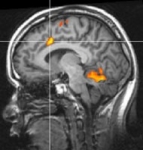
Read the full article in PDF format
01:25 Posted in Cybertherapy | Permalink | Comments (0) | Tags: Positive Technology, virtual reality, cybertherapy